
What this guide answers
- How far in advance should we start organising a fun run?
Three to four months minimum for a first-year park event — permits, insurance confirmation and sponsorship all need lead time.
- Do we need a permit for a fun run?
Almost certainly yes if it's on public land — most local authorities require an event permit or booking for organised public events in parks and reserves.
- How much should fun run entry cost?
Price so the event clearly profits at a conservative entrant estimate, with a cheaper kids' rate and a capped family price to keep it accessible.
- Do we need professional timing for a fun run fundraiser?
No — most first-year community fun runs are untimed or hand-timed, and entrants are there for the outing.
New Zealand edition. This guide is written for volunteer-run clubs in New Zealand. Where rules differ — grants, tax, incorporation, safeguarding — follow the New Zealand-specific pointers below or check with your national body.
A fun run sits in a sweet spot few club fundraisers reach: it raises real money, it pulls in people well beyond your membership, and it makes your club visible to the whole community in the best possible way. It's also more work than a barbecue fundraiser — a course, approvals, entries, timing, marshals and a wet-weather plan all have to exist before anyone crosses a start line.
The difference between a fun run that becomes a beloved annual event and one that exhausts the committee is almost entirely in the planning. This guide is the checklist: what to decide, when to decide it, and how to keep the admin from swallowing your volunteers.
Start with the decisions that shape everything else
Three or four months out, lock in the basics:
- Distance and format. A 5 km fun run with an optional 2 km family walk is the proven combination for a community event — accessible to prams, kids and casual walkers, but still a real run for the fit. Save the 10 km for year three, once you have a following.
- Timed or untimed. Untimed is dramatically simpler and fine for a first year — most entrants are there for the outing, not a PB. If you want times, a volunteer with a stopwatch and finish-order list works at small scale; professional timing becomes worth it as numbers grow.
- Date and start time. Sunday morning, early enough to beat the heat, avoiding school holidays, long weekends and any big local events competing for the same families.
- Where the money goes. "Fundraiser for the junior program" out-sells a vague appeal. Name the goal — new training equipment, ground lights, subsidised junior fees — and repeat it everywhere.
A fun run is one of the higher-effort options in the fundraising toolkit, so make sure it's the right fit — our club fundraising ideas guide compares it with lower-lift alternatives if you're not sure.
Course, permits and approvals
The course determines most of your admin. In rough order of simplicity:
- Entirely inside a park or reserve — usually the simplest approvals and no traffic management.
- Shared paths and trails — still straightforward, but think about pedestrian congestion and passing points.
- On or across roads — expect traffic management plans, road-closure processes and significantly more cost and lead time.
For a first-year event, design a course that avoids roads entirely — laps of a big park work fine and make marshalling far easier.
Whatever the course, talk to your local council early — several months out, not weeks. Public events on council land generally need a permit or booking, and councils commonly ask about expected numbers, insurance, first aid, toilets, waste and noise. Requirements differ between councils, so search your council's website for "event permit" and go straight to the source; your regional sports trust can also point you at local event support. Ask your insurer whether your policy covers a public participation event, and arrange first aid coverage appropriate to your numbers.
This is general information, not legal advice — confirm the current permit, insurance and traffic requirements with your local authority and insurer.
Budget and entry pricing
Sketch the budget before you set prices. Typical line items:
| Item | Notes |
|---|---|
| Event permit / ground hire | Varies widely — get the real number early |
| First aid coverage | Scale to entrant numbers |
| Bibs, safety pins, course signage | Reusable signage is a year-two saving |
| Finisher ribbons or medals (optional) | Kids' medals drive family entries |
| Marquees, PA, line marking | Borrow before you hire |
| Promotion | Mostly free if you start early |
Then price entries so the event clearly makes money at a conservative entrant estimate. A common structure: adult entry, cheaper kids' entry, and a capped family rate — with an early-bird discount that rewards the sign-ups that fund your deposits. Many events add an optional donation at checkout for supporters who can't attend; those pure-donation dollars often rival the entry margin.
Entries and payments: do it online, do it early
Paper entry forms and cash on the day are where fun run fundraisers go to die — queues at registration, illegible emergency contacts, and no idea until race morning how many bibs you need.
Take entries online from day one. A good setup gives you:
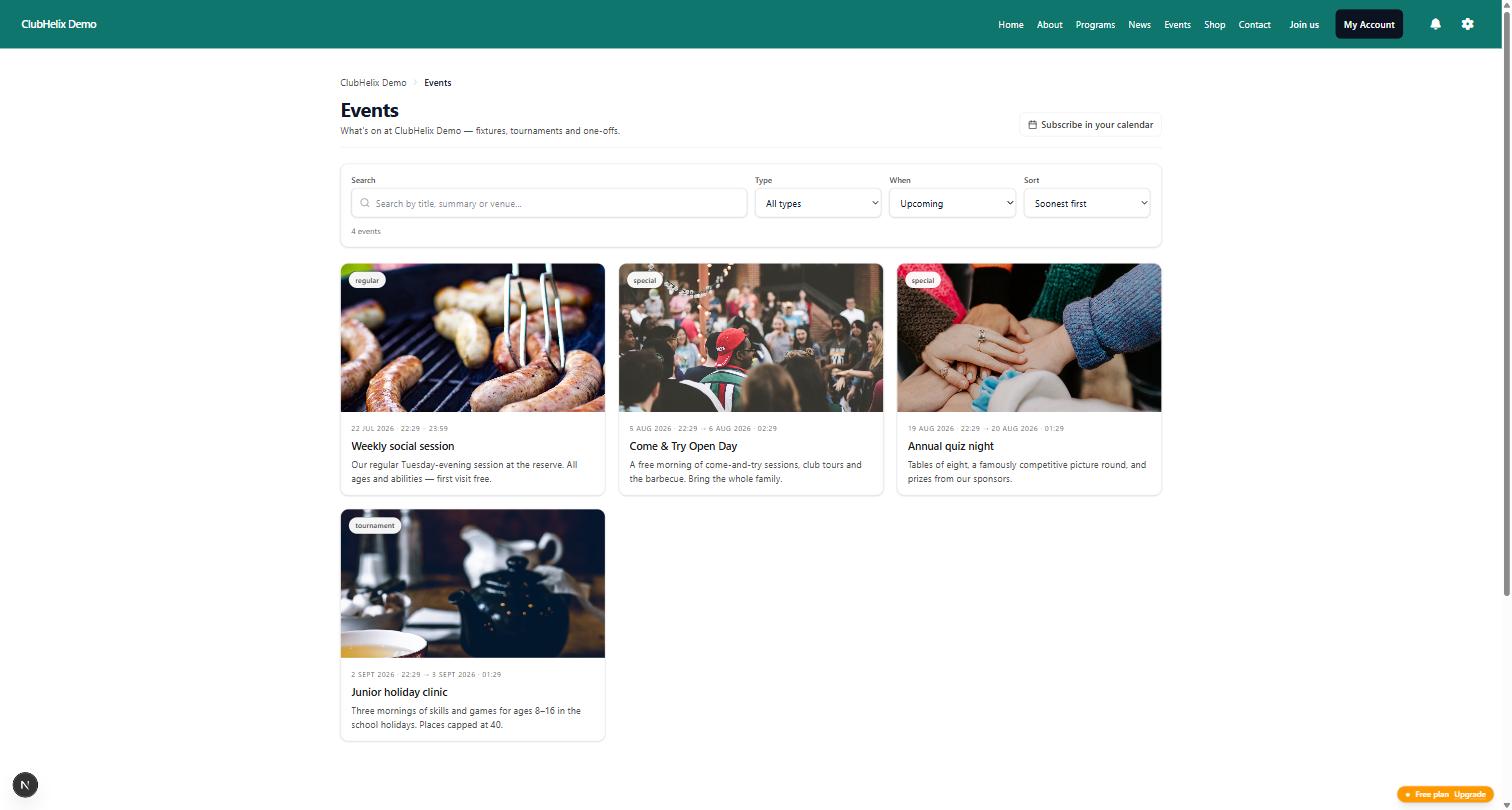
- An event page with online payment — entrants register and pay in one step, and your treasurer isn't reconciling envelopes of cash. ClubHelix clubs publish the run as a ticketed event through events, with entry types (adult / child / family / early bird) priced separately and paid by card.
- The data you actually need — emergency contact and any medical notes collected at entry, exportable as your race-day check-in list.
- A live entrant count — so catering, bibs and marshal numbers are decisions made with real numbers.
- A donation option — pair the event with an online donations page for the "can't run, still want to support the juniors" crowd, and link it in every promotion.
Close online entries the day before at the earliest, and decide in advance whether you'll take race-morning entries (card only, simple flat price, separate queue) or not at all.
Sponsorship: the quiet profit multiplier
Sponsorship is what turns a break-even community outing into a serious fun run fundraiser, because sponsor dollars arrive with almost no marginal cost. Local businesses like fun runs — family-friendly, photogenic, and full of exactly the local customers they want.
Package it simply: a naming-rights partner ("The Smithfield Bakery Fun Run"), a handful of course sponsors (a sign at each kilometre marker), and in-kind deals for the things you'd otherwise buy — fruit, water, first-prize vouchers, PA hire. Put every sponsor's logo on the event page, thank them over the PA, and photograph their signage in action for the wrap-up post; delivered visibility is what gets them back next year.
Volunteers: roster the day like a match day
A 5 km fun run needs more volunteers than most committees expect. A workable minimum for a park course:
- Course marshals at every turn and any shared-path pinch point
- Registration / bib collection — two or three people for the pre-start rush
- Start and finish — starter, finish-line crew, timing if you're timing
- Water station — two people per station
- First aid liaison, photographer, and a floater who solves problems
Recruit beyond the committee — parents who don't play are often glad to marshal for an hour (here's how to ask). Then put names against shifts in writing: a published volunteer roster with defined duties, times and positions means nobody's "pretty sure Dave's doing the water station". Brief marshals with a one-page map showing their position, their job, and the first-aid contact number.

Race day: run it off a run sheet
Write a minute-by-minute run sheet the week before — set-up crew arrival, course signage out, registration opens, marshal briefing, welcome and safety announcement, walk start, run start, first finishers, presentations, course sweep, pack-down. Add a wet-weather call: who decides, by when, and how it's communicated (a group message and a website banner beat a phone tree).
Two details that separate smooth events from chaotic ones: a marshal briefing 45 minutes before the start with everyone physically present, and a course sweep — a designated tail walker so you know when the last participant is home and marshals can stand down.
Afterwards: bank it, thank it, book it again
Within the week: publish results and photos, thank sponsors and volunteers by name, announce the amount raised and what it's funding, and survey entrants with one question — "what should we change next year?". Then, while goodwill is high, announce next year's date. Fun runs compound: year one breaks even and builds the mailing list, year two profits, year three is an institution. Promote year two to this year's entrant list first — that's the audience most likely to return (and our guide to promoting a club event covers the rest).
If your club runs on ClubHelix, the whole entry pipeline is built in: a public event page with paid registrations through events, an always-open donations page, and a volunteer roster for the day itself — with the money landing in your club account via Stripe or Square rather than a cash tin. There's a free tier to start with; see pricing.
Frequently asked questions
How far in advance should we start organising a fun run?
Three to four months minimum for a first-year park event — permits, insurance confirmation and sponsorship all need lead time. Road courses need longer again for traffic management approvals.
Do we need a permit for a fun run?
Almost certainly yes if it's on public land — most local authorities require an event permit or booking for organised public events in parks and reserves. Requirements vary, so check yours early. This is general information, not legal advice — confirm requirements with your local authority.
How much should fun run entry cost?
Price so the event clearly profits at a conservative entrant estimate, with a cheaper kids' rate and a capped family price to keep it accessible. An early-bird discount pulls entries forward and funds your deposits.
Do we need professional timing for a fun run fundraiser?
No — most first-year community fun runs are untimed or hand-timed, and entrants are there for the outing. Invest in professional timing once numbers and runner expectations justify it.


