
What this guide answers
- What is a come and try day?
It's a free, low-pressure open day where newcomers can try your sport or activity with borrowed gear, meet club members and see what the club is like — designed to turn curious locals into registered members.
- How long should a come and try day run?
Two to three hours is ideal — long enough for visitors to rotate through several stations and linger at the barbecue, short enough to keep energy high and volunteers fresh.
- How do we convert come and try day visitors into members?
Capture every visitor's contact details on the spot, offer a concrete next step like a free four-week beginner program, let decided families register and pay before they leave, and send a three-email follow-up sequence…
- How many volunteers do we need?
Roughly one volunteer per expected 8–10 visitors, covering the welcome desk, one leader per station, the barbecue and a floating first-aider.
New Zealand edition. This guide is written for volunteer-run clubs in New Zealand. Where rules differ — grants, tax, incorporation, safeguarding — follow the New Zealand-specific pointers below or check with your national body.
A come and try day is the single best recruitment tool a community club has: a low-pressure invitation for people to turn up, have a go, meet some friendly faces and picture themselves belonging. Done well, one good morning can fill a junior program or launch a whole new team. Done badly — chaotic, cliquey, no plan for what happens next — it quietly convinces visitors your club isn't for them.
The uncomfortable truth is that most come and try days fail after everyone goes home. The sessions are fun, the sausage sizzle sells out, forty families say "we'll definitely think about it"… and nobody ever hears from the club again. This guide covers the whole arc: the planning timeline, the on-the-day setup that makes newcomers feel welcome, capturing details on the spot, and the follow-up sequence that actually does the converting.
What "converts" means — decide it first
Before you book anything, define success as a number: "20 new junior registrations", "one new senior team's worth of players", "50 families on our contact list". That target drives every other decision — who you invite, what stations you run, and what you ask people to do before they leave. A come and try day without a conversion goal is just a barbecue.
Know your offer, too. The strongest converter is a bridge offer: something small and concrete a visitor can say yes to on the day — a free four-week beginner program, a "first month free" trial membership, or a discounted early-bird registration for the coming season. "Join our club" is a big ask; "come back next Saturday for week one of four" is an easy one.
Planning timeline
| When | What to do |
|---|---|
| 6–8 weeks out | Set the date and conversion target; book venue and equipment; check insurance covers non-member participants; pick the bridge offer |
| 4–6 weeks out | Recruit volunteers and assign roles; plan stations; order/borrow spare equipment for beginners; create the sign-in form and event page |
| 3–4 weeks out | Promote — school newsletters, local Facebook groups, posters, a story pitch to local media, and personal invitations (the most effective channel by far) |
| 1 week out | Volunteer briefing; print QR-code signs for sign-in and registration; confirm the barbecue, first aid and wet-weather plan |
| 2 days out | Reminder to everyone who registered interest; final volunteer roster check |
| On the day | Run it (below) — with one person whose only job is welcome and sign-in |
| Within 48 hours | First follow-up email to every attendee |
Promotion tip: ask every current member to personally invite one family. Word of mouth outperforms every poster you'll print — our club marketing plan guide covers the wider promotional toolkit, and if your event doubles as a season sign-on day, pair this guide with how to run a club registration day.
On the day: stations, not scrimmage
The classic open-day failure is newcomers standing on the edge of an existing training session, watching insiders enjoy themselves. Structure the day as a circuit of stations so every visitor is doing something within five minutes of arriving:
-
Welcome desk (non-negotiable). At the entrance, impossible to miss, staffed by your two friendliest people — not your two most senior. Every visitor gets greeted, signed in, and pointed to their first station.
-
Skill stations. Three to five simple, game-like activities run by coaches or senior players — easy enough for a first-timer to succeed at, each 10–15 minutes. Success in the first ten minutes is what makes people come back.
-
Mini-games. Short, small-sided, mixed with club members who've been briefed to be encouraging. Nobody's keeping score.
-
The social station. The sausage sizzle, coffee van or morning tea — where parents linger and real conversations happen. Station your committee here, briefed to chat, answer questions and point people to the bridge offer, not to hover.
-
Info point. Fees, season dates, uniform samples, and QR codes to your website and registration page on every table and fence sign.
Equipment matters more than you think: have enough spares that no visitor stands around waiting, and loaner gear so "we don't have a racquet/boots/stick" is never the reason a family leaves early.

Capture details on the spot — or lose them forever
Here's the make-or-break moment: a visitor you can't contact is a visitor you can't convert. Paper sign-in sheets get rained on, lost in someone's boot, and typed up (badly) three weeks later. Instead, put a digital sign-in form behind a QR code at the welcome desk and every station, asking for just enough: name, email, mobile, who they came with (ages for juniors), and how they heard about you. Thirty seconds on a parent's phone while the kids are at the first station.
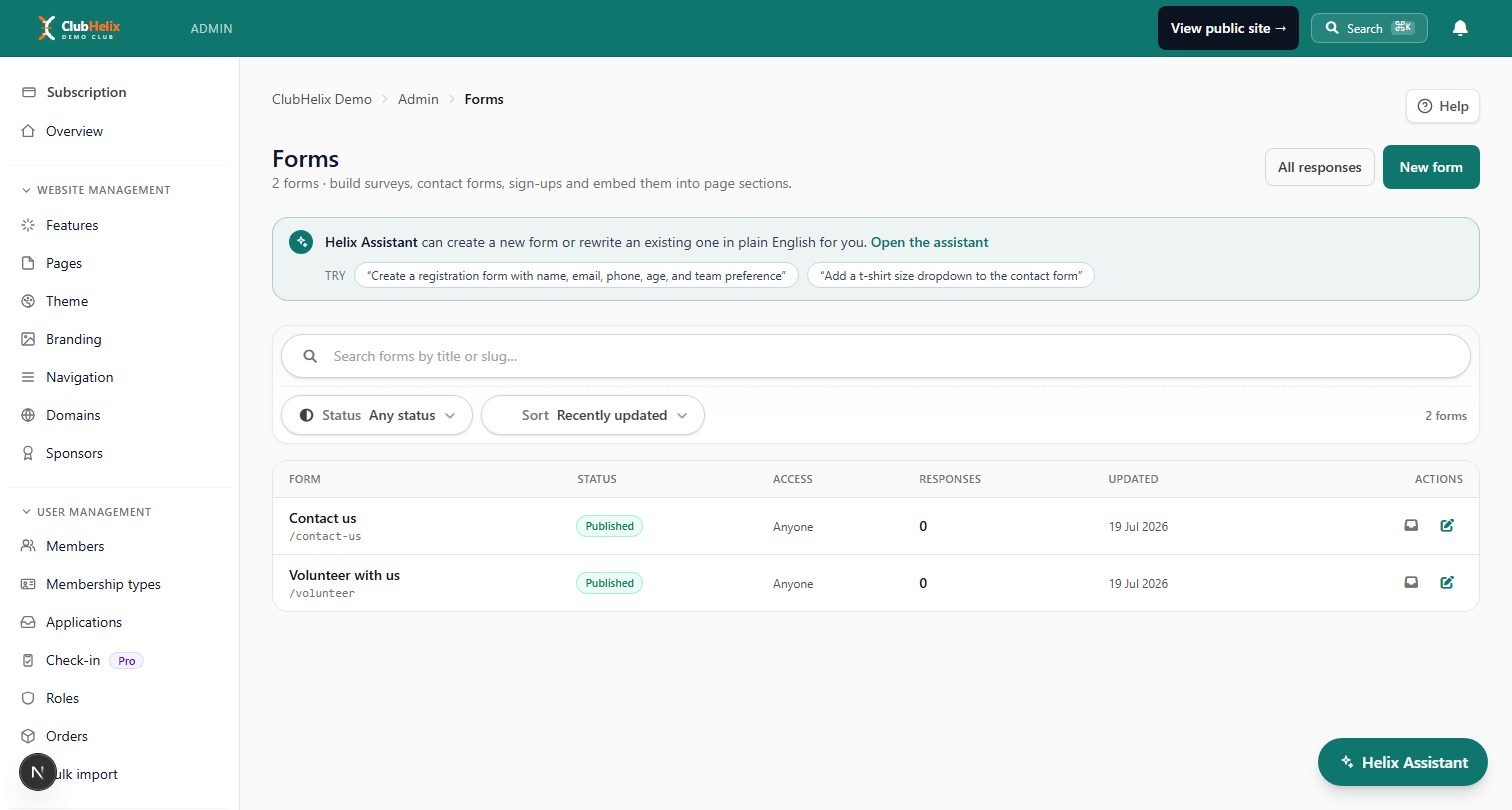
A proper form builder means the details land in your club's system instantly — no transcription, no lost pages — and you can see mid-morning how many families have signed in.
Even better: convert on the spot. Have a couple of iPads or a laptop at the info point open at your online registration page, so a family that's already decided can register and pay before they leave — enthusiasm has a half-life measured in hours, and "we'll do it when we get home" is where conversions go to die. Sweeten it with a day-only nudge: register today and the rego pack, first month, or club cap is included.
The follow-up sequence that does the converting
Most attendees leave undecided — warm, but undecided. The follow-up sequence is where a come and try day earns its name, and it's simple:
- Within 48 hours — the thank-you. Warm, short, with two or three photos from the day, the bridge offer restated, and one clear link: register here. Send it while the kids are still talking about it.
- Day 5–7 — the useful answer. Answer the questions every newcomer has but didn't ask: what fees actually cover, what beginners need (and don't need) to buy, what a normal week looks like, and who to contact. One link: register here.
- Day 12–14 — the deadline. A genuine reason to decide now: the beginner program starts Saturday, early-bird pricing ends Sunday, teams are being finalised. Last link: register here.
Three emails, one goal each, then stop — anyone who hasn't converted stays on your general list for the newsletter and next season's invitation. An email broadcast tool that can send to exactly the people who signed in on the day makes this a 20-minute job instead of a mail-merge nightmare — and because your sign-in form fed straight into the same system, there's no list-building step at all.
Track your target honestly afterwards: attendees, details captured, registrations within a month. Whatever converted best, do more of it next time.
If your club is gearing up for a come and try day, ClubHelix handles the whole funnel in one place — a public event page on your club website, QR-code sign-in forms, on-the-spot online registration with payment, and follow-up emails to exactly the people who came. There's a free tier to start with — create your club.
Frequently asked questions
What is a come and try day?
It's a free, low-pressure open day where newcomers can try your sport or activity with borrowed gear, meet club members and see what the club is like — designed to turn curious locals into registered members. Many clubs run one before each season, often paired with a sign-on day.
How long should a come and try day run?
Two to three hours is ideal — long enough for visitors to rotate through several stations and linger at the barbecue, short enough to keep energy high and volunteers fresh. A Saturday or Sunday morning typically draws the best family crowd.
How do we convert come and try day visitors into members?
Capture every visitor's contact details on the spot, offer a concrete next step like a free four-week beginner program, let decided families register and pay before they leave, and send a three-email follow-up sequence over the fortnight after the event.
How many volunteers do we need?
Roughly one volunteer per expected 8–10 visitors, covering the welcome desk, one leader per station, the barbecue and a floating first-aider. Brief them beforehand that their job is making newcomers feel welcome — not catching up with clubmates.


