
What this guide answers
- How much should a club crowdfunding campaign aim to raise?
Build the number from a written quote rather than picking a round figure.
- How long should a crowdfunding campaign run?
Three to five weeks suits most community clubs. Shorter than three and there is no room for a mid-campaign push; longer than six and the deadline stops feeling real, the champion runs out of energy and the page goes…
- What makes a club fundraising project appealing to donors?
Specificity and visibility. People fund a thing they can picture and later point at — a shelter, a mower, a scoreboard, a set of shirts for a named age group — far more readily than a general appeal for funds.
- Should we launch publicly straight away?
No. Spend a fortnight quietly asking the people closest to the club, aim to have a solid share of the target committed before the page goes public, and ask those supporters to give on launch day so the campaign visibly…
- What do we do if the campaign misses its target?
Say so publicly, quickly and without drama, and explain exactly what happens to the money.
The failure mode is always the same, and it is public. A club launches a campaign on a Monday with a target, a photograph of the crumbling change rooms and a heartfelt paragraph. By the following Wednesday the page shows 4% funded and three donations, two of them from committee members. Every person who visits after that sees a project the club's own community apparently does not believe in, and the page becomes an argument against giving. Nobody wants to be the fourth donor to a campaign that is going nowhere.
That outcome has very little to do with how worthy the project is and almost everything to do with sequence. Crowdfunding is not a way of finding money from strangers. It is a public commitment device — a mechanism for converting goodwill that already exists in your club's network into cash, quickly, by making the ask concrete, the deadline real and the momentum visible. The strangers, when they arrive, are joining something that is already happening.
This guide covers the four decisions that determine whether a club campaign works — whether the project is fundable at all, how to build a target from a quote rather than a wish, the pre-launch that gets a meaningful share of the total pledged before anyone outside the committee hears about it, and the unglamorous obligations afterwards. It assumes a volunteer committee, a modest network and no professional fundraiser.
Is your project actually fundable?
Some things clubs need are perfectly good projects and terrible campaigns. Before you write a word of copy, run the idea through five tests. A project that fails two of them will struggle no matter how well you write.
- Specific. People fund objects and outcomes, not budgets. "New scoreboard" works. "Equipment fund" does not.
- Visible. Donors want to be able to point at the thing afterwards, ideally from where they stand on a Saturday.
- Finite. It has an end. Ongoing costs — insurance, affiliation, referee payments — are what membership fees and sponsorship are for.
- Legible in one sentence. If it takes a paragraph to explain why the thing is needed, the campaign is already losing people.
- Deadline-real. There is a genuine reason it must happen by a date. A manufactured deadline is transparent and it kills urgency.
Most unfundable asks can be rewritten into fundable ones without changing what the money does:
| The ask as the committee wrote it | Why it struggles | The fundable version |
|---|---|---|
| "Help us cover rising costs" | No object, no end, no picture | "Replace the 22-year-old lawnmower before the season starts" |
| "Support our junior program" | Worthy but abstract | "Kit out four new under-9 teams — 60 playing shirts and 8 ball bags" |
| "Fundraising appeal 2026" | Not a project at all | "Build a shade shelter over the junior field so parents and kids are out of the sun" |
| "Upgrade the clubrooms" | Too big, no defined finish line | "Stage one — replace the kitchen benches and the servery window" |
| "Send our team to the nationals" | Fundable, but only to a narrow audience | Same project, but as a defined team fundraiser with named players, not a club-wide appeal |
Two further filters worth applying at the committee table. First, is crowdfunding the right instrument at all? A capital project with a matching-grant round open is usually better served by a grant application, and a campaign that runs alongside one can be stronger for it — see how to write a grant application. Second, does the project have a champion? Campaigns need one person who will talk about it every day for a month. Without a name attached, do not launch.
Time the campaign against your season, not the calendar. The weeks either side of your season opener are when the club's network is most concentrated and most sentimental — everyone is back at the ground, the juniors are training, and the project is standing in front of people rather than described to them. Avoid the deep off-season, when your community has scattered and the club is an afterthought, and avoid the fortnight of finals, when every volunteer you need is running a canteen.
Setting a target you can actually hit
The target is the single most consequential number in the campaign, and most clubs get it from the wrong place — a round figure that sounds ambitious. Build it from the bottom instead, starting with a written quote.
Everything below is expressed as a share of the quoted project cost, so you can drop your own figures in.
| Layer | Typical share | What it is |
|---|---|---|
| Quoted project cost | 100% | The actual written quote, dated, from a real supplier |
| Delivery, install, permits | Add what the quote excludes | Site prep, freight, trade work, any approvals the club must pay for |
| Reward or recognition costs | 0-8% | Only if you are offering physical rewards — see below |
| Payment processing | A couple of per cent plus a small fixed amount per gift | Check your provider's published rate rather than guessing |
| Contingency | 10% | Because quotes age and site works surprise people |
| Campaign target | Roughly 115-125% | What you actually ask for |
Then subtract, honestly, anything already committed — a grant already approved, a sponsor's pledge, money already in the building fund. Asking the community to fund the whole thing when half is already secured is a missed opportunity to say "we are most of the way there", which is the most persuasive sentence in fundraising.
Three target decisions that matter as much as the number:
- All-or-nothing, or keep what you raise? All-or-nothing creates urgency and protects donors from funding half a scoreboard, but it puts the whole campaign at risk. Keep-what-you-raise is safer and less urgent. If you choose it, say publicly what you will do with a partial total — a stage one, or a deferred purchase — so nobody feels their money vanished.
- Set the target low enough to hit and use stretch goals for the rest. A campaign at 110% with a stretch goal reads as a success. The same money against a target set 40% higher reads as a failure.
- Publish the budget. A short breakdown of where the money goes converts sceptics, and it takes ten minutes. Your club budget template already has most of it.
Before you publish anything, check the fundraising rules that apply where your club sits. Most states and territories regulate charitable and community fundraising appeals through consumer affairs or fair trading, and depending on the nature of the appeal your club may need to be registered or hold an authority before soliciting public donations. Separately, donations are only tax-deductible if the recipient is endorsed as a deductible gift recipient, which most sporting clubs are not — so do not imply deductibility on your page unless you have confirmed your status with the ATO. Say plainly what donors do and do not get, and take advice if the campaign is large.
The pre-launch — get a meaningful share pledged before you go public
This is the section that separates campaigns that work from campaigns that embarrass a committee, and it is the part almost every club skips because it feels like cheating. It is not cheating. It is how every well-run campaign is built.
The aim is to have a substantial share of the target — a third is a good working target, and some campaigns aim higher — either pledged or actually paid before the page goes public. Two things happen as a result. The first outsider sees a project with visible momentum rather than an empty bar. And you find out, privately, whether your community actually wants this thing before you have staked the club's reputation on it.
Build the seed table
A fortnight before launch, sit down with two or three people who know the club well and list every household, business and former member who might give more than a token amount. You are looking for 15 to 30 names, not 300.
| Group | Who belongs in it | How to approach |
|---|---|---|
| Committee and life members | Everyone on the committee, past presidents, life members | In person or by phone, first — before anyone else |
| Direct beneficiaries | Families of the teams the project serves | A personal message from a team manager they know |
| Local businesses | Existing sponsors, trades who use the club, nearby traders | Face to face, with the quote in hand |
| Former members and alumni | Anyone who played here and still cares | A personal note from someone who played with them |
| Quiet high-capacity donors | The people your treasurer knows have helped before quietly | In person, privately, with a specific number named |
Give the list to the people who actually know each name, and give each of them no more than five or six approaches. The single biggest determinant of whether someone gives is who asks them.
The private ask
The pre-launch ask is a conversation, not a broadcast. It has four parts and it names a number.
We're putting in a shade shelter over the junior field before summer. We've got the quote, the plan and the approvals sorted, and it comes to [the full amount]. We're launching a public campaign on the 14th and we're trying to have a solid chunk of it committed before we go live, so it doesn't sit at zero. Would you be able to put in [a specific figure] on launch day?
Naming a number is uncomfortable and it roughly doubles the usefulness of the conversation. People given a range give at the bottom of it; people given no guidance either give a token amount or defer. Pitch the number at what you genuinely think that person could do without strain, and make it easy to say a smaller number back.
Track pledges quietly, land them on day one
Keep a simple private tally — name, amount pledged, whether it is confirmed, and who is responsible for converting it. Then ask every pledger to give on launch day rather than before, so the page moves visibly in its first 24 hours. A campaign that jumps to a third of target on day one attracts a completely different reaction from one that crawls there over three weeks.
If the pre-launch stalls at well under your target, that is enormously valuable information delivered before any public risk. Either the project is not the one your community wants funded, the number is too big for this network, or the ask is not landing. Rework it and launch later. Pulling a campaign nobody has seen costs nothing.

Launch week, day by day
| Day | What happens | Who does it |
|---|---|---|
| 1 | Page goes live, pledgers give, club-wide email and post go out, project champion is visible all day | Champion + comms |
| 2 | Personal thank-you to every day-one donor, by name | Champion |
| 3 | Second post with a different angle — the person or team who benefits, not the object | Comms |
| 4 | Local businesses and community groups approached directly with the live page as proof | Sponsorship lead |
| 5 | First progress update — a real number, a photo, and one sentence on what is next | Champion |
| 6-7 | Weekend presence at the ground with a QR code on every sign, table and canteen board | Whoever is rostered on |
The rule for the whole week is that the champion replies to everything. A donation that gets a personal reply within a day produces a second donation, a share, or a conversation with someone else far more often than one that gets an automated receipt.
Breaking the middle slump
Every campaign sags in the middle. The network has given, the strangers have not arrived, and the bar stops moving for eight days. Three levers reliably restart it, and you should plan at least one before you launch rather than improvising in week three:
- A matched-giving day. A business, a life member or a group of committee members commits to matching everything given on one nominated day. It gives you a genuine reason to make noise and gives the hesitant a reason to act today.
- A milestone story. Not another plea — a story. The volunteer who has mown the ground for eleven years. The under-9s side that trains in the dark. Publish it as a club news post and email it out, rather than only posting it socially where most of your community will never see it.
- A named challenge between groups. Teams against teams, age groups against age groups, juniors against seniors, or one training night against another, with a running scoreboard on the page. Competition works on exactly the people who join clubs, which is the whole point.
What does not work is repeating the original ask louder. If the message has not moved anyone in a week, the message is the problem.
One lever worth exploring early — your local council may run a community grant or a matched-funding round that pairs with community fundraising, and several regional funders like to see local money raised before they commit. A campaign that can announce a council or trust match part way through effectively doubles every remaining dollar and gives you a natural mid-campaign story. Ask before you launch, because these rounds close on their own schedule and cannot be conjured at week three.
Rewards, or just recognition?
Physical rewards look appealing and are where club campaigns quietly lose money and volunteer hours. Every mug, cap and printed certificate has a unit cost, a fulfilment job and a person who did not receive theirs. Recognition costs almost nothing and lasts longer.
| Level | Recognition that works | Real cost to the club |
|---|---|---|
| Small gift | Named on the supporters list on your website | Nothing |
| Mid gift | Named on a physical honour board or plaque at the ground | A share of one plaque |
| Larger gift | Named on the item itself, or a naming right for a season | Nothing beyond the sign |
| Business gift | Logo on the project signage and a mention in the newsletter | Sign artwork |
| Any level | A personal thank-you from the person who benefits | Twenty minutes and worth more than all of it |
If you do offer physical rewards, cost them into the target, cap the numbers, and make one person accountable for fulfilment with a deadline. And be careful about anything that looks like a prize draw rather than a gift — raffles and prize competitions are separately regulated in most places and are a different fundraiser entirely, covered in raffle vs auction fundraiser.
After the total — thank-yous, updates and delivery
The campaign closing is the halfway point, not the end. What you do next determines whether the same people give again in three years, and most clubs squander it.
Within a week. Thank every donor personally, by name, with the final total. Post the result publicly and thank the club community as a whole, including the people who shared it rather than gave. If you missed the target, say so plainly and say exactly what happens now — silence after a shortfall is what breeds the belief that club fundraising money disappears.
Within a month. Publish what you have bought or ordered, with the actual figures. A short post showing quote, amount raised, amount spent and what happened to any surplus does more for your club's fundraising credibility than the next campaign's copy ever will.
On delivery. Photograph the thing. Invite the donors to see it. Put the plaque up. Name the shelter, the mower, the scoreboard after whoever earned it. This is the update that gets forwarded, and it is what makes the next campaign start at a third of target instead of zero.
At the annual general meeting. Report the campaign in the accounts as its own line, with the surplus or shortfall explained. Treat it with the same seriousness as any other money the club handles, because that is exactly what it is.
One more habit worth building. Ask every donor at the close whether they would like to give a small amount regularly instead. A modest recurring gift from twenty people is worth more over three years than most one-off campaigns, it takes no volunteer effort once set up, and the people most likely to say yes are the ones who just gave.
Running the campaign on your own site
There is a good argument for hosting the campaign on your own club website rather than sending your community somewhere else. The page carries your branding, the money lands in your account, the donor list stays yours, and the people who come to donate are one click from your fixtures, your membership page and your news — which is how a campaign turns into members.
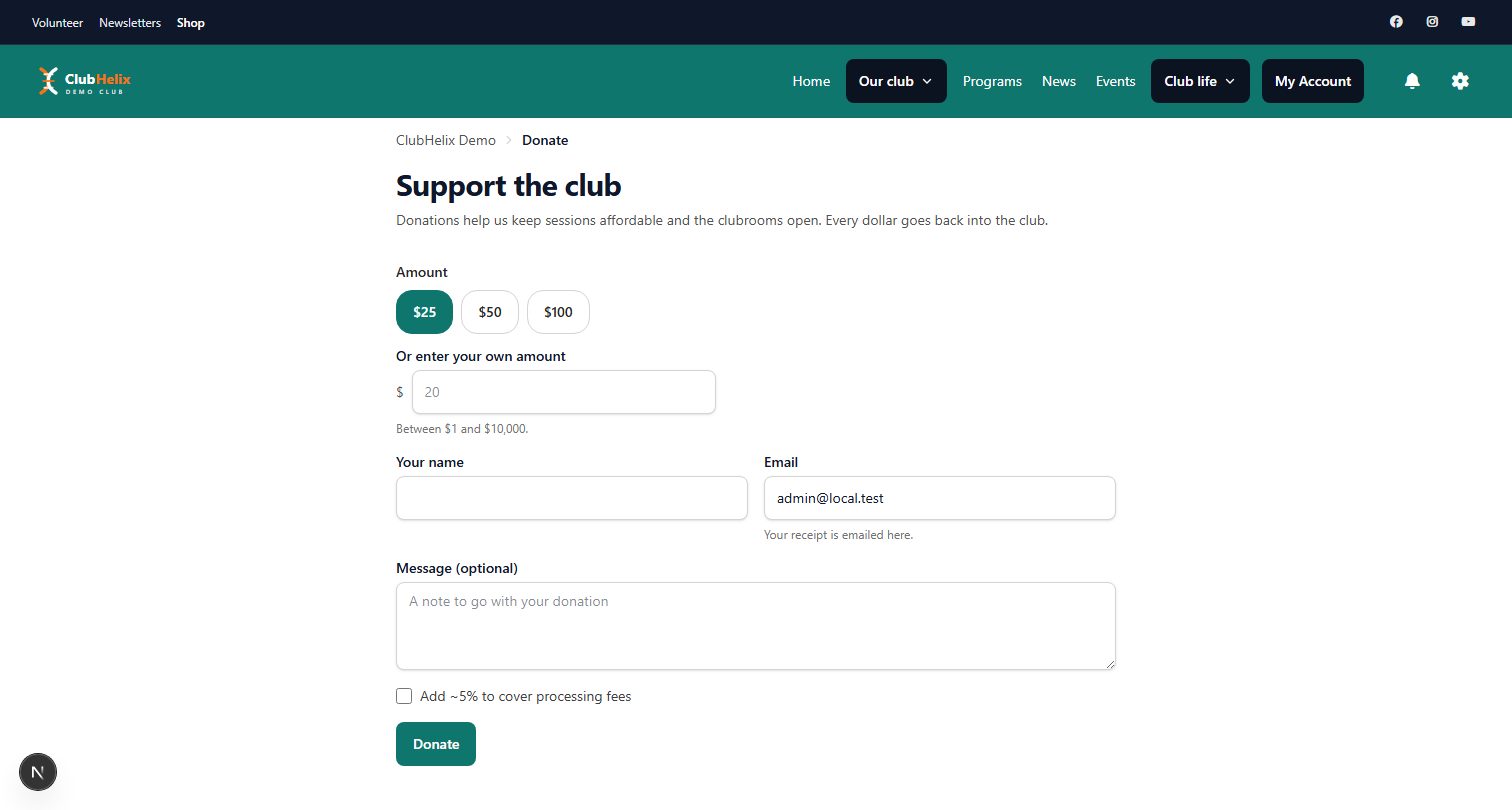
ClubHelix has donations built in, with one-off and recurring gifts, an option for donors to cover the processing fee, donor messages and a clean ledger the treasurer can reconcile. Pair it with email broadcasts from your own club address for the updates, news posts for the milestone stories, and raffles if the campaign is running alongside one.
The pricing is published in full with a free tier for small clubs, and there are no setup fees. If your current fundraising page belongs to someone else, you can create your club site and have a donations page on your own domain before the pre-launch starts.
Frequently asked questions
How much should a club crowdfunding campaign aim to raise?
Build the number from a written quote rather than picking a round figure. Add whatever the quote excludes, any reward costs, payment processing and roughly ten per cent contingency, then subtract anything already committed from grants or sponsors. Set the published target at a level you are confident of reaching and use stretch goals for the rest — a campaign that finishes above target reads as a success, while the same money against an inflated target reads as a failure.
How long should a crowdfunding campaign run?
Three to five weeks suits most community clubs. Shorter than three and there is no room for a mid-campaign push; longer than six and the deadline stops feeling real, the champion runs out of energy and the page goes quiet for weeks at a time. Set a firm end date, publish it everywhere, and count down to it in the final week.
What makes a club fundraising project appealing to donors?
Specificity and visibility. People fund a thing they can picture and later point at — a shelter, a mower, a scoreboard, a set of shirts for a named age group — far more readily than a general appeal for funds. A one-sentence explanation, a real quote, a genuine deadline and a named person leading it will outperform a longer, more emotional appeal for an abstract cause.
Should we launch publicly straight away?
No. Spend a fortnight quietly asking the people closest to the club, aim to have a solid share of the target committed before the page goes public, and ask those supporters to give on launch day so the campaign visibly moves in its first 24 hours. If the private phase stalls, you have learned something important at no public cost and can rework the project before launching.
What do we do if the campaign misses its target?
Say so publicly, quickly and without drama, and explain exactly what happens to the money. Deliver a smaller version of the project, stage it, or hold the funds for a defined and stated purpose. Donors forgive a shortfall far more readily than they forgive silence, and how you handle a miss determines whether they give again next time.
Keep reading — club fundraising ideas covers the other instruments worth running alongside a campaign, and how to get sponsors for a sports club covers the businesses you will be approaching in the pre-launch.


