
What this guide answers
- Do we need a licence to run a bar at our club?
Almost certainly, and the type of licence depends entirely on where your club is and who you serve.
- How much profit should a club bar make?
Aim to price so that around half of takings is gross margin, then protect that figure from the leaks that eat it — over-pouring, unrecorded free drinks, wastage and stock loss.
- How do you stop a club bar losing stock?
Set par levels, count the fast-moving lines at every close, do a two-person count monthly and compare it with till sales.
- Can volunteers work behind a club bar?
In many places yes, though the qualification, age and supervision requirements differ by jurisdiction and some regimes require a certified person to be on duty whenever alcohol is served.
- How should a club handle cash from the bar?
Use a fixed float counted in and out, ring up every sale before the money goes in the till, and have two unrelated people count and sign for the take before anyone leaves.
New Zealand edition. This guide is written for volunteer-run clubs in New Zealand. Where rules differ — grants, tax, incorporation, safeguarding — follow the New Zealand-specific pointers below or check with your national body.
Ask a committee why the bar exists and you will get two answers. The first is money — for a lot of community clubs the bar is the difference between a break-even season and one that funds new nets. The second is the real one: the bar is why people stay for an hour after the game, and that hour is where volunteers get recruited, sponsors get introduced and a club stops being a place people play at and becomes a place they belong to.
Both answers are true, and both are why a badly run bar is so damaging. A bar carries obligations no other part of a club carries. You are holding a licence, serving a regulated product, taking cash, and asking volunteers to make judgement calls about people they know socially. The compliance risk is real, the stock walks, and the margin quietly disappears into free drinks for the people who did the work.
This guide is general information for volunteer committees, not legal advice, and liquor licensing differs enormously between jurisdictions — every question below should be put to your own licensing authority or a solicitor who works in the area. What it does cover is the operational shape of a well-run community bar: what to ask before you pour anything, the numbers that decide whether it is worth opening, stock control that takes ten minutes a week, and rosters and cash handling that keep good volunteers out of trouble.
Start with the licence, and ask better questions
Most clubs inherit a licence rather than apply for one, which means nobody currently on the committee has read it. Get the actual licence document out of the filing cabinet, read the conditions attached to it, and put the following questions to your licensing authority in writing. Written answers are worth having on file when a committee turns over.
| Question to ask | Why it matters |
|---|---|
| What type of licence do we hold, and what does it permit? | Club, limited, occasional and full licences allow very different things |
| What are our permitted trading hours and days? | Conditions often differ on public holidays and for functions |
| Who may be served — members, guests, the general public? | Members-only conditions are common and are the most commonly breached |
| Can we serve at away venues, or at an event off the premises? | Usually requires a separate temporary permit with its own lead time |
| What qualification must the person serving hold? | Requirements differ for volunteers, paid staff and the person in charge |
| Must a nominated person be on site while the bar trades? | Many regimes require a named, qualified individual to be present |
| What signage and notices must be displayed? | Non-display is one of the easiest breaches to be pinged for |
| What records must we keep, and for how long? | Incident logs, refusals and training records are commonly required |
| What triggers a variation or a new application? | Extending hours, adding an outdoor area, or opening to the public usually does |
| Who do we notify if something goes wrong? | Know this before something goes wrong, not afterwards |
Ask about gaming machines, raffles, sweeps and social lotteries in the same conversation. They are usually licensed separately from alcohol, and the assumption that "we can run a meat tray because we have a bar licence" is exactly the kind of thing that gets a club a letter.
Alcohol licensing in New Zealand runs through your district licensing committee, and a club licence is the usual arrangement for a community sports club. A certificated duty manager is generally required to be on duty whenever alcohol is sold, which is the requirement most volunteer clubs underestimate — it means training and rostering a small pool of people, not one person. Confirm current requirements with your district licensing committee and check the renewal cycle on both the licence and the manager certificates.
Responsible service is the job, not a module
Every regime has some version of the same duty: do not serve someone who is intoxicated, do not serve a minor, and take reasonable steps to prevent harm. At a community club this is harder than in a commercial venue, because the person you have to refuse is somebody's dad, the club's best clubman, or the volunteer who lined the ground that morning.
Make it structural so it is never one person's courage:
- Two people behind the bar at any session with real volume. A refusal is far easier when someone is standing beside you.
- The refusal is the club's, not the pourer's. Write it into your handbook: "the committee has instructed that service stops when…" — and back your volunteers publicly, every single time.
- A named person in charge each session who owns the call, with the president's number in their phone.
- Free water, visible food and a hard close. Last drinks announced, then the bar shuts and stays shut. Extending "just one more" is where most bad nights come from.
- Log refusals and incidents on the night, in a book behind the bar. It takes a minute and it is the record that protects the club later.
- Watch the high-risk occasions specifically — presentation nights, season launches, a grand final win and a grand final loss. Roster your most confident people to those, not your newest.
The events most likely to cause a problem are also your biggest revenue nights, which is exactly why they deserve a plan rather than optimism. Our guide to running a presentation night covers the wider run sheet.

The numbers that decide whether the bar is worth it
A club bar can be a genuine funding engine or a break-even social service that costs volunteer hours. Which one you have is a matter of arithmetic, not vibes.
Gross margin, and the honest version of it
Gross margin is takings minus the cost of what you sold. A common rule of thumb for a community bar is to price so that roughly half of takings is margin — that is, sell for around twice what the product costs you, before any of the leaks below. Clubs that price by copying the pub down the road, or by "what people will accept", generally end up well under that and cannot work out why the bar never funds anything.
Then subtract the things that never appear on a price list:
| Leak | What it looks like in practice | Control |
|---|---|---|
| Over-pouring | Generous measures on spirits, foam on tap product | Use measures and marked glassware, train once, check monthly |
| Free and discounted drinks | The volunteer shout, the committee round, the sponsor's tab | A written comp policy with a nightly limit, recorded on a sheet |
| Wastage and line loss | Spillage, dumped tap product, stock past its date | Count it, don't hide it — an honest wastage line is a control |
| Stock walking | Cartons that leave the store without a sale | Locked store, two keys, stock counted in and out |
| Under-ringing | Cash taken and not entered, usually from haste rather than dishonesty | Every sale entered before the money goes in the till |
| Dead stock | The three cartons of something nobody drinks | Small orders, sell it down, learn the lesson |
The first two lines are where community bars differ from commercial ones, and they are usually the biggest. A comp policy that names who may give away a drink, how many, and where it gets recorded is not distrust — it protects the person behind the bar from having to say no to their mates on their own authority.
A pricing ladder that works
Price the range as a ladder rather than item by item:
- A well-priced staple that most people buy, priced to feel fair and to move volume.
- A step up for premium products, carrying a fatter margin for the people who want them.
- Soft drinks and water priced properly. They carry excellent margins, and pricing them low is a health message, not a profit one — decide which you are doing on purpose.
- A member price, if your licence permits it, that makes membership visibly worth something at the bar.
- Function and hire pricing set separately, on a per-head or consumption basis, for clubroom hires and private events.
Round your prices to something a volunteer can handle at speed without a calculator. Awkward pricing produces mistakes, queues and unhappy servers.
Stock control in ten minutes a week
You do not need a hospitality system. You need a count, a par level and one person who cares.
- Set a par level for every line — the quantity you want on hand at the start of a normal week. Order back up to par rather than ordering by feel.
- Count at close, every trading session. Not a full stocktake; a quick sheet of the lines that move.
- Do a proper count monthly, with two people, and compare it against sales. The gap between what the till says you sold and what the shelves say you sold is your variance, and variance is where every problem shows up first.
- Investigate variance calmly. It is almost always over-pouring, unrecorded comps or a data-entry slip — not theft. Treating it as theft is the fastest way to lose a volunteer.
- Keep the store locked with two key holders, and record stock moving from store to bar. That single log solves most mysteries.
- Order small and often early on. Cash tied up in stock you do not sell is the club's money sitting in a cupboard.
- Manage tap product carefully if you have it — line cleaning on a schedule, dates recorded, and an honest wastage figure for what goes down the drain.
Feed the monthly numbers into the treasurer's report as their own line rather than lumping bar takings into general income. A bar that reports separately is a bar you can actually manage.
Trading patterns follow the season shape, and a summer-season club and a winter-season club have opposite problems. Long, warm evenings after training are the ones that pay for the year, while the depths of the off-season can leave a bar open for three people. Plan an off-season trading pattern deliberately — fewer sessions, tied to something happening — rather than opening out of habit and paying a licence and a cleaner for a quiet room.
Rostering and training the people behind the bar
The bar roster is different from every other club roster because not everyone can do it, and the wrong person on a bad night is a genuine risk.
- Build a qualified pool, not a hero. Identify eight to ten people who can hold whatever qualification your jurisdiction requires, and pay for the training out of bar revenue. It is the single best use of the first money the bar makes.
- Two-hour shifts, two people. Long solo shifts produce tired judgement and unhappy volunteers who never come back.
- A named person in charge per session who does not pour for the whole shift and can step out to handle a situation.
- Never roster someone whose team is playing in the hour they are behind the bar. It seems obvious and it happens constantly.
- Induct properly, once. A thirty-minute induction covering the till, the measures, the refusal script, the incident book, the close-down checklist and where the fire exits and first-aid kit are. Do it as a group before the season.
- Roster by qualification first, availability second. The constraint that breaks a bar roster is not who is free, it is who is certified. Build each session around the qualified pool, then fill the rest of the shift around them, and keep every certificate's expiry date somewhere the whole committee can see. A Saturday should never close because the one certificated person is at a wedding. ClubHelix volunteer rostering is designed for exactly that shape of shift.
- Pay for the jobs nobody volunteers for. If the close-down clean is impossible to fill, paying someone is cheaper than losing the whole roster.
Write a one-page close-down checklist and laminate it: till counted, takings secured, kegs and lines dealt with, fridges restocked to par, wastage recorded, bins out, doors and store locked, lights and gas off, incident book signed. A checklist means the last person out is never guessing.
Cash handling that protects everyone
The point of cash controls is not suspicion. It is that a volunteer who handles money alone is exposed to a rumour they cannot disprove — and one rumour costs a club more than any till ever holds.
| Control | How it works in practice |
|---|---|
| A counted float | Same amount every session, counted in and out, recorded on the sheet |
| Every sale rung up | Money goes in the till only after the sale is entered — no exceptions for a quick round |
| Two-person count | Two unrelated people count the take, both sign, before anyone leaves |
| Sealed and stored | Takings bagged and secured, never taken home in a jacket pocket |
| Prompt banking | Banked on a fixed schedule, by two people, with the deposit matched to the session sheet |
| Reconcile to the till | Session takings compared with the till report weekly, differences noted and explained |
| Card payment as the default | Fewer notes on site, an automatic record of every sale, and a faster queue |
Push as much of the take onto cards as you sensibly can. It costs a small percentage and buys you an accurate, tamper-proof record of every sale, which is worth more than the fee to any club that has ever tried to explain a shortfall. Keep enough cash capability for the people who prefer it, and see cash versus card at the club canteen for the wider trade-off.
Making the social side pay for itself
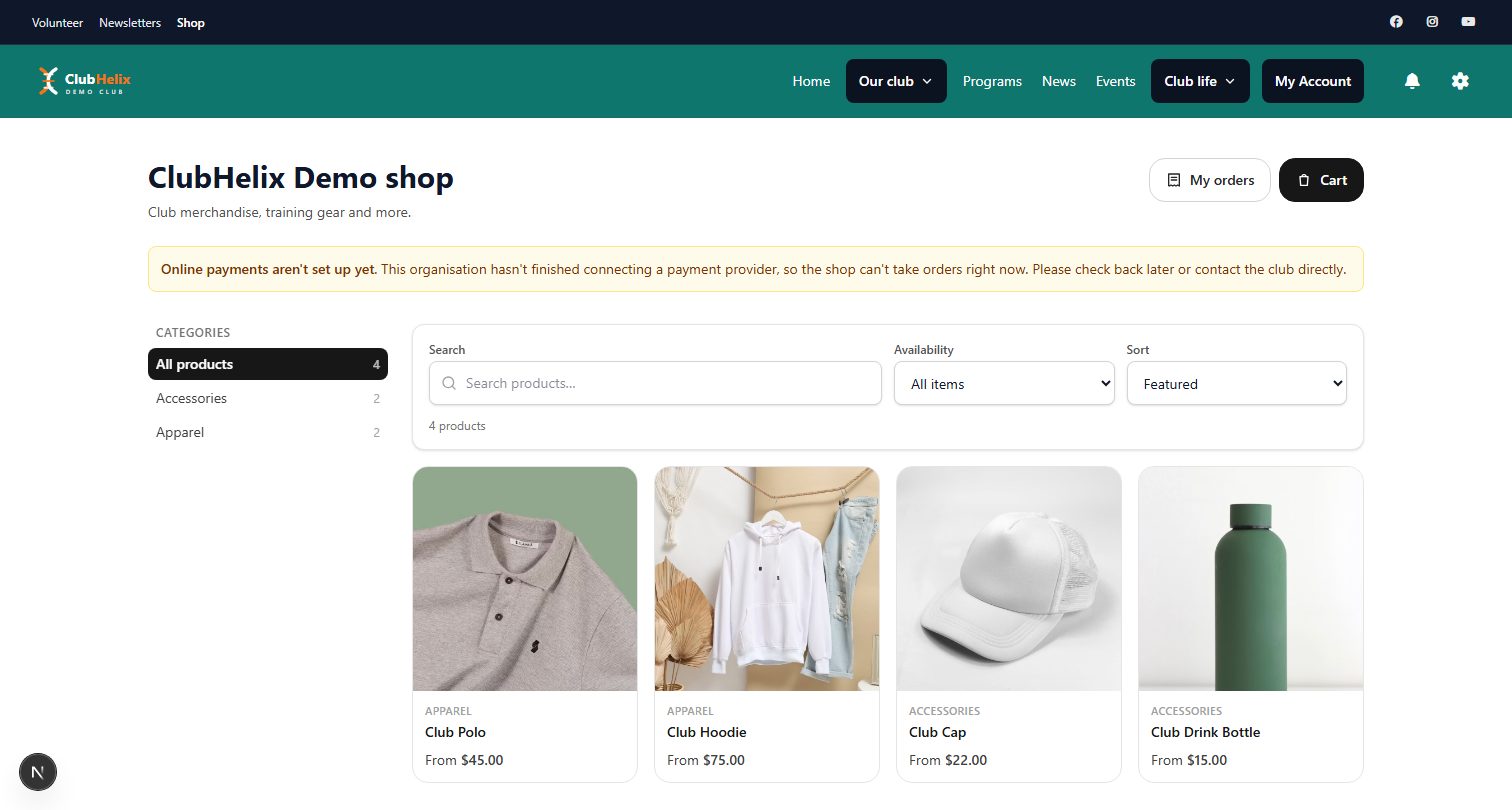
Most of what makes a bar profitable is not what happens behind it — it is knowing which sessions are worth opening, selling function and event tickets in advance, and telling members what is on before the day. Running events and ticketing through your own club website, taking function deposits and pre-sales through the club shop, and reading takings by session in your reports turns "we think Thursdays are quiet" into something you can act on.
ClubHelix gives your club a website with all of that built in, plus rosters, members and email in the same admin. There is a free tier to start on and honest pricing as the club grows — set your club up before the season starts and have the presentation night on sale in the same week.
Frequently asked questions
Do we need a licence to run a bar at our club?
Almost certainly, and the type of licence depends entirely on where your club is and who you serve. Community clubs commonly hold a club or members' licence with conditions on hours, guests and off-site service, and there are usually separate arrangements for one-off events. Treat this guide as general information and confirm the specifics with your licensing authority or a solicitor who works in licensing.
How much profit should a club bar make?
Aim to price so that around half of takings is gross margin, then protect that figure from the leaks that eat it — over-pouring, unrecorded free drinks, wastage and stock loss. A bar that reports its takings, costs and wastage as separate lines each month can be managed. One that reports a single net figure at the end of the season cannot.
How do you stop a club bar losing stock?
Set par levels, count the fast-moving lines at every close, do a two-person count monthly and compare it with till sales. Lock the store with two key holders and log stock moving from store to bar. Most variance turns out to be generous pouring or unrecorded complimentary drinks rather than theft, so investigate calmly and fix the process.
Can volunteers work behind a club bar?
In many places yes, though the qualification, age and supervision requirements differ by jurisdiction and some regimes require a certified person to be on duty whenever alcohol is served. Build a pool of qualified volunteers rather than relying on one, pay for their training from bar revenue, and confirm the current requirements with your licensing authority.
How should a club handle cash from the bar?
Use a fixed float counted in and out, ring up every sale before the money goes in the till, and have two unrelated people count and sign for the take before anyone leaves. Bank on a schedule with two people, reconcile the session sheet against the till report weekly, and move as much trade as possible onto card payments for an automatic record.
Should our club bar open every week?
Only where the session pays for itself in money or in atmosphere. Track takings by session for a season, and be ruthless about the quiet ones — a bar open for three people costs a volunteer's evening, a cleaner and your licence conditions. Tie quiet-period trading to something actually happening rather than opening out of habit.
Keep reading — how to run a club canteen covers the food side of the same building, and how to hire out your clubrooms turns the room into income on the nights you are not trading.


