
What this guide answers
- How much does it cost to run a basketball club?
Court hire is usually the biggest line, followed by association team entry and game fees, singlets and equipment, and governing-body registration/insurance.
- What's the difference between domestic and representative basketball?
Domestic is the open, graded weekly competition at your local stadium — one training and one game a week.
- Who does scoretable duty at basketball games?
The competing clubs supply it — typically a rostered parent per team each week, running the clock, score and foul count.
- What should a basketball club website include?
Registration link with online payment, fees, training and game nights, the stadium address, team/fixture information and a contact that gets answered.
Ireland edition. This guide is written for volunteer-run clubs in Ireland. Where rules differ — grants, tax, incorporation, safeguarding — follow the Ireland-specific pointers below or check with your national body.
Basketball clubs have a cost structure and a rhythm unlike most community sports clubs: you usually don't own your venue, you hire it by the hour, and your season is shaped by a timetable you don't control. Learning how to run a basketball club is largely learning to manage courts, money and rosters at the same time.
Basketball's club scene here is smaller than the sport's participation numbers suggest, and it is overwhelmingly a sports-hall sport — which means your season is shaped by a leisure-centre or school booking sheet you don't control, and by a caretaker who locks up at nine. Court hire is usually the single largest line in the budget, ahead of everything else combined.
This guide covers the full job for a volunteer committee — affiliation, court hire economics, domestic versus representative basketball, registration and fees, match-day duties, and the online presence that keeps teams full.
Getting set up: associations and stadiums
Community basketball runs through regional leagues that affiliate to the national governing body. Your club enters teams into the league's divisions; the league sets the fixture list, divisions, regulations and play-off format. Unlike sports with a home-ground culture, most clubs here rent their venue from a leisure centre, school or university, so your "home court" is a booking rather than a place you control — worth remembering before you promise anyone a fixed fixture slot.
Get these locked in early each season:
- Team nominations. Associations set nomination deadlines well before the season. Nominate honestly by grade — a team two divisions too high bleeds players by round five.
- Player registration. Every player must be registered through the governing body's system for insurance. Keep your own club records alongside it: paid status, singlet numbers, emergency contacts.
- Court bookings for training. Training courts are scarce. Book your recurring slots (often at school gyms as well as the stadium) the moment the association or venue opens winter bookings.
Because most clubs run as unincorporated members' clubs, make sure your committee understands that this leaves officers personally exposed for the club's debts and contracts — a real consideration once you're signing venue hire agreements worth thousands a season. Our club committee roles guide covers who signs what, and incorporating is worth a conversation as soon as the numbers get serious.
Court hire: the number that shapes everything
Here's the thing new committees underestimate: a basketball club's biggest expense is usually stadium court hire. Every training hour and every match is time on a court someone owns, and the hourly rate — multiplied across every team, every week, for a whole season — is the number your fees have to cover.
Manage it deliberately:
- Audit usage. Two teams sharing a court for training halves the cost per team. Junior teams rarely need a full court for a full hour.
- Match your booking to your roster. Cancel slots during school holidays if teams don't train, and know your venue's cancellation notice period — paying for empty courts is the classic basketball club money leak.
- Build it into fees transparently. Show families the maths: court hire per team per season, divided by players. When parents see the hourly rate their fees are covering, fee resistance drops noticeably.
If your club ever grows into controlling its own venue time — say, a licence over a school gym on weeknights — hiring spare hours out to social groups can flip courts from a cost to an income line. Our guide on hiring out your clubrooms covers the basics, and facility booking tools make the calendar side painless.
Domestic vs representative basketball
Most clubs field domestic teams: graded weekly competition at the local stadium, one training night, one game night, everyone welcome. Some clubs also feed or run representative programs: tryouts, higher fees, more training, and weekend travel to play other associations.
If your club touches both, keep them clearly separated in your communication and your accounts:
| Domestic | Representative | |
|---|---|---|
| Entry | Open registration | Tryouts/selection |
| Cost drivers | Court hire, weekly game fees, singlets | Travel, coaching, tournament entry, extra court time |
| Commitment | 1 training + 1 game per week | Multiple sessions plus weekend travel |
| Risk to manage | Grading, forfeits, scoretable roster | Selection disputes, burnout, cost blowouts |
The most common flashpoint is selection. Publish a clear selection policy before tryouts — criteria, who selects, how families are told — and you'll prevent most of the grief. Our team selection policy template is a solid starting point.
Registration, fees and uniforms
Basketball fees typically stack: governing-body registration, the association's team entry and weekly game fees, plus your club fee covering court hire, singlets and equipment. Two structures are common:
- All-inclusive season fee — more to collect up front, vastly less chasing. Offer instalments for families who need them.
- Club fee + weekly game fee — the traditional model, where each team hands cash to the stadium counter every week. It works, but it makes team managers into debt collectors; more clubs are rolling game fees into the season fee and paying the association centrally.
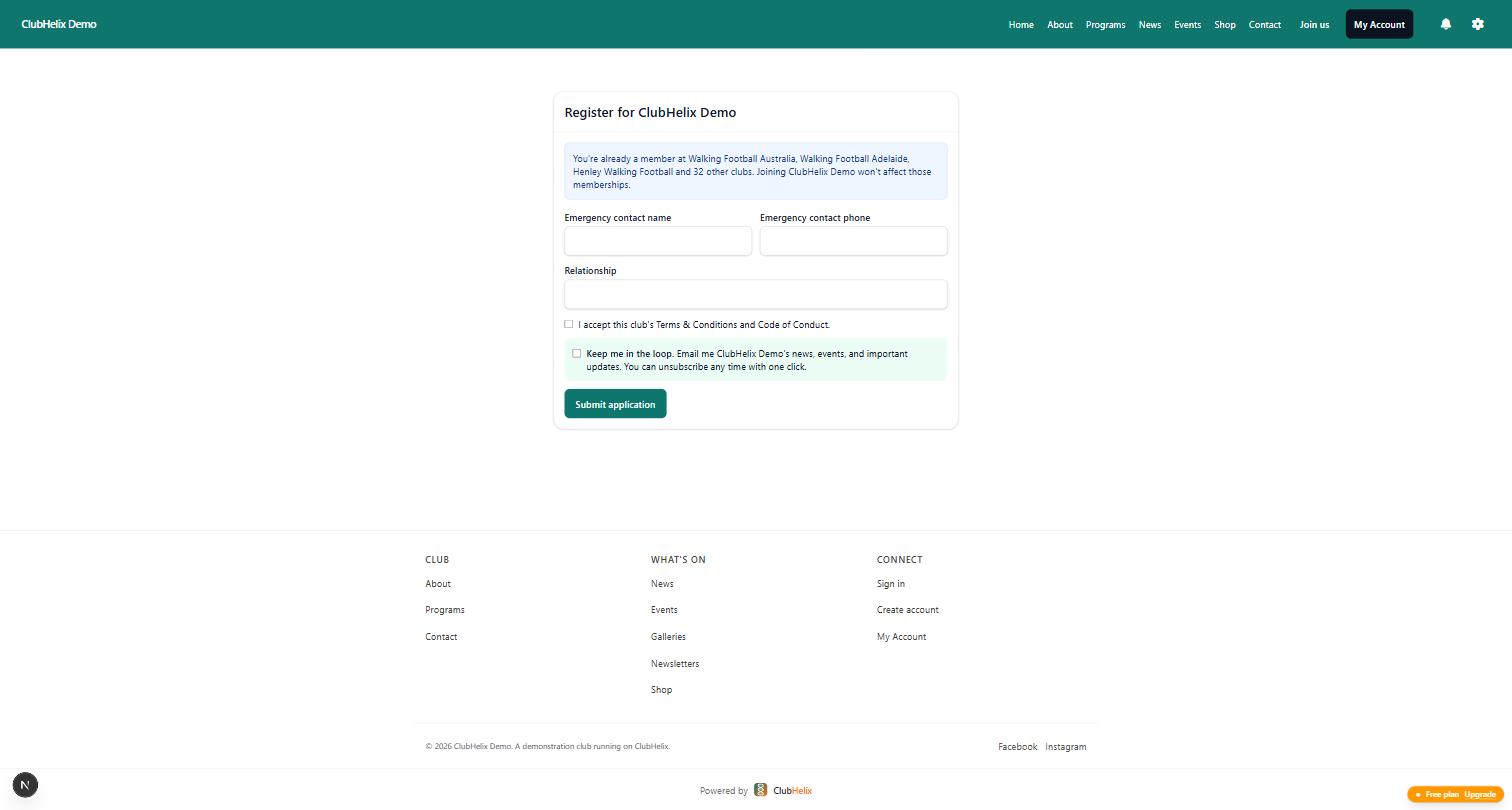
Collect it online. An online registration form that takes payment (with sibling discounts and instalment options built in) means your registrar isn't reconciling bank-transfer references at 11 pm. Reversible singlets are the standard uniform answer — one garment covers the light/dark clash rule — and selling them through a club shop page beats managing a tub of stock at the stadium.
The season: game nights, scoretable and referees
Domestic basketball runs to a weekly fixture published by the association, often across multiple weeknights and age groups — and many associations run both a winter and a summer season, so your admin cycle repeats twice a year.
Every game, each team owes the competition more than five players:
- Scoretable duty. Clubs must supply a scorer for the bench — running the clock, the score and the foul count. Roster it among parents at the start of the season, one family per week, published in advance. Scrambling for a scorer at tip-off is the most avoidable stress in domestic basketball.
- Referees. Match officials are allocated and paid via the association, but they're grown locally. Encourage teenage players into the referee ranks — it's a paid job that keeps them around the club — and back them against sideline noise. A club with a reputation for respecting referees gets better ones.
- Forfeits. Know the forfeit deadline and fee. Collecting availability early in the week — a two-tap RSVP rather than a group-chat poll — is how you find out on Tuesday, not at 6 pm Thursday, that you're down to four players.
Keep the fixture, results and ladder where families actually look: your club website. If you run any internal or holiday competitions yourself, competition management tools will generate the draw and keep the ladder without a spreadsheet.
Money and fundraising
Court hire makes basketball clubs cash-hungry, so most supplement fees with the classics: a sausage sizzle at a hardware store on a winter Saturday, a trivia night, a club raffle, and sponsorship. Basketball's sponsorship asset is singlets and stadium visibility — local businesses like seeing their name on 120 juniors every week. Package it properly (logo on singlets, sponsor wall on the website, a post per season on socials) and price it honestly; our guide on getting sponsors for a sports club walks through the pitch.

Treasurer hygiene matters more when money moves weekly: every game fee, singlet sale and fundraiser dollar through the club account, monthly reconciliation, and a budget set before nominations that prices court hire realistically. A club budget template makes the pre-season maths quick.
Your basketball club website and online presence
Basketball recruitment is constant — two seasons a year means two registration windows a year. When a parent searches for a local club, you want them landing on a page that answers, within seconds: which nights, which stadium, what it costs, how to register.
That's the case for a proper basketball club website rather than a social-media page: registration with payment built in, team pages, fixtures and news in one place that any committee member can update. Basketball club management software should also carry your roster, paid-up status and team lists so handover to next year's committee is a login, not a shoebox. See what ClubHelix includes for basketball on the basketball club management software page, and check the pricing page — there's a free tier, which suits a club testing the water between seasons.
Running a basketball club is a genuinely different job from running a ground-based club — the stadium clock is always ticking and it's always billing. ClubHelix was built for exactly this kind of committee: registration and payments, team and fixture management, a website families actually use, and records that survive committee handover. You can start free and have a working club site before the next nomination deadline.
Frequently asked questions
How much does it cost to run a basketball club?
Court hire is usually the biggest line, followed by association team entry and game fees, singlets and equipment, and governing-body registration/insurance. Because costs scale per team per week, build your budget from the court-hour up and set fees to cover it transparently.
What's the difference between domestic and representative basketball?
Domestic is the open, graded weekly competition at your local stadium — one training and one game a week. Representative basketball is selective: tryouts, extra training, higher fees and weekend travel to play other associations. Many clubs offer domestic only; that's a completely healthy model.
Who does scoretable duty at basketball games?
The competing clubs supply it — typically a rostered parent per team each week, running the clock, score and foul count. Publish the roster before round one and swap by agreement, rather than asking for volunteers at tip-off.
What should a basketball club website include?
Registration link with online payment, fees, training and game nights, the stadium address, team/fixture information and a contact that gets answered. Update it every season — with two registration windows a year, a stale site costs you twice.


