
What this guide answers
- What is a good membership retention rate for a sports club?
For community clubs, keeping around 80% of the members who were eligible to return is solid, and above 85% is excellent.
- How do we win back members who have already left?
Quickly, personally, and without guilt-tripping. A short message or call from someone they know ("we missed you this season — the door's open and here's the link if you'd like to come back") within a few months of…
- Does lowering fees improve retention?
Rarely, and usually at a cost the club can't afford. Members overwhelmingly leave over connection, communication and experience — not price.
- Whose job is retention on a volunteer committee?
Everyone's in spirit, nobody's in practice — unless you assign it.
Ireland edition. This guide is written for volunteer-run clubs in Ireland. Where rules differ — grants, tax, incorporation, safeguarding — follow the Ireland-specific pointers below or check with your national body.
Most club committees obsess over recruitment and barely measure retention — yet retention is where seasons are won. A club of 200 members that keeps 85% of them needs 30 new sign-ups just to stand still. Drop to 65% retention and you need 70. Same club, same sport, same neighbourhood — but the second club spends its whole year recruiting frantically to tread water, while the first grows gently on word of mouth.
The good news: membership churn is mostly not about your sport, your fees, or the weather. It's about a handful of fixable experiences — a lonely first season, a communication vacuum, a renewal process that relies on people remembering. This guide covers how to measure your churn honestly, why members actually leave, and the season-long habits that keep them.
One structural note before the playbook: many clubs here collect subs by instalment or standing order rather than as a single annual payment, and that changes the retention problem. Churn stops being an annual cliff and becomes a slow drip of quiet cancellations you will never notice unless someone is watching the payment list every month. Add that monthly review to everything below — a lapsed payment is far more often a changed bank card than a decision to leave.
Measure it before you manage it
Retention rate is simple arithmetic most clubs never do:
Retention rate = members who renewed this season ÷ members eligible to renew × 100
Exclude the people who genuinely couldn't return (moved away, aged out of a junior program with no senior pathway) and you get your controllable churn — the number your committee can actually influence.
Then segment it, because averages hide the story:
- First-year members vs long-timers. Almost every club loses first-year members at two or three times the rate of established ones. If your overall retention is 75% but first-years are at 50%, you don't have a retention problem — you have a first-season experience problem.
- By team or age group. One struggling team with a difficult coach can quietly account for half your churn.
- By join month. People who joined mid-season often miss the social glue of a pre-season and leave at higher rates — they may need a deliberate second welcome.
If your member records live in a spreadsheet three treasurers old, this analysis is painful. A proper member database that tracks join dates, renewals and statuses makes it a ten-minute job each season.
Why members actually leave
Exit surveys across community sport keep finding the same short list, and "the fees were too high" is rarely near the top:
- They never connected socially. The strongest predictor of renewal is whether a member (or their parents, for juniors) made friends at the club. People don't quit clubs where their mates are.
- Nobody noticed them. They missed three weeks and no one asked where they were. The lesson members draw is: my presence doesn't matter here.
- Communication chaos. Training moved and they found out afterwards. The fixture changed on a Facebook post they never saw. A few of these and busy families quietly conclude the club is more work than it's worth.
- The value question was never answered. They paid once, saw nothing all year about where the money went or what the club achieved, and at renewal time the fee felt like a bill rather than a membership.
- Life friction. Renewals that require finding a form, remembering a bank transfer, or catching the registrar at training get postponed — and postponed renewals become lapsed memberships. (Fixing this is cheap: see our guide on collecting fees online.)
Notice that every one of these is within a committee's control.
Fix the first season — your highest-churn segment
New members decide whether they're "a member of this club" or "someone who tried it once" within the first six weeks. Build a deliberate on-ramp:
- Welcome within 48 hours. An automatic welcome email at registration covering training times, what to bring, where to park, uniform ordering and who to contact. It costs nothing after the first draft and replaces the anxious "am I doing this right?" phase with confidence.
- A named welcomer per team. One existing member whose job is to learn the newcomer's name, introduce them around, and sit with them at the first club function. Formalise it — "someone will probably say hi" is not a system.
- Early involvement. People who do something — scoreboard duty, canteen shift, a social event — renew at far higher rates than people who only attend. Ask new members for one small contribution early; it signals belonging, not burden.
- The four-week check-in. One message: "How are you finding things so far? Anything we can make easier?" You'll rescue members you'd otherwise never know were wobbling.
Communicate like a club people are glad they joined
Communication is retention infrastructure. The standard to aim for: no member should ever be surprised by something the club knew.
- One reliable channel. Pick email as your system of record (it reaches everyone, including the parents who aren't on social media) and be consistent. A short weekly or fortnightly note in season — results, what's on, one thank-you — beats sporadic essays.
- Segment your messages. Under-12 parents don't need seniors' fixture changes. Sending everything to everyone trains people to ignore you, which then makes them miss the message that mattered. Send to teams, groups and roles, not always to "all".
- Close the loop on money and effort. Twice a year, tell members plainly what fees and fundraising achieved: "your fees bought new match balls and covered officiating costs; the fundraising stalls paid for the junior jackets." Members who can see the value renew without hesitation.
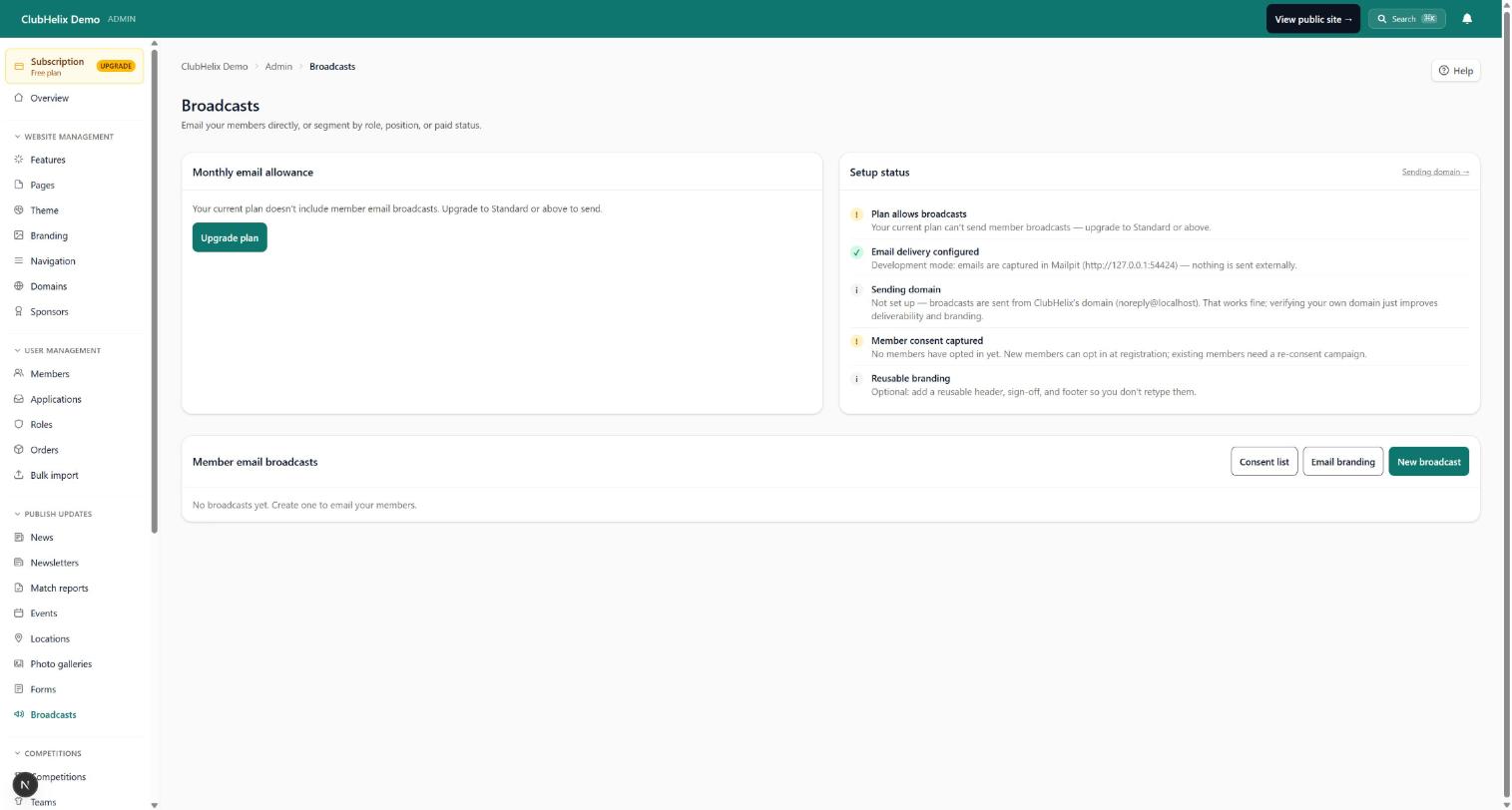
A purpose-built club broadcast tool makes the habit sustainable: pick the audience from your live member list, write once, and see who received it — no export-to-spreadsheet, no BCC accidents, no wondering whether the new families were on the list.
Use attendance as your early-warning system
Churn almost never comes out of nowhere — attendance fades first. A member who's missed three sessions in a row is telling you something; the only question is whether anyone is listening.
Clubs that track attendance — even lightly — can act while the member is still a member:
- RSVP for events and trainings gives you the signal before the no-show: a string of "not attending" replies from one family is a conversation waiting to happen.
- A simple absence rule: two consecutive unexplained absences triggers a friendly, personal message from the coach or team manager. Not a form letter — "We missed you Tuesday, everything OK?"
- Watch the volunteers too. Burnt-out volunteers churn hard and take their whole family's membership with them. Rotate duties before people have to ask.
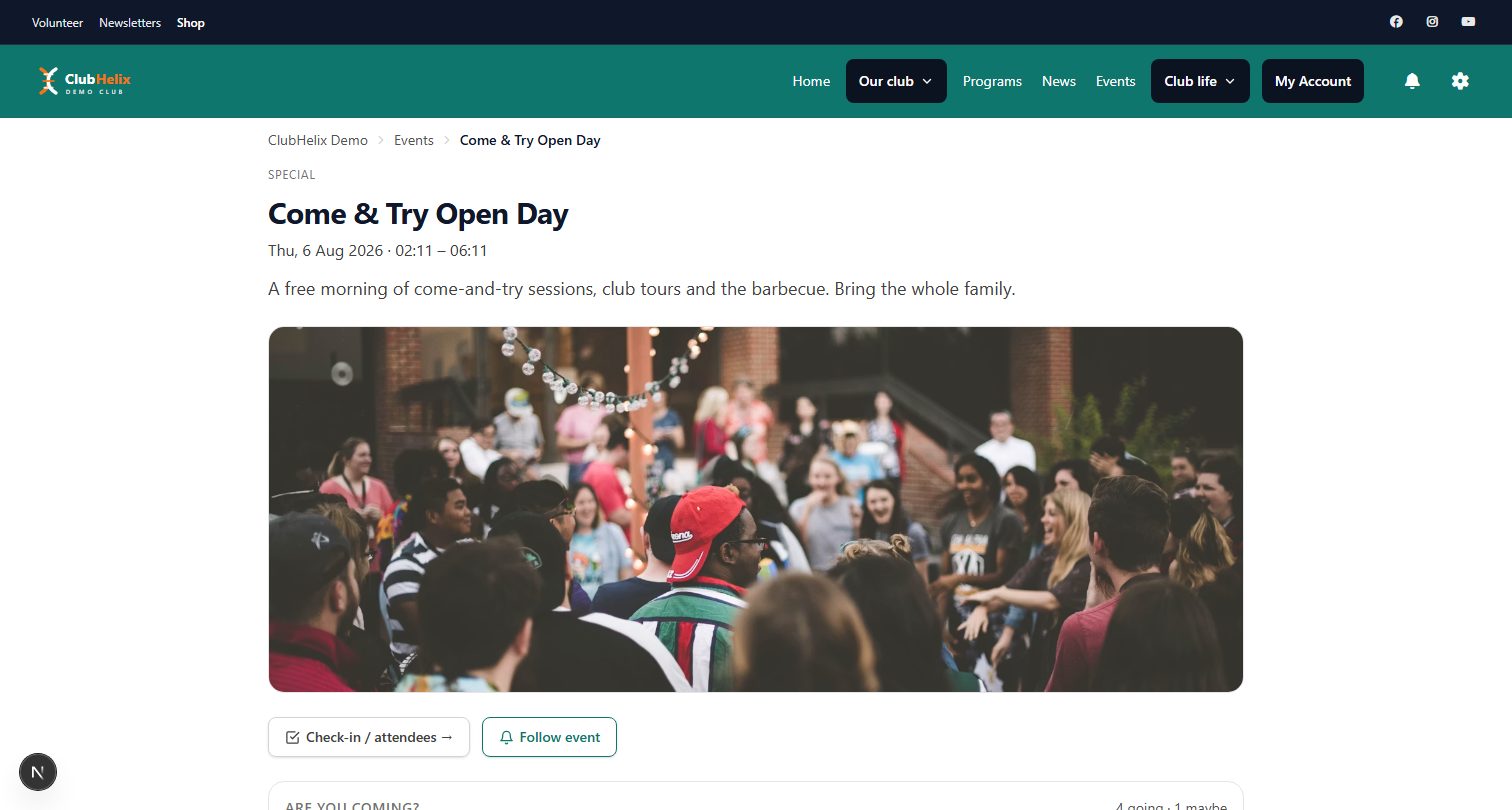
An integrated RSVP and attendance feature turns this from a coach's memory into a system: responses and attendance live against each member's record, so the pattern is visible before it becomes a resignation.
Run renewals as a campaign, not a deadline
Every season, some share of your "churn" is really just admin friction: people who meant to renew and didn't get around to it. Treat renewal like the campaign it is:
- Open early, while goodwill is high. The week after finals or presentation night is the best renewal window of the year. "Lock in your spot for next season" lands very differently in the afterglow than in the cold of the off-season.
- Make renewing a two-minute job. A personalised link, details pre-filled from last season, card payment on the spot. Every field someone must re-type is a chance to postpone. An online registration and renewal flow does this automatically.
- Offer instalments. A family fee split into a few payments removes the tight-month cashflow reason for hesitating, without discounting anything.
- Sequence the reminders. Announcement → personal-ish reminder ("we'd love to have you back in the twos") → last-call with a real deadline. Three touches, spaced weeks apart.
- Call the ones who lapse. A five-minute phone call to each non-renewer does two jobs: it wins a surprising number back on the spot, and it turns the rest into your honest exit-interview data for next year.
The retention calendar
| When | Habit |
|---|---|
| Registration | Automatic welcome email; welcomer assigned |
| Week 4 | New-member check-in message |
| All season | Weekly/fortnightly targeted club email; absence rule active |
| Mid-season | "Where your fees go" note; volunteer thank-yous |
| Post-finals | Early-bird renewal campaign opens |
| Pre-season | Reminder sequence; phone calls to lapsed members |
None of these items is hard. The clubs that keep their members are simply the clubs that do them every season — which is easiest when your member records, emails, events and renewals all live in one system instead of five volunteers' laptops.
Frequently asked questions
What is a good membership retention rate for a sports club?
For community clubs, keeping around 80% of the members who were eligible to return is solid, and above 85% is excellent. More important than the headline number is the first-year figure: if new members renew at half the rate of established ones — a very common pattern — your effort belongs in the first-season experience rather than in club-wide perks.
How do we win back members who have already left?
Quickly, personally, and without guilt-tripping. A short message or call from someone they know ("we missed you this season — the door's open and here's the link if you'd like to come back") within a few months of lapsing converts far better than a generic campaign a year later. For members gone longer, a pre-season "come back and try a session free" invitation gives them a low-stakes re-entry.
Does lowering fees improve retention?
Rarely, and usually at a cost the club can't afford. Members overwhelmingly leave over connection, communication and experience — not price. Before touching the fee, offer instalment payments (which fixes the cashflow objection without discounting) and make sure members can see what their fees deliver. If price genuinely is the issue for some families, a quiet hardship policy helps them specifically without underpricing the whole club. For fee-setting frameworks, see our guide on how much club membership should cost.
Whose job is retention on a volunteer committee?
Everyone's in spirit, nobody's in practice — unless you assign it. The pattern that works: the committee owns the calendar above, each team manager or coach owns welcomes, check-ins and the absence rule for their group, and one named person (often the secretary or membership officer) owns renewals as a campaign. Ten minutes on retention at every committee meeting keeps it honest.
ClubHelix keeps your member list, targeted email broadcasts, RSVPs and attendance, and online renewals in one place — so the retention habits in this guide run on rails. See pricing to get started.


