
What this guide answers
- How far in advance should you promote a club event?
Four weeks is the sweet spot for most club events — enough time for three email touches and word of mouth to circulate, without the date going stale.
- What's the best way to promote a club fundraiser for free?
Use the channels you already own — email list, social accounts, website, posters at the clubrooms — and multiply them through people: committee shares, coach announcements and sponsor reposts cost nothing and reach far…
- How do you sell more tickets in the last week?
Send a genuine "last chance" email with the deadline in the subject line, post daily countdowns, and share real numbers ("14 tickets left").
- Should club events use paid social media advertising?
Usually not until the free channels are maxed out — most club events fill from email, shares and word of mouth.
USA edition. This guide is written for volunteer-run clubs in the United States. Where rules differ — grants, tax, incorporation, safeguarding — follow the USA-specific pointers below or check with your national body.
Every club has run the event that deserved a crowd and got twenty people. The trivia questions were great, the raffle prizes were donated, the hall was booked — but promotion started nine days out with one social media post, and hope is not a marketing channel.
The fix isn't more effort; it's earlier, spread-out effort. Here's a simple four-week plan for promoting a club event — a fundraiser, presentation night, come-and-try day or family fun day — using channels every club already has: your website, email list, social media, posters and word of mouth.
Before week 4: get three things straight
Promotion multiplies whatever it's pointed at, so set the foundations first:
- A goal number. "Sell 120 trivia tickets" or "40 families at the come-and-try day". A number tells you each week whether promotion is working or needs a push — and whether you can afford the venue.
- An audience. Members only? Members plus family and friends? The whole town? Where you promote a fundraiser depends entirely on who it's for. A members-only presentation night needs email and team chats; a community fun day needs posters, local groups and school newsletters.
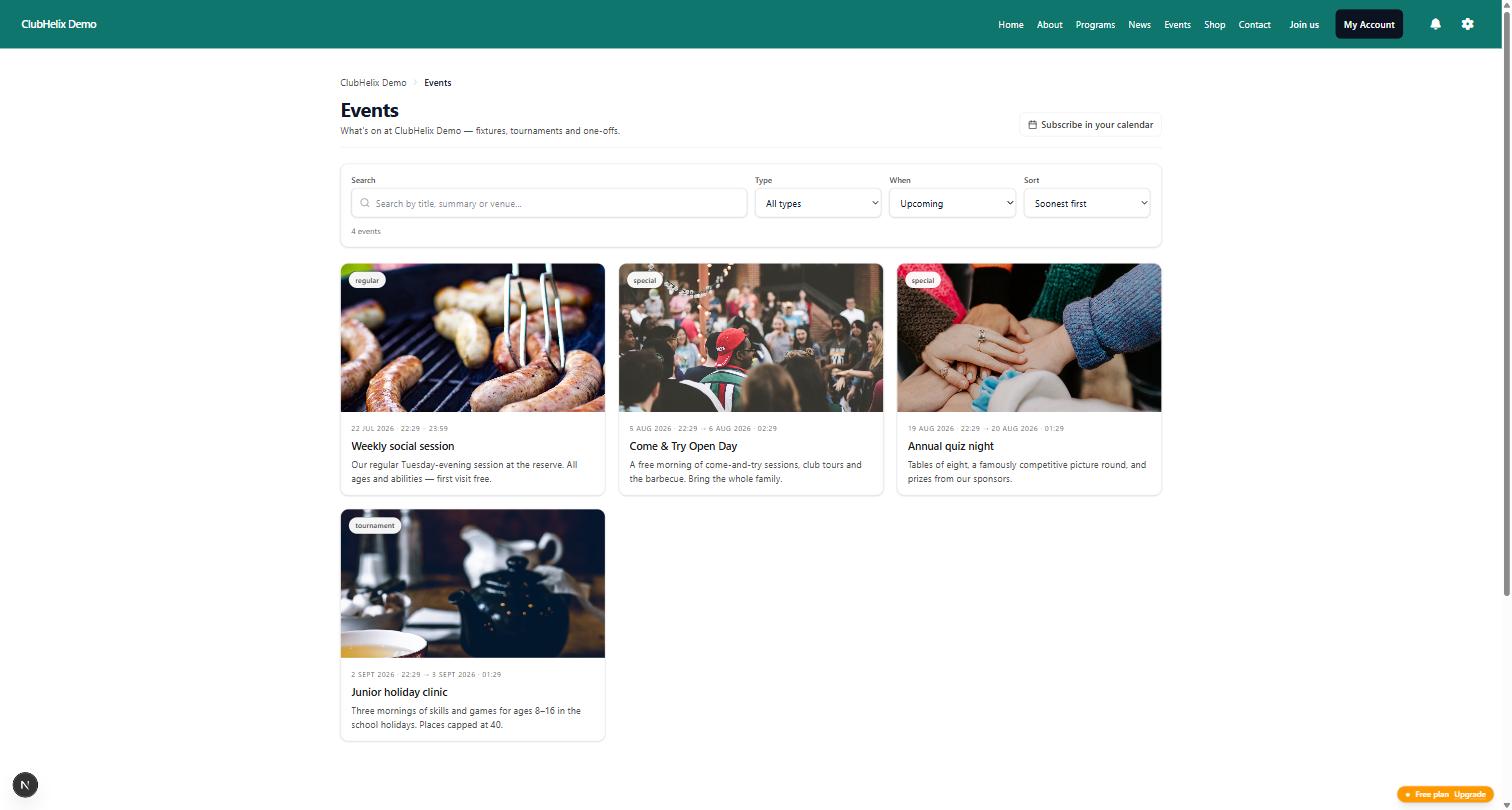
- One link. Every poster, post and email should point at a single event page with the date, time, venue, price and a buy/RSVP button. If your club runs its site on a platform with a built-in events calendar and ticketing, that page takes ten minutes; tickets sold there land straight in your account, and you can watch sales against your goal all month.
One link matters more than people think. When tickets live on an external ticketing site, the door price lives on a poster, and the details live in a chat thread, every inconsistency costs you attendees.
Week 4: announce everywhere at once
The first week is about planting the date in as many heads as possible.
- Publish the event page with tickets or RSVPs live from day one. Never announce before people can act — "details coming soon" wastes your biggest spike of attention.
- Send the announcement email to your whole list. Subject line = the event and date ("Trivia Night is back — Saturday 20 June"). Two short paragraphs, one button.
- Post on your club's social accounts — one clear image, the date, the link. Ask committee and players to share it in the first hour, when the algorithm decides whether anyone sees it.
- Put it in the newsletter and team chats. Anywhere your club already talks, the event should appear this week.
- Brief your best mouths. Coaches and team managers mention it at training: "Tickets went on sale today, grab a table."
Week 3: posters, partners and the second wave
- Print and hang posters — clubrooms, canteen, local shops, cafés, the school office, community noticeboards. Keep them simple: event name, date, one image, and a QR code pointing at your event page so a phone camera replaces typing a URL. (Generating one takes two minutes — see our QR code guide.)
- Ask partners to share. Sponsors, the venue, friendly local clubs, community social media groups and school newsletters will often post for free if you hand them ready-made words and an image. For a fundraiser, this is where "friends of friends" ticket sales come from.
- Post a "why" story. Week 4 announced the facts; week 3 sells the reason. If it's a fundraiser, say exactly what the money does: "Every table sold puts a junior player in new kit." Specific beats worthy, every time.
- Publish a news post on your website with the fuller story — it gives search engines something to find and gives your social posts somewhere to link. A news page that shares to socials in one step makes this painless.
For most clubs the free wins are school and PTA newsletters, community Facebook groups, the parks and recreation department's bulletin and neighbourhood apps — and if your club has a booster club, its contact list is a second email audience at no cost.
Week 2: proof and progress
By now the keen people have booked. Week 2 convinces the "maybe" crowd, and social proof is your best tool.
- Show momentum. "60 tickets gone, 60 left" or "12 tables booked" — real numbers only, never invented ones. Scarcity is honest when it's true.
- Show faces. Photos from last year's event outperform posters. People come to things that look fun and full.

- Send the second email — angled differently from the first. Announce the trivia host, tease the raffle prizes, name the food truck. New information gives people who ignored email one a fresh reason to open this one.
- Nudge the teams. A friendly inter-team rivalry ("Under 14s have booked three tables — over to you, seniors") fills seats fast.
- Check against your goal. Halfway to the date, you should be roughly halfway to the number. If you're well short, this is the week to add push — more shares, a committee ring-around — not the night before.
Week 1: urgency and logistics
- Send the final email 2–3 days out: "Last chance — sales close Thursday". Deadline in the subject line, one button, nothing else. This email almost always sells the most tickets of the three.
- Go daily on socials — countdown posts, prize reveals, a 20-second video of the venue being set up. Short and frequent beats long and polished.
- Text the door-price crowd if sales close early. An SMS lands within minutes: "Trivia tix close tonight! [link]".
- Message ticket-holders the practical details — parking, start time, what to bring, table numbers. Attendance on the night is promotion too; people who bought and didn't show don't come next year.
- Set up day-of capture. A QR code at the door pointing at your mailing list or next event turns tonight's crowd into next event's week-4 audience.
The 4-week plan at a glance
| Week | Website | Socials | Ground game | |
|---|---|---|---|---|
| 4 | Event page live, tickets on sale | Announcement to full list | Announcement post + shares | Coaches mention at training |
| 3 | News post with the story | — | "Why" story post | Posters + QR up, partners share |
| 2 | Update numbers on page | Second angle (host, prizes) | Momentum + last year's photos | Team-vs-team table rivalry |
| 1 | Close sales / door info | "Last chance" + details email | Daily countdown | SMS nudge, door QR ready |
What to measure afterwards
Twenty minutes after the event, while it's fresh, write down: tickets sold vs goal, which email got the most clicks, which post got shared, where attendees said they heard about it, and what you'd change. Two or three events in, you'll know exactly which channels move tickets for your community — most clubs discover email and word of mouth outsell everything else combined, with posters winning for all-of-town events. That's your club event marketing playbook, written by evidence. For more post ideas between events, raid our club social media ideas list, and if you're still choosing the event itself, start with club fundraising ideas that actually work.
If the juggling act — event page, tickets, emails, news posts, RSVP lists — is the part that puts you off, ClubHelix rolls it into one place: create the event once, sell tickets on your own site, and send targeted email broadcasts to members from the same screen. There's a free tier, so you can run your next event on it and see — get started here.
Frequently asked questions
How far in advance should you promote a club event?
Four weeks is the sweet spot for most club events — enough time for three email touches and word of mouth to circulate, without the date going stale. Big-ticket events like a major gala or anniversary dinner deserve six to eight weeks; a casual social night can work on two.
What's the best way to promote a club fundraiser for free?
Use the channels you already own — email list, social accounts, website, posters at the clubrooms — and multiply them through people: committee shares, coach announcements and sponsor reposts cost nothing and reach far beyond your own followers. Community noticeboards and school newsletters are also free and effective for family events.
How do you sell more tickets in the last week?
Send a genuine "last chance" email with the deadline in the subject line, post daily countdowns, and share real numbers ("14 tickets left"). Urgency works when it's true — most events sell a third or more of their tickets in the final days.
Should club events use paid social media advertising?
Usually not until the free channels are maxed out — most club events fill from email, shares and word of mouth. If you do boost a post for a big community event, a small spend targeted tightly to your local area in the final two weeks is enough.


