
What this guide answers
- How many rounds does a round robin take?
With an even number of teams n, a single round robin takes n − 1 rounds with n/2 games per round (8 teams → 7 rounds).
- How do byes work in a fixture draw?
Add a phantom team called BYE and fixture as if you had one more team.
- What is the fairest finals format for a club competition?
For a typical grade, the top-4 Page playoff is the community-sport standard: the top two earn a double chance (rewarding the home-and-away season) while third and fourth must win every week.
- What if a team withdraws mid-season?
Decide the policy in advance and write it into your competition rules.
USA edition. This guide is written for volunteer-run clubs in the United States. Where rules differ — grants, tax, incorporation, safeguarding — follow the USA-specific pointers below or check with your national body.
Somebody at every club or association eventually inherits the job: "can you do the draw?" It sounds like an afternoon with a spreadsheet. It turns into three weekends of scribbled grids, a team that somehow plays the same opponent twice before meeting another at all, and a phone call from a coach who's noticed their side has four away games in a row.
The good news is that fixture drawing is a solved problem. The round robin has a simple rotational method that guarantees everyone plays everyone, byes have a standard trick, and finals formats are well-understood systems you can pick off the shelf. This guide walks through all of it — the maths, the method, the fairness checks, and how finals series actually work — whether you're fixturing an internal club competition or a whole association season.
(One translation note: in North American leagues this whole job is usually called "making the schedule" — a fixture draw is the same thing: who plays whom, where, in which round. The maths is identical whatever you call it.)
Start with the shape of the season
Before any grid-drawing, pin down four numbers:
- How many teams? (In each grade/division — each one gets its own draw.)
- How many playing weeks? Count the real calendar: season start to finals start, minus public holidays, rep weekends, and any general byes you want mid-season.
- How many rounds do you want? A single round robin (everyone plays everyone once), a double (home and away), or something in between.
- How many venues/timeslots per week? This constrains how many games can happen simultaneously and drives the timeslot allocation later.
The core maths that makes rounds fit weeks:
- With n teams (n even): a single round robin takes n − 1 rounds, with n/2 games per round. Eight teams → 7 rounds, 4 games a week. Total games: n(n−1)/2 = 28.
- With n teams (n odd): add a phantom team called BYE and fixture n+1 teams as normal. It takes n rounds, and each round one team "plays" BYE — that's their week off. Seven teams → 7 rounds, 3 games plus a bye each week.
- A double round robin doubles the rounds (and flips home/away). Eight teams → 14 rounds.
Check the fit first: if you have 9 teams and 16 playing weeks, a single round robin (9 rounds) leaves 7 weeks over — not enough for a second full round (9 more). Your options: a round-and-a-half (awkward but common, seeded by the first round's ladder), promoting/merging grades to change n, or extra weeks of finals. Deciding this consciously beats discovering it in round 12.
Round robin explained: the circle method
The classic hand-method — and the algorithm inside most fixturing software — is the circle (rotation) method. For 8 teams:
- Number the teams 1–8. Fix team 1 in place. Arrange the rest in a circle (two rows works on paper):
Round 1:   1  2  3  4
           8  7  6  5
Each column is a match: 1v8, 2v7, 3v6, 4v5.
- For the next round, rotate every team except team 1 one position clockwise (2 drops down, 8 moves along the bottom, 5 pops up to the top row):
Round 2:   1  3  4  5
           2  8  7  6
Matches: 1v2, 3v8, 4v7, 5v6.
- Repeat the rotation for each round. After n−1 rotations you're back at the start, and every team has played every other team exactly once. That's the whole trick.
For an odd number of teams, label position 8 (or wherever you fix) as BYE — whoever rotates into facing it has the week off, and the byes distribute perfectly evenly.
Home and away: alternate within each pairing — in each match, give home to the team that's had fewer home games so far (the fixed team 1 needs manual alternation since it never rotates). In a double round robin, replay the same rounds with venues flipped. Then sanity-check the pattern: no team should have more than two consecutive home or away fixtures if you can help it.
Timeslots and grounds: once the pairings exist, allocate each match to a ground and time. Spread the "good" slots (main ground, prime time) around the grades over the season, keep clubs with shared volunteers or families at the same venue on the same day where possible, and note ground unavailability (ground works, overlap with other sports' seasons) before you allocate, not after.
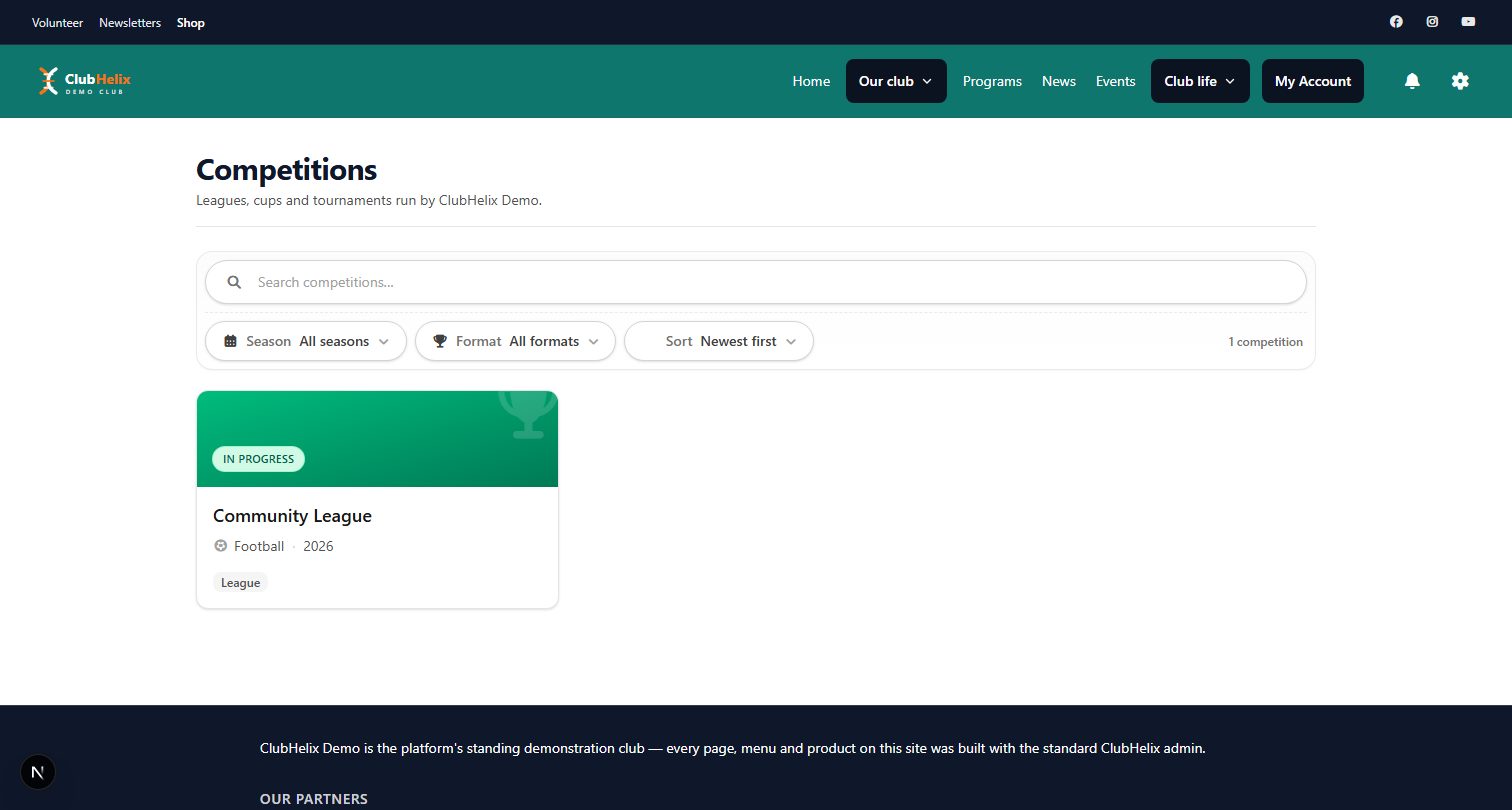
This is exactly the kind of mechanical-but-fiddly work software should do. A competitions system generates the round robin, handles the bye, balances home and away, and — the part spreadsheets never do — publishes the fixtures, results and a live ladder to your website automatically, so a mid-season change (a withdrawn team, a washed-out round) is an edit, not a re-issue.
Grading: getting teams into the right competition
A perfect draw can't fix a lopsided grade. Grading — sorting teams into divisions of similar strength — is what makes a season competitive, and it feeds the draw (you need final team counts per grade before fixturing).
Practical approaches, roughly in order of reliability:
- Last season's results. Promote the runaway winners, relegate the winless. Simple and defensible.
- Grading games. Two or three pre-season rounds fixtured deliberately (often strong-vs-strong based on nominations), after which teams are re-sorted and the real draw starts. Costs calendar weeks — budget them in your pre-season countdown.
- Nomination-based seeding. Clubs nominate a grade with supporting info (returning players, last season's grade). Works when clubs are honest; pair it with an early-season regrade window for when they aren't.
- Mid-season regrade. The safety valve: after 3–5 rounds, move the team that's winning 100–0 up and the team losing 100–0 down. Announce the possibility before the season so it's policy, not punishment — and decide in advance how carried-over points work (percentage of ladder points is common).
However you grade, publish the criteria. Grading grievances are like selection grievances — usually communication failures wearing a competition costume (the same logic as a good selection policy).
How does a finals series work?
The home-and-away season ranks teams on a ladder; the finals series turns that ranking into a premiership. The main formats, from simplest up:
Straight knockout (top 4 or top 8). Semi-finals then a grand final: 1v4 and 2v3, winners meet. Simple, brutal, one bad day ends anyone's season. Best when the season itself should mean less and the cup atmosphere more.
Page playoff (top 4) — also called the Page–McIntyre system: less famous than straight knockout, and much better at rewarding the regular season:
- Week 1: Qualifying final: 1 v 2. Elimination final: 3 v 4 (loser out).
- Week 2: Preliminary final: loser of 1v2 plays winner of 3v4 (loser out).
- Week 3: Grand final: winner of 1v2 plays winner of the preliminary final.
The design intent: finishing top two earns a double chance — lose your first final and you're still alive — while third and fourth must win every week. It rewards the home-and-away season without making finals a formality. A top-2 version (major/minor semi structure) and top-5/top-6 McIntyre variants exist for bigger grades; the top-4 Page is the one to reach for by default.
Ladder + grand final only. The top two after the round robin meet in a one-off decider. Cheap on calendar weeks; leaves third place with nothing to play for late in the season.
Whatever you choose, publish these rules before round one: how many teams qualify, the format, tie-break order on the ladder (points → percentage/for-and-against → head-to-head is conventional), what happens to drawn finals (extra time? replay? higher-ranked team advances?), and player eligibility rules (a minimum number of home-and-away games is standard, to stop stacked finals teams). Finals disputes are almost always about rules invented the week before finals.
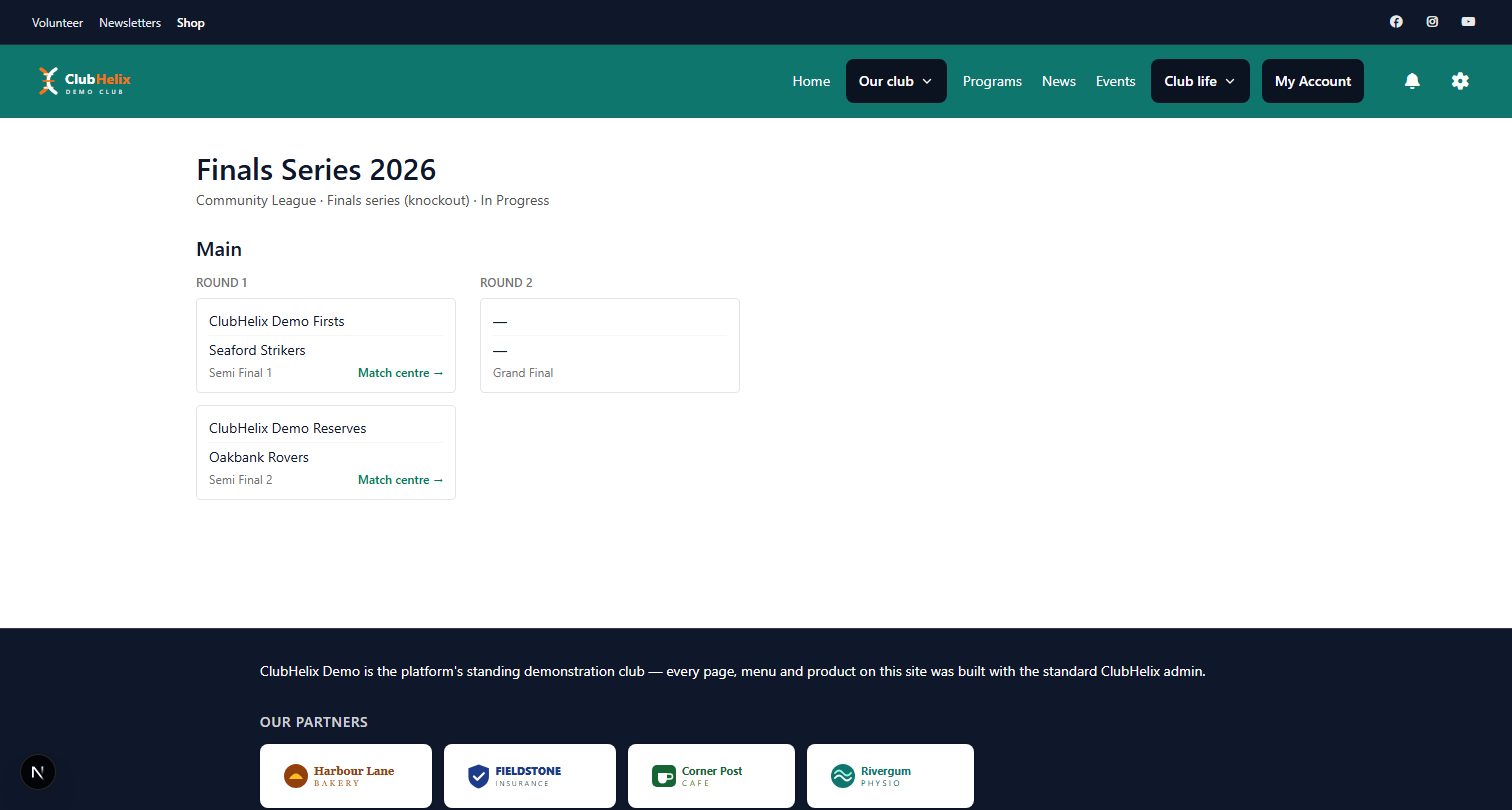
Bracket software earns its keep here too — a finals series tool seeds the bracket straight off the final ladder and advances winners automatically, so the format you announced before round one is exactly what runs in finals week.
Fairness checks before you publish
Run the draft draw past this list — it catches the complaints before the coaches do:
- Does every team play every other team the same number of times?
- Are byes evenly spread (and not clustered against school holidays for junior grades)?
- Home/away balanced within one game, with no long consecutive-away runs?
- Prime timeslots and the main ground shared around over the season?
- Derbies and traditional rivalry games placed deliberately (not round 1, not clashing with rep duties)?
- Public holidays, rep weekends and ground unavailability all respected?
- Does the last round of the season have meaningful games where possible (avoid 1v8, 2v7 across the board)?
Then publish early and in one authoritative place — your website, not a PDF that spawns out-of-date copies. Every revision should replace the original everywhere at once, which is, again, the argument for fixtures living in a system rather than a document.
Frequently asked questions
How many rounds does a round robin take?
With an even number of teams n, a single round robin takes n − 1 rounds with n/2 games per round (8 teams → 7 rounds). With an odd number, it takes n rounds and each round one team has a bye (7 teams → 7 rounds). A double round robin — everyone plays everyone home and away — doubles that. Total matches in a single round robin: n(n−1)/2.
How do byes work in a fixture draw?
Add a phantom team called BYE and fixture as if you had one more team. Whichever team is drawn against BYE that round has the week off. Because the phantom rotates through the draw like any other team, byes distribute perfectly evenly — every team gets exactly one per full round robin. Never hand-assign byes; hand-assigned byes are how one team ends up with two in three weeks.
What is the fairest finals format for a club competition?
For a typical grade, the top-4 Page playoff is the community-sport standard: the top two earn a double chance (rewarding the home-and-away season) while third and fourth must win every week. Use straight knockout when calendar weeks are tight or when you want cup-style stakes, and a grand-final-only decider for small grades. Fairness is mostly about pre-announcement — qualification, tie-breaks, drawn-final rules and player eligibility published before round one.
What if a team withdraws mid-season?
Decide the policy in advance and write it into your competition rules. The standard treatment: the withdrawn team's played results are either expunged entirely or stand as played (pick one — expunging is cleaner if they withdrew early, letting results stand is fairer late), and every remaining fixture against them becomes a bye or a forfeit win at your standard forfeit score. Recalculate the ladder immediately and republish — this is a five-minute job in competition software and an evening in a spreadsheet.
ClubHelix builds the draw for you — competitions with generated round robins, automatic ladders and results on your public site, plus a finals series bracket seeded straight from the ladder. Start free and fixture your next season in minutes.


