
What this guide answers
- How much should we charge to hire out our clubrooms?
Price against three comparable local venues — community halls and other clubs — with an hourly rate, an evening/function rate, and a discounted regular-hirer rate.
- Do hirers need their own insurance?
Commercial and regular hirers (fitness instructors, dance teachers) should provide a certificate of currency for their own public liability cover before they start.
- Can hirers serve alcohol in our clubrooms?
It depends on your state or territory's liquor licensing rules, your own licence conditions if you have one, and whether alcohol is being sold or BYO.
- Should we allow 18th and 21st birthday parties?
Decide as a committee before the first enquiry, not on the phone.
Ireland edition. This guide is written for volunteer-run clubs in Ireland. Where rules differ — grants, tax, incorporation, safeguarding — follow the Ireland-specific pointers below or check with your national body.
Walk past your clubrooms on a Tuesday afternoon. The lights are off, the kitchen is cold, and the function room that fits eighty people is hosting precisely nobody — while somewhere nearby, a family is paying serious money for a venue half as good for a 40th birthday. Most clubrooms sit empty 80% of the week, and every empty hour is income the club isn't earning.
Venue hire is one of the most reliable revenue streams a club with its own rooms can build: recurring, low-effort once systemised, and completely independent of the weather, the ladder and the canteen roster. But it only works if you treat it like a small business — clear prices, a proper hire agreement, and a booking process that doesn't run through one volunteer's mobile. Here's how to set it up.
First, check you're allowed to
Before advertising anything, confirm the ground rules:
- Your lease or licence. Most clubrooms sit on council or municipal land under a lease or seasonal licence, and many of those agreements restrict commercial use, subletting or third-party hire. Read yours, and if hire isn't clearly permitted, ask the landowner — many councils and municipalities are happy to allow community hire, sometimes with conditions.
- Your committee. Get a formal committee decision minuting that the club will hire out the rooms, on what terms, and who administers it.
- Your insurer. Tell them you intend to hire the rooms out. Public liability arrangements differ, and you need to know what your policy covers before the first booking.
Ten minutes of checking now prevents the genuinely bad outcomes later.
Set your prices like a business (a friendly one)
Ring three comparable local venues — community halls, other clubs, council rooms — and price against them. You'll usually land on a structure like:
| Rate | Typical use | Notes |
|---|---|---|
| Hourly rate | Meetings, classes, small groups | Minimum 2 hours |
| Half-day / evening rate | Parties, functions | Your bread and butter |
| Full-day rate | Markets, workshops, wakes | Include set-up/pack-down time |
| Regular-hirer rate | Weekly yoga, playgroup, dance class | Discounted — recurring income is gold |
| Member rate | Members' private functions | A visible membership perk |
| Bond | All casual hires | Refundable, sized to your worst plausible clean-up |
Three pricing principles. Charge enough to cover the invisible costs — power, cleaning, wear, and the volunteer hour at each end; a hire that nets next to nothing after a fight over a dirty kitchen isn't worth having. Chase regular hirers hardest — a weekly fitness class at a modest rate out-earns a dozen one-off parties and brings none of the party risk. Take a bond on every casual hire — not because most hirers are careless, but because the bond conversation is what makes the careless ones careful.
Feed the projected income into your club budget conservatively in year one — you're building a track record, not banking on one.
The clubroom hire agreement: a simple checklist
Never hand over keys on a handshake. A one-or-two-page hire agreement signed before the booking is confirmed protects both sides. Yours should cover:
- The basics — hirer's name and contact, date, hours (including set-up and pack-down), rooms and equipment included, guest numbers.
- Payment terms — hire fee, deposit to confirm, balance due date, and the bond: how much, when it's refunded, and what it can be applied to (cleaning, damage, lost keys, overtime).
- Insurance evidence — for commercial and regular hirers (the yoga instructor, the dance teacher), require written evidence of their own public liability insurance (a certificate of currency or certificate of insurance) before they start. For private one-off functions, ask your insurer what they expect — arrangements vary.
- Alcohol rules — see the next section; your agreement should state plainly whether alcohol is permitted and under what conditions.
- House rules — end time and noise expectations (your neighbours' goodwill is a club asset), smoking policy, decorations (no nails in the honour board wall), kitchen use, rubbish removal, and the left-as-found cleaning standard.
- Access and security — key or code collection and return, who locks up, alarm instructions, and an emergency contact at the club.
- Cancellation terms — notice required for a refund, and the club's right to cancel (with full refund) if the ground floods or the building becomes unusable.
- What's not allowed — 18th and 21st birthday parties are the classic judgement call; many venues either decline them or require security. Decide your policy in advance, not on the phone.
Keep a signed copy on file for every hire, and review the template each season. This is general information, not legal advice — have someone qualified look over your hire agreement, and check any conditions in your lease with your council.
Alcohol: know the rules before you say yes
Alcohol is where clubroom hire gets legally interesting, and the rules are state and territory specific. The broad shape: supplying or selling alcohol generally involves your state's liquor licensing regime — if your club holds a licence it will have conditions about functions and who may be served, and one-off events may need a temporary or limited licence; hirers running their own bar are generally taking on licensing obligations themselves. BYO private functions are treated differently again in different jurisdictions.
Don't guess. Check your own licence conditions if you have one, and point commercial hirers to the official sources: business.gov.au links each state and territory's liquor licensing body, and in NSW for example the regulator is Liquor & Gaming NSW. Write the outcome into the hire agreement — "no alcohol", "BYO permitted, no sales", or "licensed functions only by prior arrangement".
This is general information, not legal advice — check the current requirements with your state or territory's liquor licensing authority linked above.
Take bookings properly (not through one volunteer's mobile)
The moment hire works, the booking admin becomes the bottleneck: double-booked Saturdays, "I'm sure I told you about the dance class", and one exhausted volunteer fielding enquiries at dinner time. Systemise from the start:
- Publish a venue-hire page on your club website — photos of the rooms set up for a function (not after a muddy home game), capacity, what's included, prices, house rules and the booking process. Half your enquiries answer themselves.
- Run one bookings calendar that shows the rooms' real availability — training nights, home games and club functions blocked out first, so hire can never collide with club use.
- Take booking and payment online. With ClubHelix facility booking, the clubrooms go up as a bookable space with your hourly and session rates: hirers see live availability, pick their slot and pay by card or settle at the venue, and the calendar blocks it instantly — no phone tag, no double bookings. A comments box on the booking form ("tell us what the function is") means the club knows it's a 21st before the keys are handed over; the answer is private to the club, shown beside the booking in the admin and never on the public page. Put the presentation night and the club's other events in as admin blocks first, so a wedding can never be booked over the top of them.
- Confirm in writing, every time — booking, payment, agreement signed, key arrangements. If it isn't written down, it didn't happen.
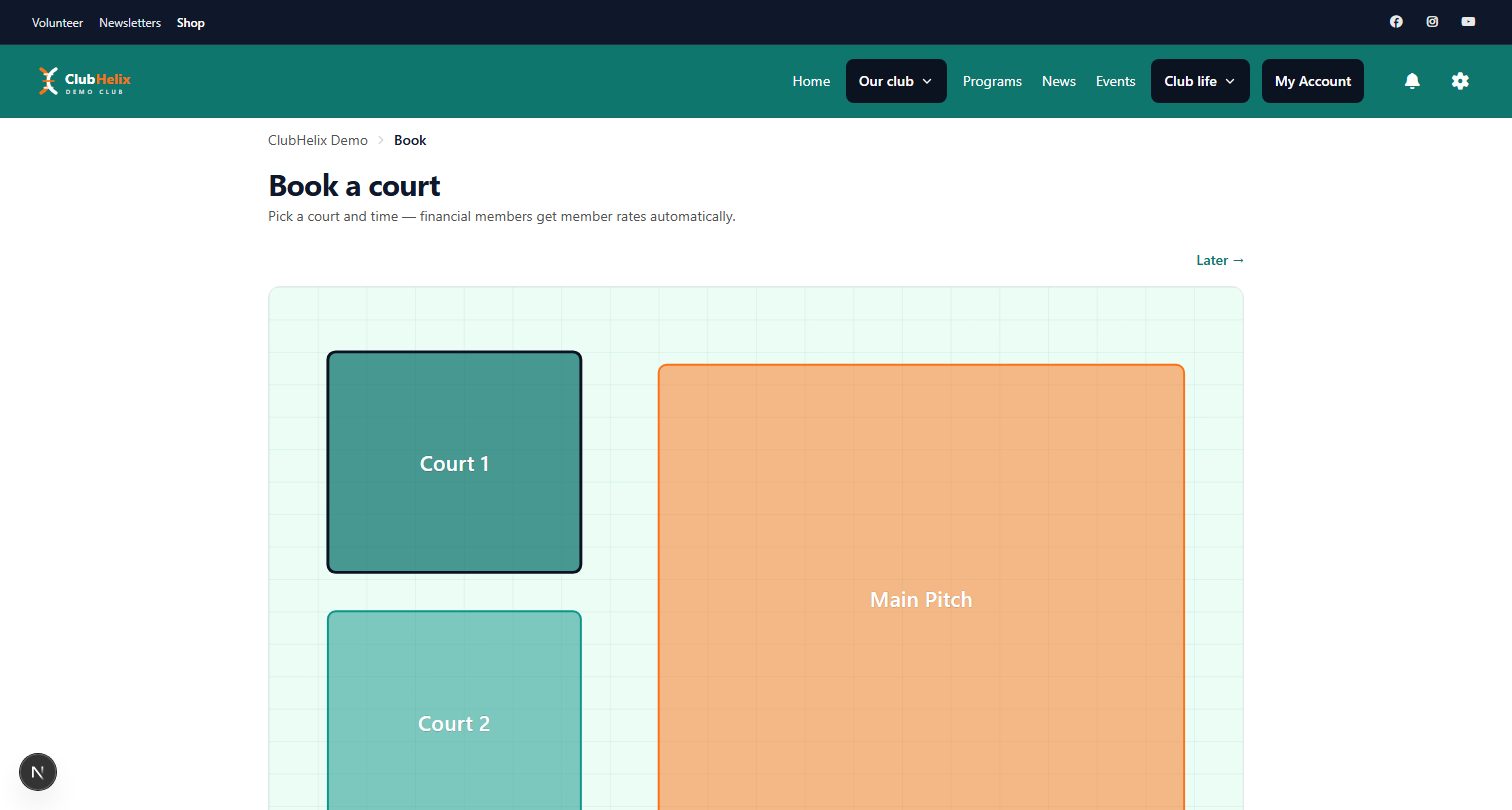
Taking payment at the venue
Not every hirer wants to pay by card weeks ahead, and not every club has a card processor connected. Set the clubrooms to be paid at the venue and a one-off hirer — the family booking the hall for a birthday — is confirmed straight away and told what to pay and how: a QR code by the kitchen, the card reader at the bar, or cash on the day. The admin shows what is owed on every venue-settled booking, and Mark paid records cash, card at the venue or bank transfer, with an optional reference and receipt, once the money arrives. Venue-settled bookings need no payment processor, and money the club records itself carries no platform commission, so the hall can be bookable from day one; regular hirers who book weeks ahead are still better served by card at the time of booking. Our guide to taking payment at the venue covers the reconciliation side, and pitch and oval bookings applies the same setup to the ground.
Find hirers without a marketing budget

You need surprisingly few channels: a good venue page that Google can find ("venue hire {suburb}" is a genuinely searched term), a listing on your council's community-venue directory if it runs one, a couple of posts a year in local community Facebook groups, and — most effective of all — your own members. A line in the newsletter ("did you know members get a discount on clubroom hire?") books more birthdays than any ad. Regular hirers are worth actively hunting: approach local fitness instructors, playgroups, dance teachers and community groups directly, because one weekly booking quietly out-earns your entire party trade.
Make the handover bulletproof
Most hire disputes are really handover failures. Close the loop with a routine: a five-minute walkthrough (or photo set) before each hire recording the state of the rooms, the same after, bond refunded promptly when all's well — promptly is what earns the five-star word of mouth — and deductions itemised with photos when it isn't. Then track the numbers each quarter: hire income, hours booked, and which hirers return. If the rooms are empty on the same nights every week, that's not a failure — it's your next regular-hirer sales target. And if hire income really takes off, it can fund the things fundraising never quite reaches — see our club fundraising ideas for how venue income compares with the alternatives.
If your club runs on ClubHelix, clubroom hire slots straight in: a venue page on your club website, live-availability facility booking with card or venue payment, and admin blocks for your fixtures and events keeping the calendar clear of club use. It turns "ring Barry about the hall" into a booking system — see pricing to get started.
Frequently asked questions
How much should we charge to hire out our clubrooms?
Price against three comparable local venues — community halls and other clubs — with an hourly rate, an evening/function rate, and a discounted regular-hirer rate. Make sure the price covers power, cleaning and volunteer time, and always take a refundable bond on casual hires.
Do hirers need their own insurance?
Commercial and regular hirers (fitness instructors, dance teachers) should provide a certificate of currency for their own public liability cover before they start. For private one-off functions, ask your insurer what they require — arrangements differ between policies. This is general information, not legal advice — confirm with your insurer.
Can hirers serve alcohol in our clubrooms?
It depends on your state or territory's liquor licensing rules, your own licence conditions if you have one, and whether alcohol is being sold or BYO. Decide your policy in advance, write it into the hire agreement, and point commercial hirers to your state regulator via business.gov.au.
Should we allow 18th and 21st birthday parties?
Decide as a committee before the first enquiry, not on the phone. Many community venues either decline them or require conditions such as security and a higher bond — whatever you choose, put it in writing in your hire terms so the answer is consistent.

