
What this guide answers
- How much does club membership usually cost?
It varies enormously by sport and region — junior memberships at community clubs commonly land in the low hundreds of dollars per season, with senior fees higher, and equipment-heavy or facility-heavy sports higher…
- Should juniors pay less than seniors?
Almost always, for two reasons: juniors typically cost less to field (shorter games, smaller grounds, lower official costs), and junior fees are the most price-sensitive decision in club sport — a family weighing three…
- How often should we review membership fees?
Every year, as a standing item before registrations open — even if the answer is "no change".
- Is it okay for membership fees to make a surplus?
Yes — a planned small surplus (roughly 5–10% of turnover) is good governance, not greed.
New Zealand edition. This guide is written for volunteer-run clubs in New Zealand. Where rules differ — grants, tax, incorporation, safeguarding — follow the New Zealand-specific pointers below or check with your national body.
Every pre-season, somewhere between the AGM and registration day, a committee stares at the same question: what should membership actually cost this year? And most clubs answer it the same way — last year's fee, maybe plus ten dollars, decided in five minutes so the meeting can move on.
That habit is how clubs drift into trouble. Fees set by inertia slowly fall behind costs (insurance and ground hire don't hold still), until one year the club needs a painful 30% catch-up rise that genuinely does drive members away. Or fees drift the other way — higher than the club's real costs justify — and the committee wonders why junior sign-ups are soft.
There's no universal right number, because a fee is a local decision: your costs, your community, your competitors. But there is a right method. This guide walks through it: build the cost floor, check the market ceiling, structure categories fairly, and communicate the number so members see a membership, not a bill.
Start with your cost floor: what does a member actually cost?
A membership fee has one non-negotiable job: keeping the club solvent. So the first number to find isn't a fee — it's your cost per member.
Pull together your annual running costs (your club budget should hand you these):
- Fixed costs that arrive regardless of member numbers: insurance and affiliation fees, ground or facility hire, utilities, equipment replacement, admin and software.
- Variable costs that scale with members: playing kit, match-day costs, umpire and official fees, per-player levies from your association.
Then:
Cost floor per member = (fixed costs ÷ expected members) + variable cost per member
Run it with a conservative member estimate — budgeting for 200 and getting 160 is how clubs end seasons in the red. If your realistic total is $48,000 across 180 expected members with $60 of variable cost each, your average member must contribute roughly $325 before the club breaks even on membership alone.
Two honesty checks while you're here:
- Don't price assuming fundraising saves you. Fees should cover core operations; fundraising and sponsorship should fund improvement — new equipment, subsidised programs, facility upgrades.
Clubs that need the sausage sizzle to pay the insurance bill are one wet Saturday from a crisis.
- Include a surplus line. A small planned surplus (5–10%) isn't profiteering; it's the buffer that absorbs a storm-damaged net or a mid-season levy without an emergency levy on members.
Then check the market ceiling: what will your community bear?
Your cost floor says what you must charge. The market says what you can. Spend an evening researching:
- Nearby clubs in your sport. Most publish fees on their websites (and if they don't, that's a lesson — hidden fees read as expensive; publish yours). You don't need to be the cheapest, but if you're 40% above the club two suburbs over, you need a visible reason — better facilities, better coaching, more included.
- Competing activities. For juniors especially, you're not just competing with the other football club — you're competing with swimming lessons, dance and gymnastics for the same family budget. Know what a term of those costs in your area.
- What's included. A fee that covers the playing shirt, match fees and presentation night ticket can be higher than a stripped fee and still feel cheaper, because families hate surprise add-ons. Count the true cost-to-play when you compare.
If your cost floor sits above your market ceiling, the fee isn't the problem — the budget is. That's a signal to attack costs, grow member numbers (fixed costs divide further), or lift non-fee income, rather than to price your club out of its own community.
Structure: categories that are fair and simple
A good fee schedule balances fairness (people pay according to what they use and can afford) against simplicity (a parent can find their number in ten seconds). Aim for five to eight categories, max. The standard set:
| Category | Typical approach |
|---|---|
| Senior playing | The anchor fee — full cost recovery plus margin |
| Junior playing | Commonly 50–70% of senior; juniors cost less to field and price-sensitivity is highest here |
| Family | Cap or discount: e.g. full price for the first two children, third and beyond free or heavily discounted |
| Concession (student/pensioner/healthcare card) | Commonly 60–75% of the relevant full fee |
| Social / non-playing | A modest fee that keeps supporters, parents and past players formally inside the club — your future volunteers and committee |
| Life members | Free by definition — but record them, they're members |
Structural decisions worth debating properly:
- Family caps matter more than the junior discount. The family with three kids is the one comparing you against cheaper options — or against dropping a child's sport entirely. A cap is targeted generosity: it costs you little (you'd likely lose those marginal registrations anyway) and buys enormous loyalty.
- Instalments beat discounts. If affordability is the worry, splitting a fee into two or three scheduled payments helps more families than shaving $20 off, and costs the club nothing. Pair it with online payment so instalments run themselves — see our guide on collecting fees online.
- Early-bird beats late fees. A modest discount before a published date pulls cash forward and gives your reminders a deadline; late fees mostly generate arguments.
- A quiet hardship line. One sentence on the join page — "if fees are a barrier, contact us confidentially" — with authority delegated to one or two officers. Every club needs it; no club should make families ask publicly.
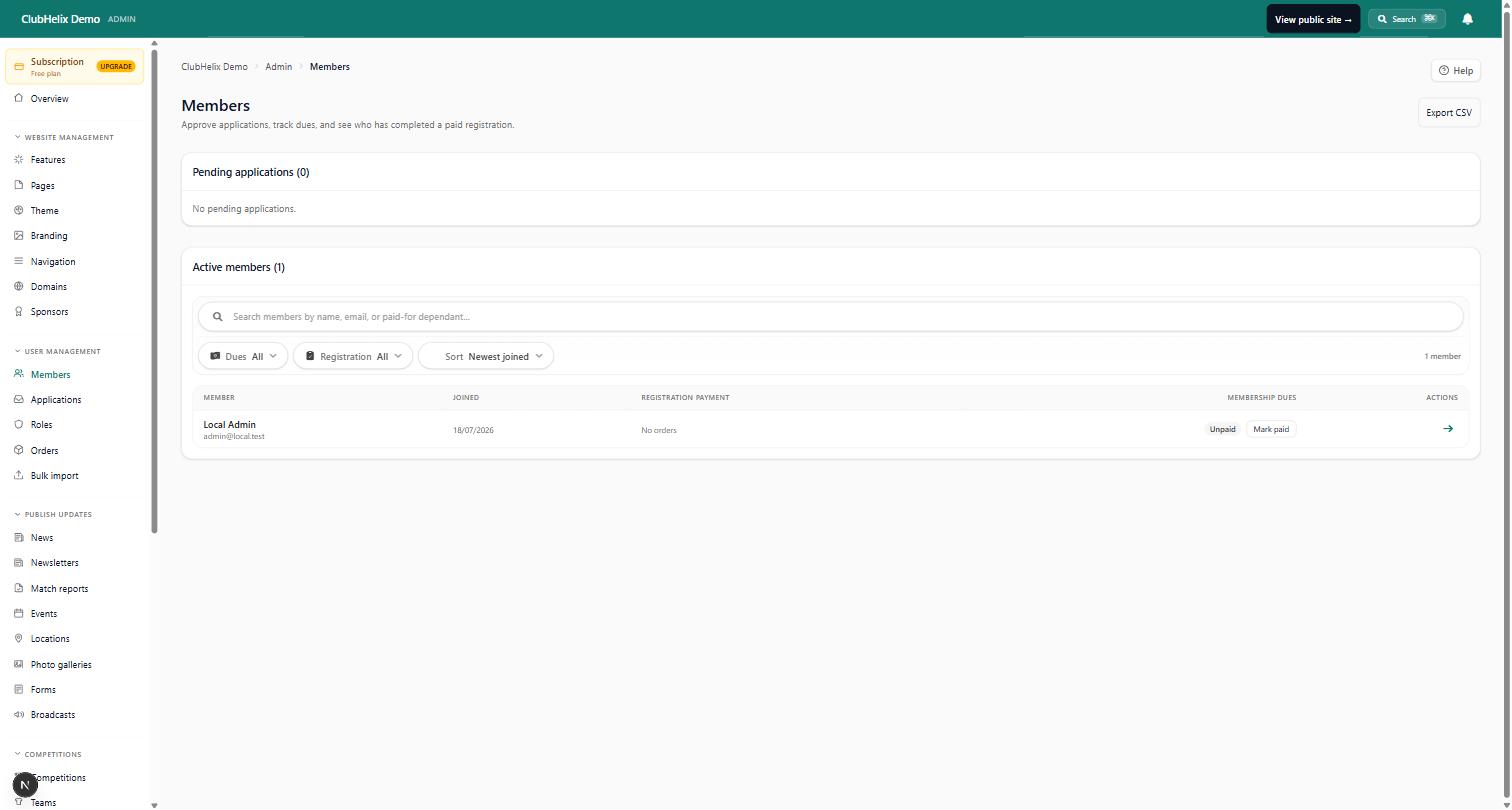
Whatever you choose, publish the whole schedule with what's included. Then make it real online: your registration system should present the right categories and prices so people select and pay in one pass.
Communicate value, not just price
Members don't experience a fee in isolation — they experience it against what they can see the club doing. The same $300 feels different at a club that shows its work:
- Break the number down once a year. "Your senior fee: $120 insurance and affiliation, $80 ground hire, $45 equipment and match costs, $35 umpires, $20 club operations." Suddenly $300 looks like what it is — cost recovery, run by volunteers.
- Name what fees made possible. New training balls, the resurfaced nets, the junior development coach. Members fund improvements more happily when improvements are visible.
- Anchor against the alternatives. A season of club sport, per week of activity, is usually dramatically cheaper than a term of private lessons in almost anything. It's fair to say so.

Raising fees without a revolt
Costs rise every year; the clubs that avoid fee drama raise fees the same way:
- Small and regular beats big and rare. A CPI-ish rise every year is barely noticed; a 30% correction after five frozen years feels like betrayal, even though members paid less overall. Put an annual fee review on the AGM-adjacent calendar permanently.
- Lead with the why. One short paragraph: insurance up X%, ground hire up Y%, here's what we cut first. Members are adults; they see prices rising everywhere.
- Protect the sensitive categories. If a rise is needed, put more of it on senior and social fees than on juniors and families, and say you did.
- Bundle a visible improvement when you can. A rise that arrives alongside "and this year the fee includes your match shirt" lands as a change, not a grab.
- Never spring it at registration. Announce at least a month before registrations open, so the price on the join page is old news by the time anyone pays.
A worked example
A suburban club expects 180 members: 60 seniors, 100 juniors, 20 social. Total budget $48,000; variable costs $80 per senior, $50 per junior.
- Fixed costs: $48,000 − (60×$80 + 100×$50) = $38,200 → $212 per member.
- Cost floors: senior ≈ $292, junior ≈ $262, social ≈ $212.
- Market check says local seniors pay $280–$360, juniors $180–$240 — the junior floor is above market.
- Resolution: price seniors at $340 and social at $120, letting seniors and social cross-subsidise juniors at $220 with a two-child family cap; the remaining gap (~$3,500) is assigned to sponsorship income — a named target, not a hope.
That's the whole method: floors, ceiling, deliberate cross-subsidy, and any gap given to a named income line before the budget is approved.
Frequently asked questions
How much does club membership usually cost?
It varies enormously by sport and region — junior memberships at community clubs commonly land in the low hundreds of dollars per season, with senior fees higher, and equipment-heavy or facility-heavy sports higher again. The averages matter less than your local market: check the published fees of nearby clubs in your sport and the cost of competing activities in your area, because that's the comparison your prospective members are actually making.
Should juniors pay less than seniors?
Almost always, for two reasons: juniors typically cost less to field (shorter games, smaller grounds, lower official costs), and junior fees are the most price-sensitive decision in club sport — a family weighing three activities per child. Most clubs land juniors at 50–70% of the senior fee, protected further by a family cap. Seniors and social members modestly cross-subsidising juniors is normal and healthy; today's cheap junior membership is tomorrow's senior player, volunteer, and committee member.
How often should we review membership fees?
Every year, as a standing item before registrations open — even if the answer is "no change". Annual review is what makes small, tolerable adjustments possible and prevents the multi-year freeze followed by a painful catch-up rise. Rebuild the cost floor with current insurance, hire and levy quotes, re-check two or three neighbouring clubs' published fees, and minute the decision with its reasoning.
Is it okay for membership fees to make a surplus?
Yes — a planned small surplus (roughly 5–10% of turnover) is good governance, not greed. It's the buffer that absorbs equipment failures, weather-lost fundraising and surprise levies without an emergency call on members. What fees generally shouldn't do is bankroll major capital works on their own; fund those from grants, sponsorship and targeted fundraising so the everyday cost of playing stays accessible.
Once the committee lands the number, ClubHelix does the rest: fee categories with online payment at registration, instalments, and every payment tracked against the member record with club billing tools. See pricing for plans.


