
What this guide answers
- Do sponsors really check where their website visitors come from?
Many small businesses rarely open their analytics until someone gives them a reason to.
- What should a sponsor's logo link to?
Ask the sponsor and write the answer into the agreement. The best target is usually the page they most want customers to see, such as a booking page, a quote request or a member offer, rather than the home page.
- Is it awkward to tell a sponsor their website has problems?
It is easier when you frame it as checking that the club's links work, which is true.
- Do we have to suggest Tideframe Digital to our sponsors?
No. Tideframe Digital is the studio that builds ClubHelix, which is why we mention it here, but passing its name on is entirely optional.
UK edition. This guide is written for volunteer-run clubs in the UK. Where rules differ — grants, tax, incorporation, safeguarding — follow the UK-specific pointers below or check with your national body.
A local business sponsors your club for two reasons. One is goodwill: they like the club, their kids play, and they want to put something back. The other is business: they hope the people who see their name at the ground and on your website will ring them, book with them or walk into their shop. Goodwill gets the first cheque signed. Business is what gets it renewed.
That second reason runs through a website, and usually through two of them. Your club website sends the visitor, and the sponsor's own website has to turn that visitor into a customer. If either end is weak, the sponsorship looks like a donation, and donations are the first thing a business trims when money is tight.
This guide covers both ends. First, the practical things a committee can do so sponsors get real, measurable visitors from the club. Then a short health check you can run with a sponsor on their own website, and what to suggest if it isn't up to the job.
Why sponsors stop renewing
Ask a business owner why they let a club sponsorship lapse and you rarely hear "we didn't like the club". You hear "we couldn't tell if it did anything". The sign on the fence is real, but nobody can count the phone calls it produced. The logo on the website is real too, but if it links to the sponsor's home page, or to nothing at all, the sponsor has no way to see who came from the club.
There is also a quieter problem. Plenty of small businesses, especially trades and local tourism operators, have a website that was built years ago and hasn't been touched since. It loads slowly on a phone, the phone number is an image you can't tap, and the enquiry form quietly stopped sending emails two owners ago. Every member who clicks the club's sponsor link and lands there is a lost customer, and the sponsor never finds out why the deal "didn't work".
Neither problem is the club's fault, but both are the club's opportunity. A club that can show a sponsor "here is how many visitors we sent you this season, and what they looked at" is having a very different renewal conversation from one that sends an invoice and hopes.
Make the sponsor page work for the sponsor
Start with what you control: how sponsors appear on your own site.
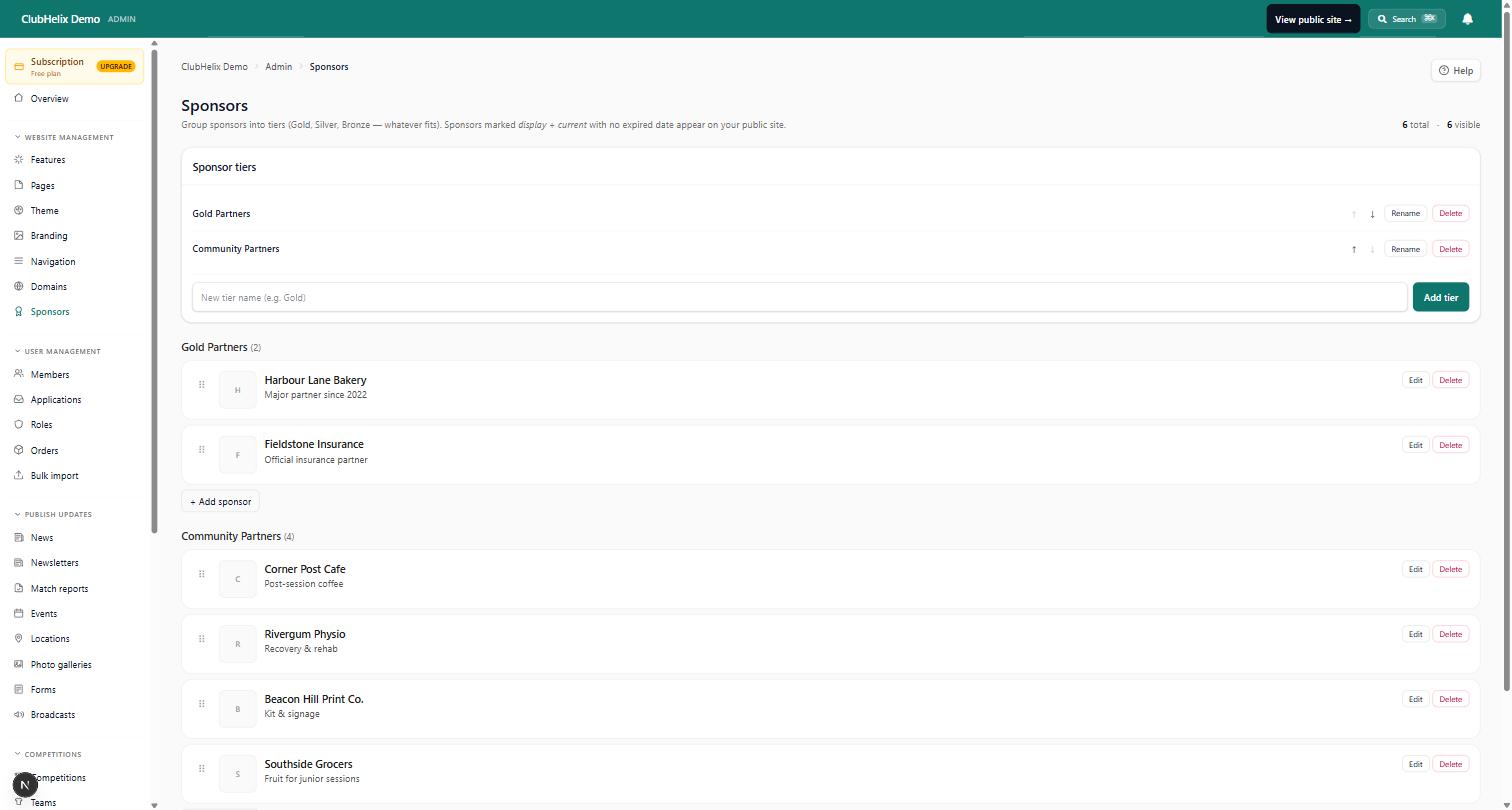
In ClubHelix, sponsors live in the Billing & sponsors area. You group them into tiers (Gold, Community, or whatever names suit your packages), upload their logos, and drop a sponsor section onto any page as a compact strip, a logo grid or a tier-grouped wall. Each sponsor has an expiry date, so a logo comes down by itself when a deal ends. That matters more than it sounds: a current sponsor notices when a former one still sits beside them for free.
A few habits make that sponsor wall far more valuable:
- Link every logo, and link it somewhere useful. A logo with no link is decoration. A logo that links to the sponsor's home page is better, but a logo that links to the page they actually want customers to see (the plumber's "book a job" page, the café's catering menu, the tour operator's family tours) is better still. Ask each sponsor which page they want, and write it in the agreement.
- Give your top tier more than a logo. A short paragraph about the business, what they offer members and how to contact them turns a logo into an introduction. A sponsor page with a few lines per Gold sponsor reads like a recommendation from the club, and that is what the sponsor is paying for.
- Put sponsors where people already look. The fixtures page, the registration page and the news page get far more visits than a dedicated "Our sponsors" page that nobody opens. A slim sponsor strip at the foot of the busiest pages earns more clicks than a grand wall on a quiet one.
- Keep the logo files sharp. Ask for a proper logo file at the start of the deal rather than lifting a blurry one from social media. A crisp logo is a small courtesy that sponsors do notice.
Our guide on how to display sponsors on your club website goes deeper on layout and tiering.
Send trackable visitors, not anonymous ones
The single most useful thing you can give a sponsor is proof. Proof comes from tagged links.
Most small-business websites run some form of analytics, even if the owner rarely opens it. Those tools all understand UTM tags: a few extra words on the end of a link that say where a visitor came from. If your club's links to a sponsor carry them, every visit from your website, newsletter or social posts shows up in the sponsor's own reports, labelled with your club's name.
A tagged link looks like this:
https://example-plumbing.com/book/?utm_source=riverside-fc&utm_medium=sponsor-wall&utm_campaign=2026-season
Three parts do the work:
utm_sourcenames your club, so the sponsor sees exactly where the visit came from.utm_mediumsays which kind of link it was: the sponsor wall, the newsletter, a news post.utm_campaignnames the season or the deal, so next year's numbers don't blur into this year's.
Use the same source name everywhere, change the medium for each placement, and you have given the sponsor a small report they can open whenever they like. Set it up once when the deal starts: paste the tagged link into the sponsor's entry, and use variations of it in every newsletter and news post that mentions them.
Two cautions. Don't tag links on your own site that point to your own pages; UTM tags are for links that leave your site. And keep the tags tidy and lower-case, because "Riverside-FC" and "riverside-fc" show up as two different sources in most reports.
Give sponsors a voice in your news and newsletters
Logos are passive. Members respond to stories.
Most sponsorship packages promise a few "mentions", and most clubs deliver them as a one-line thank-you at the bottom of a newsletter. You can do much better with almost no extra work:
- A welcome post when a deal starts. A short news post that introduces the business, says why they back the club and includes the tagged link. If the sponsor has a member offer (a discount, a free quote, a family pass), lead with it.
- A sponsor spot in each newsletter. One sponsor per issue, rotated through the season, with a sentence or two and a link. Broadcasts in ClubHelix go to members who have chosen to receive club news, so the spot reaches people who actually read the club's email, and every broadcast carries a one-click unsubscribe so the list stays healthy.
- Real moments, not filler. The sponsor who shouts the under-12s a sausage sizzle, the business whose apprentice plays in the seconds, the café that opens early on grand final morning. These are the posts members read and share.
Every mention is another tagged link, and every tagged link adds to the sponsor's report.
Close the season with a sponsor report
At the end of the season, send each sponsor a one-page summary before you send the renewal invoice. It doesn't need to be elaborate:
- what the agreement promised, and confirmation that each item was delivered;
- where their logo appeared, and for how long;
- the news posts and newsletters that featured them, with dates;
- a suggestion to check their own analytics for visits from your club's source name, with the exact name you used;
- any photos of their signage, players in their shirts, or the event they supported.
ClubHelix's sponsorship records help here: each agreement keeps a delivery checklist built from the package, so you can see what was promised and what was delivered without digging through old emails, and renewal reminders reach the committee 30 and 7 days before a deal ends. Our guide on keeping club sponsors happy covers the renewal conversation itself.
A five-minute website health check to run with a sponsor
Here is where a club can do a sponsor a real favour. Before you send them visitors, look at the page those visitors will land on, together. Frame it as making sure the club's links work, which is true, rather than as a critique of their business.
Open the sponsor's linked page on a phone, not a laptop, because that is where most members will click from. Then work through five questions:
- Does it load quickly on a phone? If you are still staring at a blank screen after a few seconds, so will members, and most of them will give up.
- Can you call or email in one tap? The phone number should be a tappable link, not an image or plain text you have to copy. The email address or contact form should be easy to find without scrolling through the whole page.
- Does the enquiry form actually work? With the sponsor's permission, send a test enquiry and ask them to confirm it arrived. Broken forms are far more common than owners realise, because a form that fails silently looks exactly like a quiet week.
- Is the business findable on Google Maps? Search the business name and suburb. A complete, current Google Business Profile with the right hours, phone number and website link often matters as much as the website for a local trade or a tourism business.
- Is the page current? Old prices, a closed location, last year's opening hours or a copyright date from long ago all tell a visitor the business might not be paying attention.
If everything passes, wonderful: you can send visitors with confidence. If it doesn't, you have just spotted something worth more to the sponsor than another logo placement, and you can tell them kindly.
When a sponsor's website needs more than a quick fix
Some issues are five-minute jobs: a tappable phone number, an updated opening-hours line, a Google Business Profile that needs claiming. Point the sponsor to them and you're done.
Others aren't. A site that is slow on every page, can't be edited by anyone at the business, or was built so long ago that nobody has the logins, usually needs rebuilding rather than patching. The sponsor may not know where to start, and the club's member who "does websites on the side" may not have the time.
This is where we can make a suggestion, as long as you know who is making it.
ClubHelix is designed, built and run by Tideframe Digital, a web studio. We are the same team. So when we suggest Tideframe Digital to your sponsors, please read it as a suggestion from us about our own studio, not as a neutral recommendation.
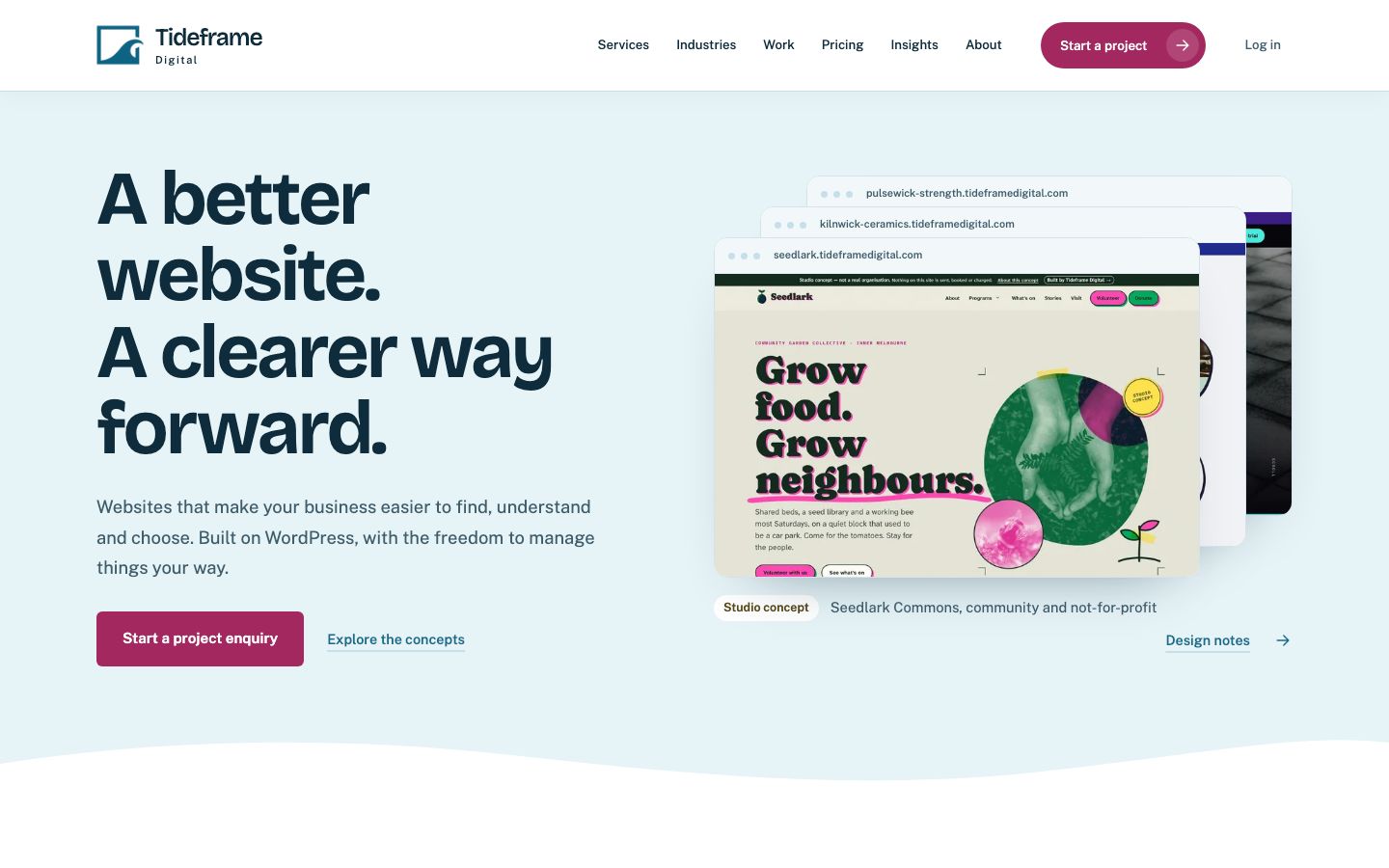
Tideframe Digital is a remote studio that works with businesses remotely and welcomes suitable international projects. Its first areas of focus were tour and activity operators and trades, which happen to be exactly the businesses that sponsor a lot of community clubs, and it takes on suitable work from any industry. The studio builds websites on an established open-source content management system that the business can edit itself, and every project follows the same plain sequence: plan the audience, pages and enquiry journey; build and review a private preview; test the agreed pages and forms before launch; then hand over records of accounts, renewals and editing guidance.
After launch, the business chooses how it owns the site: studio hosting and care, its own hosting with studio care for the work it wants help with, or a build-and-handover where it looks after everything itself.
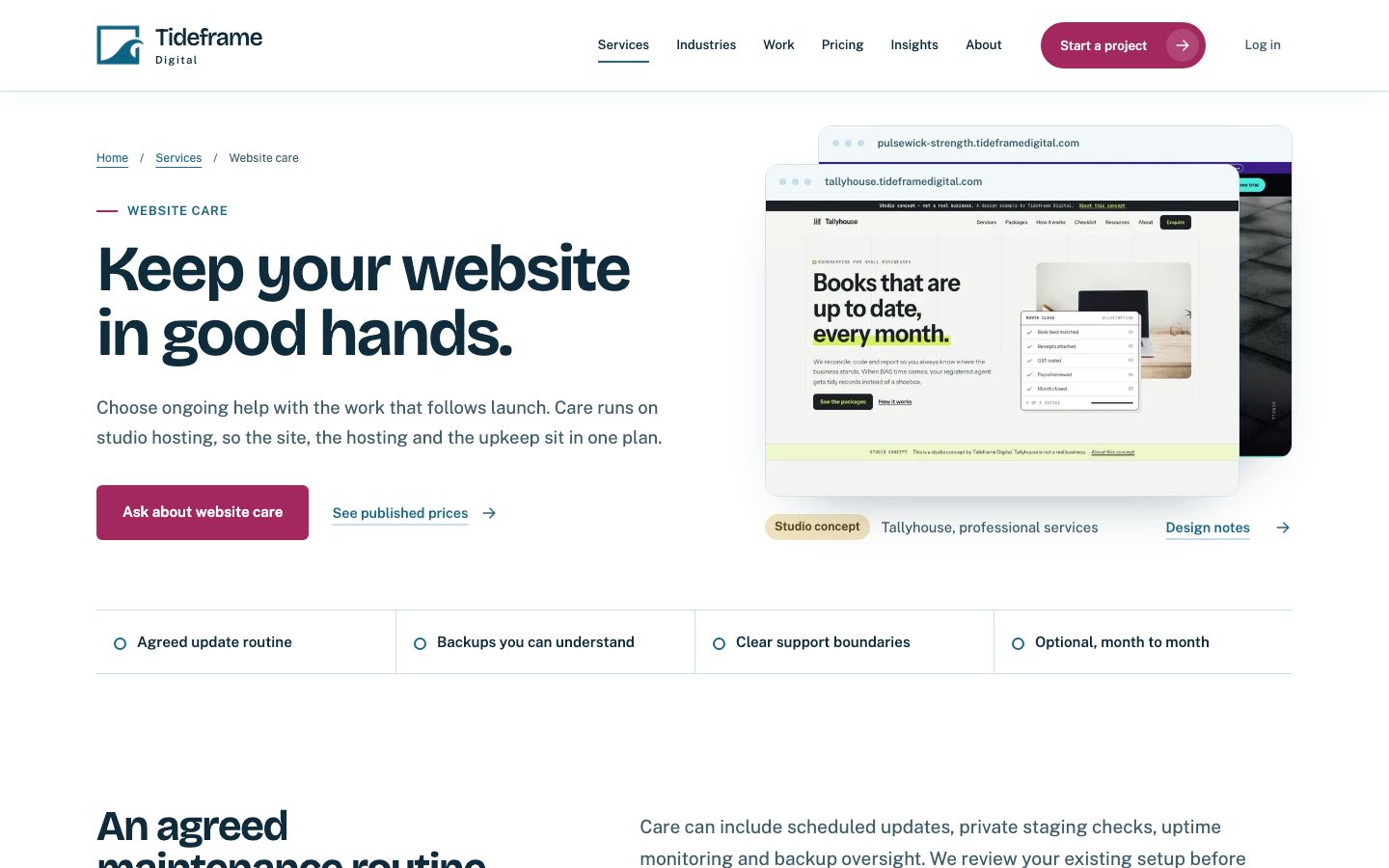
Tideframe Digital publishes its prices on its pricing page, so a sponsor can see the cost before making contact. You can read more about the studio and how it relates to ClubHelix on our Tideframe Digital page, or send the sponsor straight to tideframedigital.com.
Some ground rules we would ask any club to keep:
- No pressure. Passing on a name is a favour; selling to a sponsor is not the club's job. If the sponsor isn't interested, drop it.
- Mention alternatives. If a member or another local business builds websites, say so. The sponsor should choose what suits them.
- Keep it separate from the deal. A sponsor's choice of web designer must never affect their package, their tier or how the club treats them.
Putting it together
A sponsorship that can show its value renews. The steps are small: link every logo to a useful page, tag those links so the sponsor can see the visitors, give sponsors a real voice in your news and newsletters, and close the season with a short report. Add a friendly website health check, and you'll often find something that helps the sponsor more than any sign on the fence.
If you are still building the sponsor side of your club, see what ClubHelix includes on each plan, or start your free club site and set up your first sponsor tier this week.
Frequently asked questions
Do sponsors really check where their website visitors come from?
Many small businesses rarely open their analytics until someone gives them a reason to. A tagged link and an end-of-season note that names the exact source to look for gives them that reason, and makes the club's contribution visible in their own reports.
What should a sponsor's logo link to?
Ask the sponsor and write the answer into the agreement. The best target is usually the page they most want customers to see, such as a booking page, a quote request or a member offer, rather than the home page.
Is it awkward to tell a sponsor their website has problems?
It is easier when you frame it as checking that the club's links work, which is true. Look at the page together on a phone, mention what you noticed, and leave it with them. Most owners are glad to hear about a broken form before more customers hit it.
Do we have to suggest Tideframe Digital to our sponsors?
No. Tideframe Digital is the studio that builds ClubHelix, which is why we mention it here, but passing its name on is entirely optional. It has nothing to do with your ClubHelix plan, and it should never affect a sponsor's package or how the club treats them.
