
What this guide answers
- Does a small club have to register for GST?
Registration is mandatory once turnover reaches the threshold that applies to not-for-profit organisations, and optional below it.
- Are membership subscriptions subject to GST?
For a registered club, subscriptions are commonly taxable — the assumption that subs sit outside the system is one of the more frequent errors.
- How often do we lodge?
Most organisations of community-club size lodge quarterly, though the cycle depends on turnover and on what the tax office has assigned to your club.
- What happens if we get a quarter wrong?
Errors can generally be corrected, and correcting one promptly is treated very differently from leaving it.
- Can we just give our accountant a bank statement?
You can, and you will pay for the hours it takes them to categorise it.
This is general information, not tax advice. Every club's situation depends on its structure, its turnover and its activities. Nothing here is a substitute for advice from a registered tax agent or accountant who has looked at your club's actual circumstances, and nothing here should be relied on when lodging.
Ask a new club treasurer what worries them most and it is rarely the budget. It is the quarterly activity statement — an obligation they inherited with the role, involving a system nobody explained, where the consequences of getting it wrong feel disproportionate to the size of the club.
This guide is an orientation. It will not tell you what to lodge. It will tell you what the moving parts are, so that the conversation with your accountant is a short one and the records you keep during the year are the ones you will need.
The two questions that decide everything
Is the club registered for GST? Registration is mandatory once annual turnover reaches the registration threshold, which is higher for not-for-profit organisations than for businesses. Below the threshold, registration is optional — and it is a genuine decision, not an obvious one, because a registered club charges GST on its sales but can also claim credits on its purchases.
What is the club's turnover? This is the number that determines the answer to the first question, and it is worth calculating carefully. It is not the same as profit, and for a club with a busy canteen, a shop and a function room, it can be far higher than the committee assumes.
Get those two answered by someone qualified, in writing, and revisit it whenever the club's activities change materially — a new bar licence, a big new event, a facility hire business.
If the club is registered
A registered club generally:
- charges GST on its taxable sales — typically merchandise, bar and canteen sales, event tickets, facility hire, and often membership subscriptions;
- claims GST credits on its purchases, where it holds a valid tax invoice;
- lodges a business activity statement — usually quarterly for organisations of this size — reporting sales, purchases and the net amount owed or refundable;
- keeps records substantiating every figure, for the retention period the tax office requires.
The categories that most often surprise committees:
Membership subscriptions are commonly taxable for a registered club. Many treasurers assume subs are outside the system because they are "not sales". They usually are sales.
Donations given freely, with nothing supplied in return, are typically not subject to GST — but the moment the donor receives something of value (a raffle ticket, a dinner seat, naming rights), the picture changes.
Sponsorship almost always involves the club supplying something — signage, naming, hospitality — and is generally treated as a taxable supply rather than a gift.
Grants vary considerably depending on what the granting body receives in return. Do not assume either way.
Raffles and fundraising events have their own treatment and their own state-level rules on top of the tax question.
None of those are decisions for a committee to make by reasoning from first principles. They are exactly what you take to your accountant once, and then apply consistently.
What a good BAS quarter looks like
The clubs that find the activity statement painless share one habit: they capture the tax at the moment of sale, not at the end of the quarter.
That sounds obvious and it is where most of the pain comes from. If a merchandise sale is recorded only as "$45 received", the treasurer at quarter's end has to work backwards — was that item taxable, at what rate, was postage included? Multiply by four hundred transactions and a fortnight disappears.
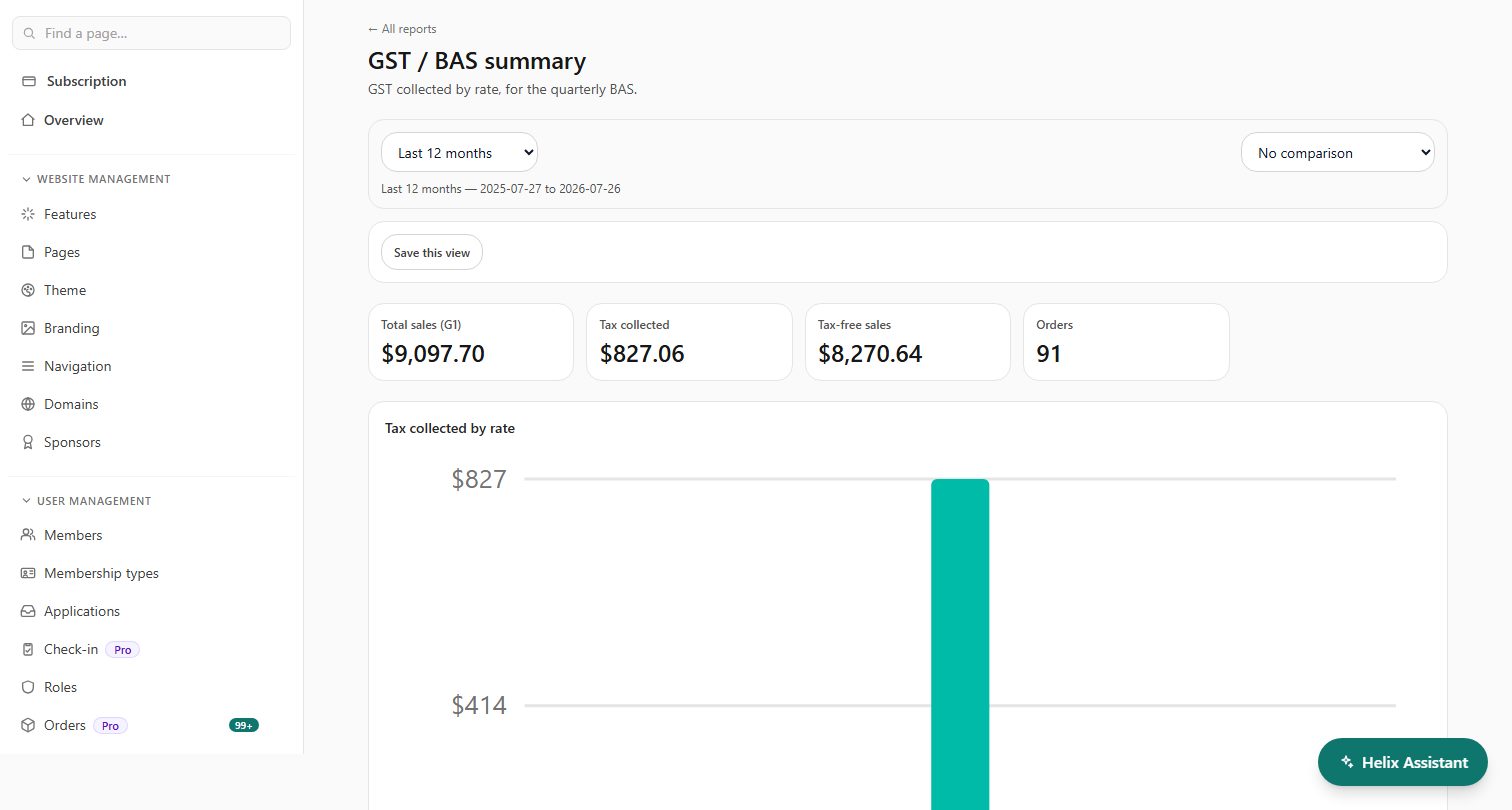
If instead each sale records the tax component against it at the time, the quarter's figure is a sum, not a reconstruction. Sales systems that snapshot the tax onto the order — rather than recalculating it later from a rate that may since have changed — give you a figure that reconciles to the cent and can be evidenced line by line if it is ever queried.
The records to keep during the year
Whatever software you use, these are the records that make a quarter straightforward:
- Every sale with its tax component, dated by when payment was received.
- Tax invoices for purchases you intend to claim credits on. No invoice, no credit — this is the most common cause of a club overstating its claim.
- A clear split between taxable and non-taxable income. Donations separated from ticket sales; a genuine gift separated from sponsorship.
- Refunds recorded against the original sale, so the period they belong to is unambiguous.
- Bank reconciliation, monthly rather than quarterly. Three reconciled months make a quarter; three unreconciled months make an ordeal.
Keep them for the full retention period the tax office specifies — longer than most committees expect, and longer than most volunteer laptops survive. This is a strong argument for the club's records living somewhere the club owns rather than on a personal device.
Cash basis and why club reporting uses it
Most community clubs of this size account on a cash basis: income counts when the money arrives, not when the invoice is raised. It is simpler, it matches what is actually in the account, and it is what a committee intuitively understands.
It also means your reporting has to date things by payment date. A report that dates a registration fee to when the form was submitted rather than when the card cleared will not reconcile to the bank, and reconciliation is the whole game. When you produce income reports for the club, check which date the report is using — it should say.

Working with your accountant
You will get better value from a smaller amount of professional time if you arrive with:
- A statement of the club's structure and registrations — incorporation status, tax registrations, any charity or deductible gift recipient endorsement.
- Turnover for the last two years, so the threshold question can be answered rather than estimated.
- A list of income sources with a plain description of what the payer receives in return. This is the fact pattern that determines treatment for most of the awkward categories.
- A sample quarter of transactions with the tax component visible.
Ask for the answers in writing, and file that document where the next treasurer will find it. Half the cost of tax advice in community clubs is paying for the same advice again after a handover.
Where the software fits
Software does not decide your obligations, and any tool that implies otherwise should be treated with suspicion. What it can do is make the figures reliable:
- Record the tax on each sale at the time of sale, so the quarter's total is evidenced.
- Report total sales and tax collected for any period you choose, on the quarters your financial year actually uses.
- Export in a shape accounting software will import without hand-editing — the column row first, currency as decimal dollars.
- Keep the underlying transactions available, so a query can be answered by producing the line rather than reconstructing it.
If your club runs its money through one system, those become reports you open rather than spreadsheets you build. What you lodge is still a decision for your accountant. What you can prove is what changes.
Frequently asked questions
Does a small club have to register for GST?
Registration is mandatory once turnover reaches the threshold that applies to not-for-profit organisations, and optional below it. Whether voluntary registration is worthwhile depends on how much GST the club pays on its purchases relative to what it would charge on sales. Your accountant can work that out in about twenty minutes with your figures.
Are membership subscriptions subject to GST?
For a registered club, subscriptions are commonly taxable — the assumption that subs sit outside the system is one of the more frequent errors. Get it confirmed for your club's specific circumstances.
How often do we lodge?
Most organisations of community-club size lodge quarterly, though the cycle depends on turnover and on what the tax office has assigned to your club. Check the club's own registration details rather than assuming.
What happens if we get a quarter wrong?
Errors can generally be corrected, and correcting one promptly is treated very differently from leaving it. Talk to your accountant as soon as you spot it rather than trying to balance it out in the next quarter.
Can we just give our accountant a bank statement?
You can, and you will pay for the hours it takes them to categorise it. A club that provides a transaction register with sources and tax components already recorded typically pays substantially less — the reporting habit pays for itself in professional fees alone.


