
What this guide answers
- Can our club use images from Google Images?
No — a search engine finds images but doesn't give you any right to use them, and most results are copyrighted.
- What happens if a club uses a copyrighted photo by accident?
Rights holders and image-tracking services routinely send takedown requests and invoices, and community groups aren't exempt.
- Do we need permission to publish photos of our own members?
Best practice is yes — collect photo consent at registration and honour opt-outs, and take particular care with photos of children, where your governing body's safeguarding and photography policies apply on top of…
- Do free stock photos require attribution?
Under the standard Unsplash, Pexels and Pixabay licences, generally no — though crediting the photographer is good etiquette.
Ireland edition. This guide is written for volunteer-run clubs in Ireland. Where rules differ — grants, tax, incorporation, safeguarding — follow the Ireland-specific pointers below or check with your national body.
Every club website needs images. A homepage without photos looks abandoned; a news post without a picture gets half the attention. So the volunteer building the site does what everyone does — searches the web for "netball action shot", right-clicks something good, and pastes it in. It feels harmless. It's also, in most cases, copyright infringement, and community clubs are not too small to get caught.
The good news is that there's a genuinely enormous supply of high-quality images you can use for free, legally, without asking anyone — you just need to know where to look and what the licences actually say. This guide covers why copyright matters even for a volunteer-run club, the free sources worth bookmarking, why your own photos beat all of them, consent for photos of members and children, attribution etiquette, and the practical business of sizing images so your pages load fast.
Why copyright matters for volunteer-run clubs
Copyright is automatic: the moment someone takes a photo, they own it, and using it without permission is infringement — regardless of whether the image had a watermark, whether you credited them, whether you found it on a search engine, or whether your club makes any money. Three habits in particular get community groups into trouble:
-
Using search engine image results. A search engine finds images; it doesn't license them. Almost everything in those results is owned by someone, and "it was on Google" has never been a defence.
-
Borrowing from other clubs, leagues or news sites. Another club's photos belong to that club or its photographer. Professional match photos, newspaper images and agency shots are the riskiest of all — they're often tracked.
-
Assuming small means invisible. Image-tracking services crawl the web automatically and send infringement letters with invoices attached, and volunteer-run community groups receive them just like businesses do. A few hundred euro per image, multiplied across a website that's been quietly accumulating borrowed photos for years, is a nasty surprise for a club treasurer.
The fix isn't to have no images — it's to only use images you have the right to use: photos your club took, photos you've been given permission to use, or photos published under a genuinely free licence.
For the legal detail, the Intellectual Property Office of Ireland publishes plain-English copyright guidance at ipoi.gov.ie, including how it applies to photographs.
This is general information, not legal advice — check the current guidance with the official body linked above if your club has a specific copyright question or has received an infringement claim.
Where to get free images for a website (legally)
A handful of well-known libraries publish photos under free licences that permit exactly what a club needs — free use, including commercial use, without payment or mandatory attribution:
| Source | What you'll find | Watch out for |
|---|---|---|
| Unsplash | Large, high-quality library; strong on sport, landscapes and community life | Its separate paid tier — check you're downloading a standard free-licence photo |
| Pexels | Big library of photos and videos, good action and lifestyle shots | Occasional sponsored/partner content alongside free results |
| Pixabay | Photos plus illustrations and vector graphics | Same — confirm the individual image's licence before use |
Their licences generally permit you to download, use, crop and edit images for your club website, posters, newsletters and social media without paying or crediting anyone. But — and this is the habit worth building — check the licence on the specific photo you're downloading, every time. These sites evolve, several mix a paid "plus" or premium tier into search results, and a photo's page tells you exactly which licence applies. The thirty-second check is what keeps "free" actually free.
Two cautions that apply across all stock imagery: identifiable people in stock photos are fine for generic decoration but shouldn't be presented as if they're your members, and images containing visible brands, logos or artworks can carry their own complications — prefer clean, generic shots.
Your own photos are still the best option
Stock photos are a fallback, not a strategy. Nobody joins a club because of a beautiful photo of anonymous strangers; they join because the photos show real people, at your grounds, in your colours, having a great time.
A season's worth of genuine club photography — match action, the annual dinner dance, the clubhouse crew, the under-9s in jerseys two sizes too big — is worth more than any stock library, and it's free in every sense.
You don't need a professional. A parent with a decent phone, briefed on a few basics, can cover a club's needs — our guide on how to take good club photos covers the practical technique. Ask around: many clubs discover they already have a keen amateur photographer in the ranks. If you do use a volunteer or hired photographer, agree in writing (an email is fine) that the club can use the photos on its website and social media — remember, the photographer owns copyright by default, even at your own event.
Consent: the other half of using member photos
Owning the copyright isn't the whole story — the people in your photos matter too, especially children. Before publishing member photos:
-
Collect photo consent at registration, not per-photo — and treat it as a legal requirement rather than good manners. Under data-protection law a recognisable photo is personal data, so your consent wording has to be specific, freely given and as easy to withdraw as it was to give, and you need a record of who consented and when. A tick-box on the membership form does the job provided it isn't bundled with the terms and isn't pre-ticked.
-
Honour the opt-outs operationally. The photographer and whoever publishes need to know which faces can't appear. For juniors, many clubs also avoid pairing a child's full name with their photo.
-
Take extra care with children. Photos of minors carry safeguarding obligations well beyond copyright. Your national governing body will publish a photography policy — read it before your first match day, because most of them go further than the law does, restricting long-lens photography at junior fixtures, requiring photographers to be identifiable, and forbidding the pairing of a child's full name with their image. Where consent for a child is concerned, it is the parent or guardian who gives it, and an older child's own view should be taken into account too.

Attribution etiquette
Most free licences don't require a credit — but giving one anyway is good manners and good practice. A simple "Photo: [photographer's name] via Unsplash" in a caption or a site credits page costs you nothing and supports the photographers who make free libraries possible. For your own club photographers, credit is more than etiquette: a "photos by Jan from the under-12s" line is exactly the kind of volunteer recognition that keeps Jan shooting next season. Where a licence does require attribution — some Creative Commons licences do — the credit isn't optional, so follow the format the licence specifies.
Sizing and compressing images for the web
The most common club-website problem isn't a missing image — it's a 8 MB phone photo dropped straight onto the homepage, making the page crawl on mobile data. A few rules of thumb:
- Resize before you upload. Full-width hero banners rarely need more than ~1600–1920 px wide; images in the body of a page or news post are fine at ~800–1200 px. A phone photo's original 4000+ px is wasted on the web.
- Compress. Export as JPEG (or let your platform convert to modern formats) at 70–85% quality — visually identical, a fraction of the size. As a rule of thumb, aim under ~300 KB for most images and under ~500 KB for a hero.
- Crop with purpose. Wide, shallow crops suit banners; squarer crops suit cards and news thumbnails. Keep the subject away from the very edges so nothing important is lost on small screens.
- Write alt text. A short description of each image ("under-14s celebrating a goal at Memorial Park") helps vision-impaired visitors and search engines alike.
A good website platform does the heavy lifting here — ClubHelix's drag-and-drop page editor resizes, compresses and serves uploaded images automatically, so a volunteer can drop in photos straight from their phone without thinking about file sizes.
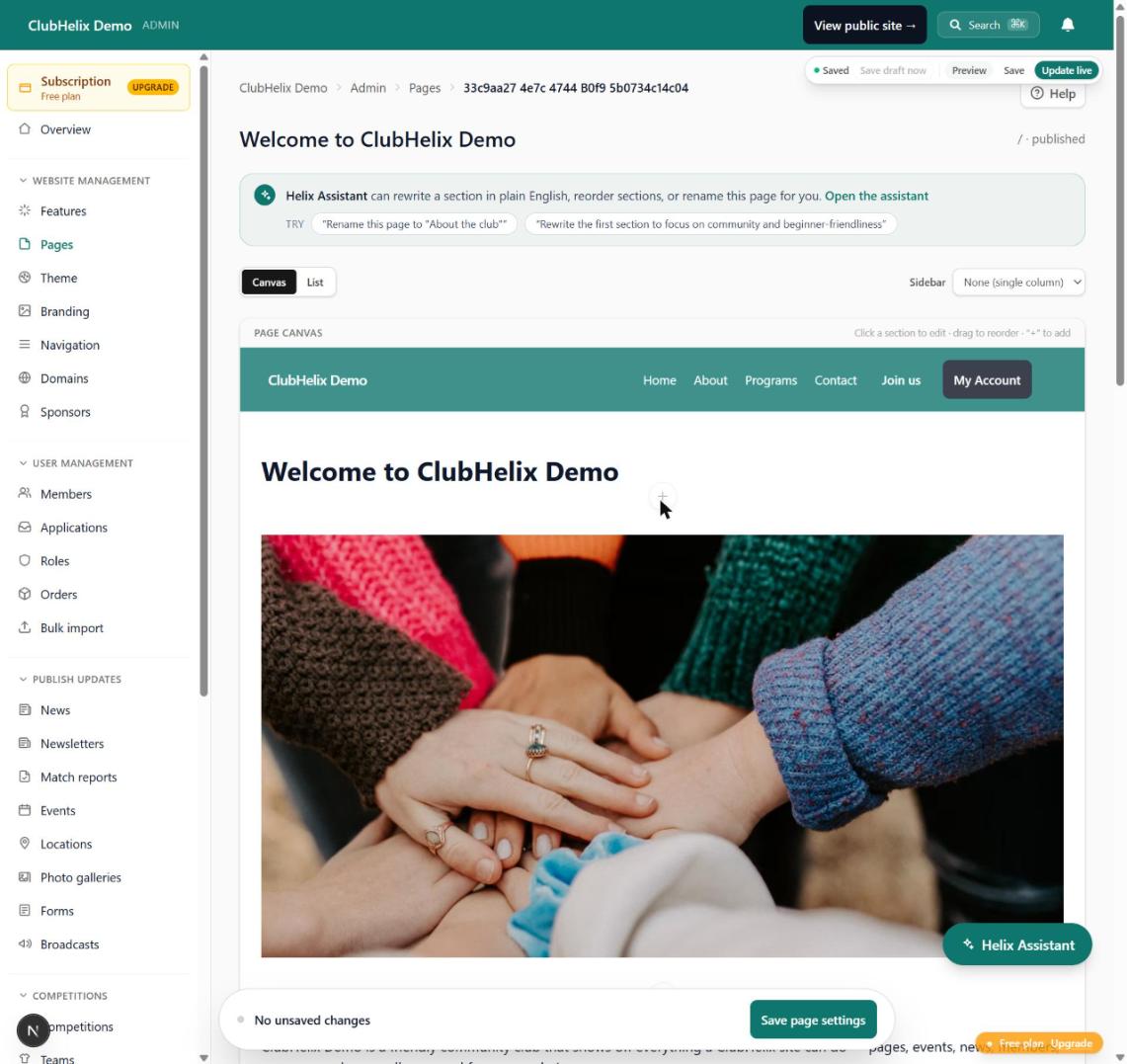
If your club website needs a refresh along with its photo library, ClubHelix gives you a professional club site with themes, a visual page editor, and a news section built for photo-rich match reports — with image handling done for you and a free tier to start on. Create your club or browse the templates to see it in action.
Frequently asked questions
Can our club use images from Google Images?
No — a search engine finds images but doesn't give you any right to use them, and most results are copyrighted. Use a free-licence library like Unsplash, Pexels or Pixabay, or better still your own club photos.
What happens if a club uses a copyrighted photo by accident?
Rights holders and image-tracking services routinely send takedown requests and invoices, and community groups aren't exempt. If it happens, remove the image promptly, keep a record of when it went up and came down, and seek guidance before paying anything — some demand letters materially overstate what's owed.
The Intellectual Property Office of Ireland's copyright guidance covers this situation.
Do we need permission to publish photos of our own members?
Best practice is yes — collect photo consent at registration and honour opt-outs, and take particular care with photos of children, where your governing body's safeguarding and photography policies apply on top of copyright.
Do free stock photos require attribution?
Under the standard Unsplash, Pexels and Pixabay licences, generally no — though crediting the photographer is good etiquette. Always check the licence on the specific photo, as some sites mix paid tiers and some Creative Commons licences do require attribution.
