
What this guide answers
- Should we charge a no-show fee?
Only after the gentler rungs are in place, and only if you are confident a volunteer will actually apply it.
- How long should our cancellation notice window be?
Match it to how quickly the slot could realistically be taken by somebody else.
- What counts as a no-show rather than a late cancellation?
A late cancellation is a booking the member told you about after the window closed.
- Do we need to treat peak and off-peak differently?
Yes, and it is the change that makes a policy feel fair. A no-show at a quiet hour costs the club almost nothing, so a penalty there is punishment without a victim.
- How do we handle a member who says they had a genuine reason?
Write the exception into the policy before you need it, name who decides — the committee or a named officer, never whoever happens to be at the desk — and record each decision so the same situation gets the same answer…
Canada edition. This guide is written for volunteer-run clubs in Canada. Where rules differ — grants, tax, incorporation, safeguarding — follow the Canada-specific pointers below or check with your national body.
Tuesday, quarter past seven, the best two hours of the club's week. Court 2 is empty and has been since seven. It is booked — the grid says so, and three members were told this afternoon that there was nothing free. Two of them went home. One of them is standing at the gate watching an empty court, and by Thursday four people will have heard about it.
Nobody did anything wrong here, exactly. Somebody booked a court on Sunday, something came up, and they forgot. That is the whole crime. But a held court is not a small thing: at peak times it is the club's scarcest asset, it is the thing members pay their subscription for, and it is often the thing casual hire income depends on. A no-show turns that asset into nothing at all, and unlike almost every other club problem it is completely invisible in the numbers unless you go looking.
This guide is about what to do next, and the honest answer is: less than you think, in a particular order. Most clubs jump straight to a penalty, which is the firmest tool available, the hardest to enforce, and the one most likely to end in an argument with a life member. If you are still setting the courts up, start with how to set up online court booking and come back here once bookings are running. What follows is the deeper version: measuring, the notice window, the ladder of responses, money, exceptions, and how to write it all down in words people will actually follow.
Why no-shows cost more than they look
Three separate costs, and clubs usually only see the first one.
- The lost slot. At peak time, a court held and not used is a court nobody else could book. If the slot is paid, that is income the club did not get. If it is a member benefit, it is the benefit the club promised and failed to deliver.
- The trust cost. This is the expensive one. Members who are turned away and then see an empty court stop believing the grid. Once they stop believing it, they stop trying to book, they start ringing the volunteer again, and the club slides back towards the diary it just escaped.
- The volunteer cost. Every no-show generates a conversation. Someone has to hear the complaint, look up who had the court, decide whether to say anything, and then not say anything because it is awkward. That is the actual reason clubs let it drift.
Off-peak, a no-show costs close to nothing — an empty court at eleven on a Wednesday morning was probably going to be empty anyway. That asymmetry is the most useful fact in this guide, and it should shape everything you do: a no-show policy that treats peak and off-peak the same is a policy that punishes people for nothing.
Measure it before you police it
Committees regularly build a whole penalty regime on top of one loud incident. Spend a month counting first, because the count usually changes the decision.
You do not need anything clever. For four weeks, pick your busiest sessions and have whoever is already at the club note three things: the slot, whether anyone was on the court, and whether it was booked. A page on a clipboard is enough.
What you are looking for:
| What you find | What it means | What to do |
|---|---|---|
| A handful across the month, spread thin | Ordinary human forgetfulness | Reminders and easy cancellation; nothing else |
| Clustered in one or two peak sessions | A scarcity problem, not a behaviour problem | Fix access at peak — caps, windows, a waiting list |
| The same few names repeatedly | A small-numbers problem | A quiet word beats a club-wide policy every time |
| Lots of late cancellations, few no-shows | The system is working — people are telling you | Make the freed slot reusable, do not punish the cancellers |
| Bookings that were never going to be used | Speculative booking, usually caused by a long window | Shorten the advance window before you reach for a penalty |
That last row catches more clubs than they expect. If members can book two weeks out and it costs nothing to hold a slot, some will book several "just in case". The behaviour is rational and the fix is structural, not disciplinary.
Keep counting after you change something. A policy nobody measures is a policy nobody can tell is working.
The notice window: how long is fair
The notice window is the point before a slot after which a cancellation counts as late. It is the single most contested number in the policy, and the right answer depends entirely on how quickly somebody else could realistically take the slot.
| Facility | Typical window | Why |
|---|---|---|
| Courts, members booking peak | 2 to 12 hours | Another member can pick up an evening court the same day; overnight notice is plenty |
| Courts, casual or paid hire | 12 to 24 hours | Money has usually changed hands, and the club needs time to re-sell the slot |
| Pitches and ovals | 24 to 72 hours | A team cannot be assembled at short notice, and grounds prep may already be done |
| Clubrooms and function spaces | 7 days or more | Staffing, catering and set-up are committed well in advance |
| Coaching and paid group sessions | 24 hours | The coach's time is the cost, and it cannot be re-sold on the day |
Two principles decide the number for your club.
The window should match the re-booking reality, not the inconvenience. If a freed evening court reliably gets taken within an hour, a 24-hour window is punishing people for a problem that no longer exists. If your grid is quiet and nobody is watching it, a longer window is fair because the slot genuinely is lost.
The window has to be one number, published, and the same for everyone. The moment it becomes "whatever seems reasonable", every enforcement is a negotiation, and volunteers will avoid having it. Two hours applied consistently beats twenty-four hours applied occasionally.
A useful compromise for a busy club: a short window for members at off-peak times, a longer one at peak and for anything paid. Two rules is fine. Five is a policy nobody can remember.
The ladder of responses
Work down this list in order. Each rung is cheaper, kinder and more effective than the one below it, and most clubs never need to reach the bottom.
1. Remind people before the slot
A large share of no-shows are forgetfulness, and forgetfulness responds to a nudge. A short message the day before, or a few hours ahead, naming the court and the time and how to cancel, removes the cause rather than punishing the effect. Nothing else on this ladder delivers as much for as little.
Keep the reminder useful: the time, the court, and a way to cancel in one tap. A reminder that does not make cancelling easy is half a reminder.
2. Make cancelling easier than not cancelling
If a member has to ring somebody to cancel, they will not cancel. They will feel bad about it, decide it is too awkward, and let the slot go. Self-service cancellation removes the awkwardness entirely, which is why it is the single biggest lever on this list — in ClubHelix, members cancel their own bookings and the slot goes straight back on the grid.
Then say so, repeatedly. "You can cancel yourself, any time, no explanation needed" belongs on the booking page, in the reminder, and in the newsletter, because plenty of members assume a cancellation is a favour they are asking for.
3. Give the freed slot somewhere to go
A cancellation only helps if somebody else uses the slot. Two low-effort ways to close that loop: keep a short waiting list for the sessions that actually fill — a simple list somebody checks — and make freed peak slots visible, with a message to the people most likely to want them. Members who see that cancelling gets a court to a club-mate rather than into a void cancel more readily.
4. Count strikes, and tell people you are counting
Once the gentle rungs are in place, the remaining no-shows are a small group. A strike system — three no-shows in a season starts a conversation — is mostly a communication tool. Its value is not the punishment at the end; it is that people know a record exists.
If you run one, decide four things in advance and write them down: what counts as a strike (a no-show, or a cancellation inside the window, or both), the period strikes are counted over, who keeps the count, and what happens at each step. Also decide what the first step is, and make it a friendly message rather than a sanction — a note saying "we noticed, is everything alright, here is how to cancel" resolves most of them, because a fair number of repeat no-shows turn out to be one person with a recurring booking they no longer need.
5. Pause booking privileges
For the rare member who ignores everything above, pausing the ability to book for a couple of weeks is proportionate, reversible and — importantly — costs nobody any money, which makes it far easier for a volunteer to apply than a fine. State it as a defined step with a defined end, never as an open-ended ban, and have it applied by the committee rather than by whoever is at the desk.
6. Money, last
A fee is the firmest rung and it earns its place last, because charging money after the fact is where enforcement actually breaks down. Somebody has to send the message, chase the payment, and hear the objection — and it is usually a volunteer, to a person they will see on Saturday. Plenty of clubs adopt a no-show fee and quietly never apply it, which is worse than not having one, because it teaches everyone that the policy is decorative.
If you do want money in the mix, the next section is the part that matters.
Charging at booking, or a fee afterwards
These two look similar on paper and are completely different in practice.
Taking payment when the booking is made means the slot is already paid for before anyone fails to turn up. There is nothing to chase, nothing to invoice and nothing to argue about; if the booker cancels in time, the club refunds them, and if they do not, the club keeps what it already holds. The awkward conversation never happens, because the decision was made at booking time by the person booking.
A no-show fee afterwards means the club has to pursue someone for money they have not spent, for a court they did not use, over a rule they may not remember agreeing to. Every one of those is an argument waiting to happen, and every one of them lands on a volunteer.
Paying at the time of booking is dramatically easier to run, and it is quietly the most effective anti-no-show measure there is — a slot somebody has already paid for gets used or gets cancelled properly. In ClubHelix, a booking can be paid by card at the time of booking or paid at the venue, so a club can start with venue payment while it works out the rules and move to card payment for the peak sessions where no-shows actually hurt.
Two things to settle before you switch anything on:
- What happens to money on a late cancellation. Refund in full, refund minus a stated amount, or no refund inside the window. Pick one, publish it, apply it the same way every time.
- Whether members pay at all. Many clubs charge casuals at booking and let members book free. That is a perfectly good answer — it just means your no-show tool for members is the rest of the ladder, not money.
Credits instead of cash
There is a middle option that clubs consistently underuse. Instead of taking money off somebody for a late cancellation, hold the value as a credit towards a future booking.
It works because it keeps the money inside the club and out of the argument. The member has not lost anything permanently, so the conversation is short; the club has not lost the income; and the credit is a reason to come back. For a community club where the person on the other end of the policy is a volunteer's neighbour, that difference is worth a great deal.
Credits suit late cancellations, weather calls and genuine mishaps. Keep cash penalties, if you use them at all, for repeated no-shows with no contact — the small group where nothing else has worked.
Peak and off-peak deserve different rules

Write the policy so it bites only where the scarcity is.
- Peak sessions — the two or three hours a week your grid genuinely fills — get the longer notice window, the reminders, the waiting list and any money.
- Off-peak gets a short window or none at all, and no penalty. Nobody was waiting.
- Say which is which, by name and time, on the booking page. "Peak is weekdays from five, and Saturday morning" is a sentence anybody can follow.
The same logic covers seasonal swings. A club whose courts are unusable in the wettest month should not be running a penalty regime through it.
Guests, juniors and coaching bookings
Three groups need naming explicitly, or the policy will be applied unevenly.
Guests and casual hirers have no ongoing relationship with the club and no membership to pause, which is exactly why paying at the time of booking suits them best. If you take money up front from one group only, make it this one.
Juniors are booked by parents, cancelled by parents, and any consequence lands on the parent. Keep the policy the same but route every message to the responsible adult, and think hard before applying a fee to a family — a junior member is worth many seasons of subscriptions, and a bad-tempered exchange about a missed court is a poor trade.
Coaching and regular block bookings are the biggest hidden source of empty courts, because a standing weekly booking outlives the reason it was made. Review recurring bookings every term, ask the holder to confirm, and release anything unconfirmed. One unconfirmed weekly block returned to the grid is worth more than a season of chasing individual no-shows.
The genuine-reason exception, and who decides
Every policy needs a release valve, or it will eventually be applied to somebody who was in hospital, and the club will look heartless for the sake of a court.
Write it as a short, deliberate clause:
Where a member could not cancel in time for reasons outside their control — illness, a family emergency, a road closure, unsafe weather — the committee may waive any consequence under this policy. Requests are made to the secretary within fourteen days and the decision is recorded.
Three design notes. Name the decision-maker, and make it the committee or a named officer, not "whoever is on duty" — otherwise the answer depends on who you ask, which is the fastest way to lose trust in the whole policy. Do not demand proof. Asking a member for a medical certificate over a court booking is out of proportion, and it will cost you more goodwill than the slot was ever worth. Record the decision in a line somewhere the committee can see, so the same situation gets the same answer next time and so a pattern of requests from one person is visible without anyone having to remember.
Weather deserves its own line. Decide in advance who calls an unplayable surface, and make it a club decision rather than a member judgement — then nobody is deciding whether their own cancellation counts.
Writing it in plain words
The policy should fit on half a page and survive being read on a phone at the gate. Here is the shape:
- What we are asking. "If you cannot use your booking, cancel it so somebody else can."
- How to cancel. One sentence, one link.
- The window. One number, and what peak means.
- What happens if you cancel in time. Nothing, ever. Say it plainly — this is the sentence that makes people cancel.
- What happens if you cancel late. One outcome.
- What happens if you do not show up at all. One outcome, and the step before it.
- The exception. Who to contact, and within what time.
- When it was last reviewed. A date.
Avoid the words that make volunteers reluctant to apply it: penalty, breach, offence, sanction. "If you do not cancel, the slot stays paid for" says the same thing and starts no fights.
Publish it in three places — on the booking page itself where it is read at the moment of booking, in the reminder message, and in the club's own terms for facility hire. A policy that lives only in a document nobody opens is a policy that does not exist.
Announce any change at least a fortnight before it starts, explain the problem it is solving rather than the rule, and name the date it begins.
Reviewing it each season
Once a season, at a committee meeting, spend ten minutes on four questions.
- Did no-shows actually fall? Compare against the count you took before you started. If nothing changed, the policy is not the thing that needed changing.
- Was it ever applied? A rule applied zero times in a season is either unnecessary or unenforceable. Both mean it should go.
- How many exceptions were granted? A lot of exceptions usually means the window is too tight rather than that members are unreliable.
- Has the scarcity moved? Peak hours shift with daylight, season and a new junior programme. A policy pointed at last year's busy sessions protects nothing.
Minute the review and the date, so next season's committee inherits the reasoning rather than just the rule.
Where ClubHelix fits
Most of this guide is policy, and policy is yours to decide. What a booking system can do is remove the causes.
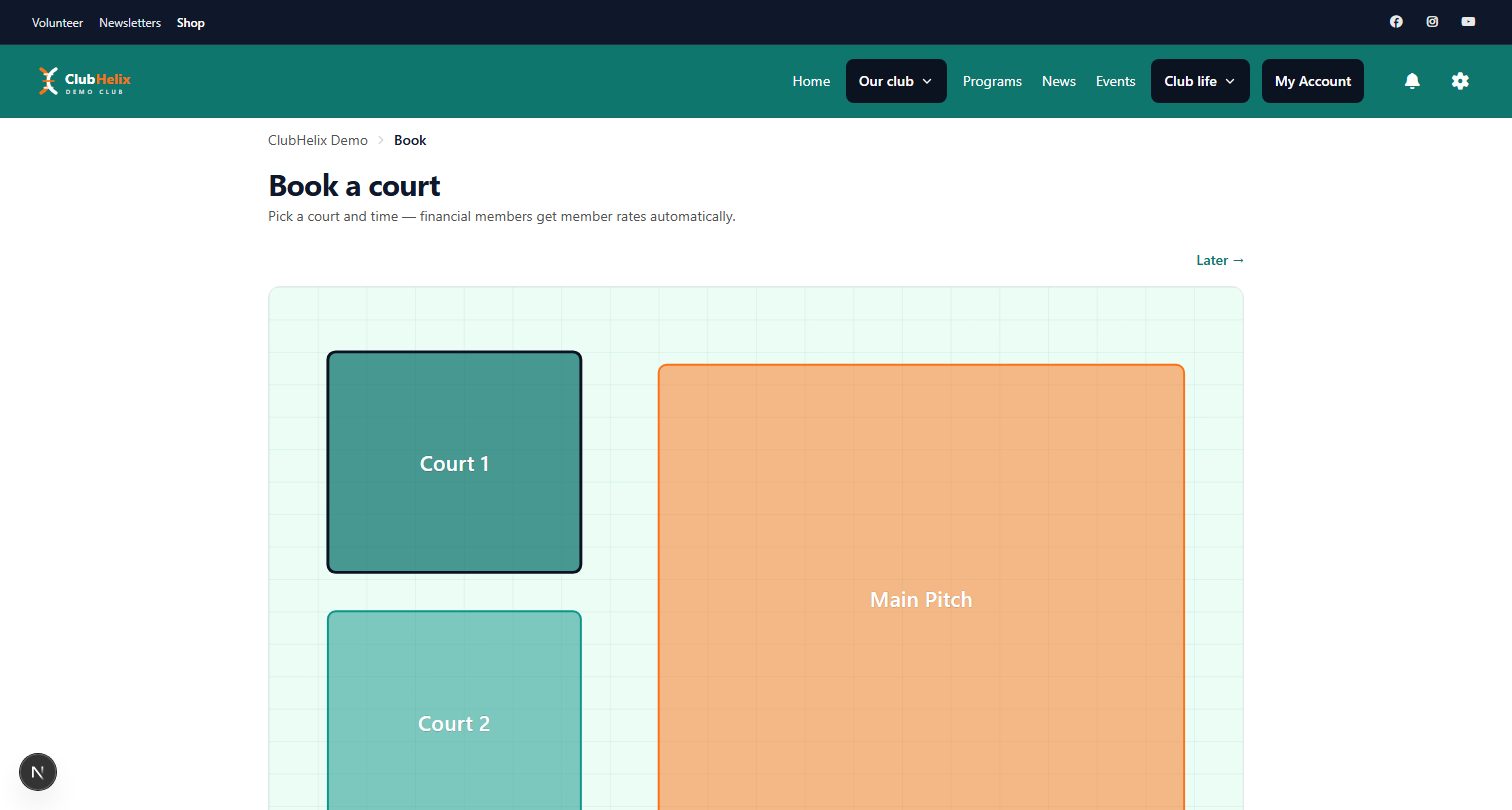
Facility booking in ClubHelix puts your courts, pitches, arenas and rooms on a drawable venue map, bookable clash-proof — two people can never hold the same court at the same time, so the grid members are looking at is the truth. Slots can be priced per slot and paid by card at the time of booking or paid at the venue, which is the choice the charging section above turns on. Members cancel their own bookings, so the easiest rung on the ladder is already in place, and a freed slot is back on the grid immediately rather than after a phone call. Drawing your courts accurately on the locations map, and knowing which sessions fill, is what makes peak and off-peak visible in the first place.
If you are working out what the slots should cost before you decide what a late cancellation costs, how to price facility hire is the companion to this one, and taking payment at the venue covers the pay-on-arrival route in detail.
Frequently asked questions
Should we charge a no-show fee?
Only after the gentler rungs are in place, and only if you are confident a volunteer will actually apply it. Taking payment at the time of booking solves the same problem without anybody having to chase money afterwards, so most clubs get a better result from that than from a fee they never enforce.
How long should our cancellation notice window be?
Match it to how quickly the slot could realistically be taken by somebody else. Two to twelve hours suits members booking courts, twelve to twenty-four hours suits paid or casual hire, and pitches, clubrooms and coaching need longer because the commitment behind them is bigger. Whatever you pick, publish one number and apply it the same way every time.
What counts as a no-show rather than a late cancellation?
A late cancellation is a booking the member told you about after the window closed. A no-show is a booking nobody ever cancelled and nobody used. Treat them differently: the late canceller did the right thing too slowly, and punishing them the same way teaches everybody not to bother cancelling at all.
Do we need to treat peak and off-peak differently?
Yes, and it is the change that makes a policy feel fair. A no-show at a quiet hour costs the club almost nothing, so a penalty there is punishment without a victim. Point the notice window, the reminders and any money at the sessions that genuinely fill, and leave the rest alone.
How do we handle a member who says they had a genuine reason?
Write the exception into the policy before you need it, name who decides — the committee or a named officer, never whoever happens to be at the desk — and record each decision so the same situation gets the same answer next time. Do not ask for proof; over a court booking it is out of proportion and it costs more goodwill than the slot is worth.
What about regular weekly bookings that stop being used?
Review them every term rather than every week. Ask each holder to confirm the block is still needed, release anything unconfirmed back to the grid, and say up front that this is what happens. One abandoned weekly booking recovered is usually worth more court time than a whole season of chasing individual no-shows.


