
What this guide answers
- What should a club welcome pack include?
At minimum: a welcome letter, key contacts with role-based emails, the season calendar with training times and venue details, confirmation of fees paid and what they cover, kit requirements, how the club communicates…
- When should the welcome email be sent?
The confirmation email should be instant and automatic at the moment of registration — any delay creates doubt about whether the sign-up worked.
- Should the welcome pack be printed or digital?
Digital-first, with one printed page. Keep the full pack on your club website so it's always current and every email can link to it, then hand new members a single printed sheet (calendar on one side, contacts and…
- How is a junior member welcome pack different?
Address it to the parents as much as the player — they're the ones reading it.
USA edition. This guide is written for volunteer-run clubs in the United States. Where rules differ — grants, tax, incorporation, safeguarding — follow the USA-specific pointers below or check with your national body.
Think about the last time you joined anything — a gym, a course, a new workplace. The first week decided how you felt about the whole thing. Sports clubs are no different: a new member who spends their first fortnight confused about training times, unsure who to talk to, and wondering whether their registration even went through is a member who quietly doesn't come back next season.
A welcome pack fixes that. Not a glossy brochure — a deliberate, repeatable bundle of information and small gestures that answers every first-month question before it's asked and makes a new member feel like the club expected them. This guide gives you the full pack contents as a template, a delivery timeline, and welcome email examples you can copy, edit and send.
Why a welcome pack pays for itself
Most clubs lose more members to indifference than to rivals. The people who leave after one season rarely storm out; they drift, because nobody learned their name and nothing made week one easy. Retention research across membership organisations keeps landing on the same point: the strongest predictor of a member renewing is how connected they felt early.
A welcome pack is the cheapest retention tool you'll ever build, for three reasons:
- It's built once, used hundreds of times. Two hours of writing this month welcomes every member for years, with only seasonal touch-ups.
- It removes the awkward questions. "What do I wear?", "Where do I park?", "Have I actually paid?" — new members often won't ask these out loud. The pack answers them anyway.
- It protects your volunteers. Every question the pack answers is a message your secretary or team manager doesn't field at 9pm.
The club welcome pack template
Here's the complete contents list. Split it mentally into three layers: the essentials every club needs, the connection layer that makes people stay, and nice-to-haves as budget allows.
Layer 1 — the essentials
| Item | What it covers |
|---|---|
| Welcome letter | One page from the president: genuine welcome, what the club stands for, one sentence on history |
| Key contacts | Names, roles, photos and role-based emails (secretary@…, not personal addresses) |
| Season calendar | Training times, season dates, home venue(s) with parking notes, major events |
| Fees confirmation | What they've paid, what it includes, when the next payment (if any) is due |
| What to bring/wear | Kit requirements, what the club supplies, where to buy uniforms |
| How the club communicates | Which channels are official (email, app, website), which are social, and how to update details |
| Code of conduct | The member/parent code, one page, plain language |
Layer 2 — the connection layer
-
A named buddy or contact person. "Your first point of contact is Sarah, the under-12s manager — she's expecting you Tuesday." This single line does more for retention than everything else in the pack combined.
-
"Your first session" walkthrough. Where to park, which gate, what happens in the first ten minutes, who will greet them. Written for someone who has never set foot at the ground.
-
How to get involved. A low-pressure menu of volunteer roles with realistic time costs ("scoreboard: one hour, twice a season"). New members are more willing to help than committees assume — they just don't know what's needed. Pair this with a genuine volunteer appreciation culture and you've built your future committee.
-
The social calendar. Trivia night, the awards banquet, the season kickoff cookout — the events where members become friends.
Layer 3 — nice-to-haves
-
A club sticker, keyring, or bumper sticker (cheap, and members genuinely use them)
-
A concession-stand voucher for their first game day — it gets them to the concession stand, where the conversations happen
-
Sponsor offers (ask your sponsors for a new-member discount; they'll usually jump at it)
-
A club history one-pager for clubs with real history to tell

Digital, printed, or both?
Print is lovely and gets lost. Digital is searchable and always current. The pragmatic answer for most clubs:
- Digital as the source of truth. The full pack lives as a page (or short series of pages) on your club website, linked from every welcome email. Update it once a season and it's never out of date. If your site has member-only pages, put the contact list there and keep the rest public — a public welcome page is also brilliant marketing for prospective members deciding whether to join.
- Print the one-pager. A single sheet — season calendar on one side, key contacts and first-session walkthrough on the other — handed over at the first training session along with the verbal welcome.
The welcome email sequence (with examples)
The pack's delivery mechanism is email, and timing matters more than polish. Three emails across the first month outperform one giant email nobody finishes.
Email 1 — instant confirmation (the moment they register)
This one should be automatic. If you're using a proper online registration flow, the confirmation email fires the second the form and payment complete — receipt attached, no volunteer involved. That immediacy matters: it's the difference between "did that even work?" and "this club has its act together."
Subject: Welcome to Riverside Hockey Club, Priya!
Hi Priya,
You're in! Your registration for the 2027 season is confirmed and your payment receipt is attached.
Here's what happens next: — Training starts Tuesday 3 February, 6:00pm at Riverside Reserve (enter via Gate 2 — parking map here). — Your first point of contact is Sarah Nguyen, Women's 2s manager — she knows you're coming. — Everything you need for week one is in our online welcome pack: [link]
Any questions before then, just reply to this email.
See you Tuesday, Riverside Hockey Club
Email 2 — the personal welcome (within a week, from a human)
Short, personal, and sent by the president or the relevant team manager. The entire job of this email is to prove a human noticed them join.
Subject: Great to have you at Riverside, Priya
Hi Priya,
Just a personal note to say welcome — great to have you with us this season. You're with the Women's 2s, and Sarah tells me you've already been in touch.
Two things worth knowing early: our season launch barbecue is Sunday 15 February (families welcome), and if you ever have a question the quickest answer is usually the welcome pack on our website or a reply to this email.
Looking forward to meeting you at the ground.
Tom Callaghan President, Riverside Hockey Club
Email 3 — the check-in (around week three or four)
Subject: How's your first month been?
Hi Priya,
You're a few weeks in — how's it going? If anything's been confusing (training, uniforms, who to ask about what), reply and tell us. We genuinely use this feedback to fix things for the next new member.
Also: our trivia night is coming up on 21 March — it's the best night of the season for getting to know people. Details and tickets are on the events page: [link]
Cheers, Riverside Hockey Club
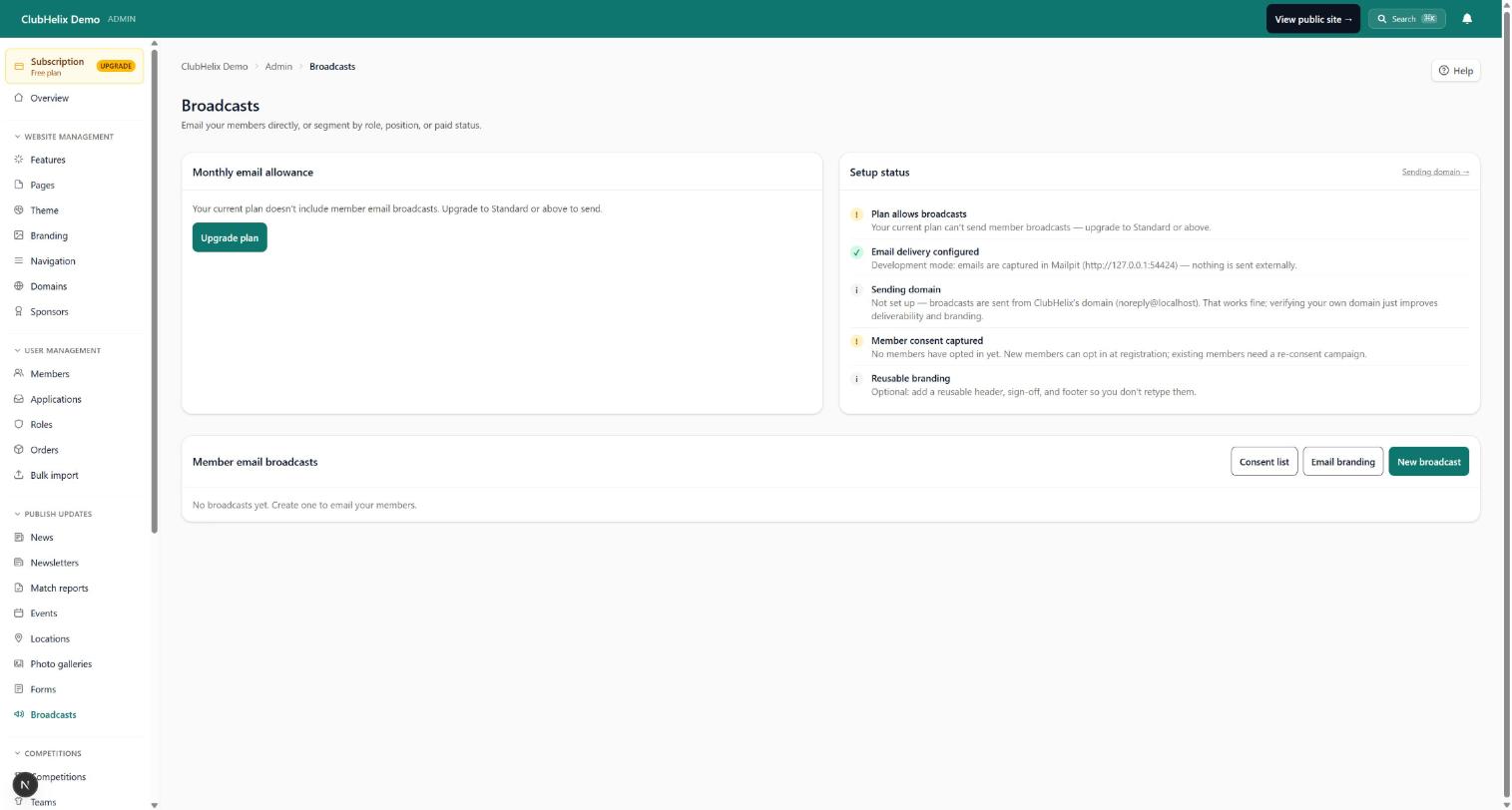
Send emails 2 and 3 as scheduled member emails — with a system like member broadcasts you can write them once, filter to "members who joined in the last month", and reuse the drafts all season instead of rewriting them for every intake.
Automate it so it survives committee handover
Here's where welcome packs usually die: they depend on one organised person remembering to send things, and when that person hands over, the habit evaporates. The fix is to wire as much as possible into systems:
- Registration triggers the confirmation automatically. With online self-registration, the member record, the payment, and the confirmation email with receipt all happen in one pass — zero volunteer effort per member.
- The welcome pack lives on the website, so it's one URL to maintain instead of an attachment floating around in old email threads.
- The human emails run off a checklist and saved drafts. New-member list on one screen, draft templates ready to personalise and send in bulk.
A club that wires it up this way welcomes its 200th member exactly as warmly as its 2nd — regardless of who's on the committee that year.
Seasonal maintenance checklist
Put a fifteen-minute "welcome pack review" in the pre-season committee agenda:
- Update season dates, training times, and fees
- Check every named contact still holds the role (and photos are current)
- Refresh the social calendar with this season's dates
- Re-read the welcome letter — does it still sound like the club?
- Send yourself a test registration to check the automatic emails still look right
Frequently asked questions
What should a club welcome pack include?
At minimum: a welcome letter, key contacts with role-based emails, the season calendar with training times and venue details, confirmation of fees paid and what they cover, kit requirements, how the club communicates, and the code of conduct. The retention magic comes from adding a named first contact and a "your first session" walkthrough — the items that make a stranger feel expected.
When should the welcome email be sent?
The confirmation email should be instant and automatic at the moment of registration — any delay creates doubt about whether the sign-up worked. Follow it with a short personal welcome from a real person within the first week, and a check-in email at around week three or four. Three well-timed emails beat one enormous one.
Should the welcome pack be printed or digital?
Digital-first, with one printed page. Keep the full pack on your club website so it's always current and every email can link to it, then hand new members a single printed sheet (calendar on one side, contacts and first-session guide on the other) at their first session. Full printed booklets look impressive and go out of date by round three.
How is a junior member welcome pack different?
Address it to the parents as much as the player — they're the ones reading it. Add: what parents do during training and games, the club's child-safety contacts and policies, how team communication works (and which channels are official), volunteer expectations for families, and uniform sizing help. A named parent contact in the same age group is the junior equivalent of the buddy system, and just as effective — it's one of the most reliable levers for growing junior participation.
ClubHelix automates the whole first week: online registration creates the member and takes payment, transactional emails confirm instantly with receipts, and broadcasts handle the personal follow-ups at any scale — start free and have it running this season.


