
What this guide answers
- What should a club uniform policy include?
Ten things: the compulsory playing uniform and standards; what's optional; clash/alternate strip arrangements; sponsor logo rules; the single purchasing channel and order windows; exchange and return terms; junior…
- Should the club hold uniform stock or take pre-orders?
Mostly pre-orders. Run two ordering windows a season aligned to your supplier's production runs, and hold only a small buffer of compulsory items in common sizes for mid-season joiners.
- How do we handle families who can't afford uniforms?
Three layers: a discreet subsidy clause in the policy (one named contact, private requests, an annual budget line — often funded from shop margin), a normalised second-hand exchange rack at sizing days, and signposting…
- Can players wear their own shorts or socks if they're the right colour?
That's your call to make in the policy, bounded by your competition's rules — many associations require matching strip in matches, and match officials can enforce it.
- What margin should a club put on uniform items?
A small, stated one — commonly around 10–20%, or a modest flat amount per item — published as "cost plus" so members see the club isn't gouging.
UK edition. This guide is written for volunteer-run clubs in the UK. Where rules differ — grants, tax, incorporation, safeguarding — follow the UK-specific pointers below or check with your national body.
Uniforms are one of those club topics that seems trivial until it isn't: a junior turned away from a final over sock colour, a supplier who can't deliver medium shirts until round nine, a family quietly dropping out because the compulsory kit list hit a price they couldn't pay, or a uniform coordinator's garage full of unsold hoodies bought on a hopeful minimum order. A written uniform policy prevents most of it — it settles what players must wear, who pays for what, how kit is bought, and what happens at the edges (growth spurts, hardship, sponsors, hand-me-downs) before those edges become arguments.
This guide gives you a full policy template to adapt, then works through the operational decisions the policy depends on: suppliers, sizing, stock and subsidies.
What a uniform policy needs to settle
Before the template, the six questions your committee should answer — the policy is just these answers written down:
- What's compulsory and what's optional? Playing strip usually compulsory; training wear, hoodies, bags and caps usually optional. Keep the compulsory list as short and cheap as your competition rules allow — every compulsory item is a barrier to participation.
- Who supplies what? Club-provided (and returned) shirts vs member-purchased items. Many clubs provide match shirts from club stock — it keeps sponsor logos current and controls quality — while members buy shorts and socks.
- What are the standards? Correct strip on match day, numbers assigned how, sponsor logos where, what happens with clashes (your competition rules govern; the policy points to them).
- How is kit bought? Through the club shop, at sizing days, via a supplier portal — one channel, stated.
- Who pays when money is tight? A quiet subsidy path, decided in advance.
- Who owns the decisions? A named uniform coordinator role with defined authority, so choices don't bounce around the committee for months.
Club uniform policy template
[Club Name] Uniform Policy — Adopted [date], review [date]
1. Purpose. This policy sets out uniform requirements for players and officials of [Club Name], how uniforms are supplied and purchased, and how the club supports members for whom cost is a barrier.
2. Playing uniform (compulsory). The playing uniform is: [shirt description incl. colours], [shorts], [socks], plus [protective/sport-specific items]. Players must wear the full correct uniform in all competition matches, per [competition/association] rules. Match shirts are [club-provided and returned at season's end / purchased by members]. Shirt numbers are assigned by [team manager/registrar] and remain with the player for the season.
3. Training and off-field wear (optional). Club training tees, hoodies, jackets, caps and bags are optional purchases. No optional item is ever required for selection or participation.
4. Alternate strip and clashes. In the event of a uniform clash, [competition rule reference] applies; the club maintains [an alternate strip / bibs] managed by the uniform coordinator.
5. Sponsor logos and alterations. Sponsor placements on club uniforms are determined by the committee under the club's sponsorship agreements. Members must not alter, remove or add logos or badging to club uniform items.
6. Purchasing. All uniform items are purchased through [the club's online shop / stated channel]. Orders close [dates] to meet supplier lead times. Pricing is set annually by the committee at cost plus [amount / X%] toward club funds, published with the item.
7. Exchanges and returns. Unworn items with tags may be exchanged for a different size within [30] days, subject to stock. Faulty items are replaced per consumer law. Personalised items (names, numbers) cannot be exchanged for change of mind.
8. Junior sizing and growth. Juniors who outgrow compulsory items mid-season may [swap through the club's second-hand rack / exchange club-stock shirts for the next size where available]. The club runs a second-hand uniform exchange — donated outgrown items in good condition are available at [a token price / no charge].
9. Affordability and subsidy. No member misses out for cost. Members may confidentially request uniform subsidy from [president/treasurer/welfare officer]; the club may cover up to [100%] of compulsory items from [budget line/fund]. Requests are handled privately and are not disclosed to team staff.
10. Club-owned kit. Club-provided items (match shirts, goalkeeper kit, officials' wear) remain club property, are returned by [date], and are laundered per [arrangement]. Unreturned items are charged at replacement cost.
11. Roles. The uniform coordinator manages supplier relationships, stock, sizing events and the exchange rack, and recommends range and pricing to the committee annually.
Choosing and managing a supplier
The supplier decision drives most uniform pain, so make it deliberately:
- Lead times beat unit price. A shirt that's marginally cheaper and arrives in twelve weeks costs you new-member goodwill every registration season. Ask for realistic in-season reorder times, in writing, and test them with a small early order.
- Continuity of range. Confirm how long your strip's fabric/colour run will be available. Re-matching a discontinued teal three seasons in is misery; clubs that lock a design for 3–5 years save money and grief.
- Minimums and who carries them. Minimum order quantities are where clubs accidentally become warehouses. Negotiate low minimums on slow sizes, or an on-demand arrangement for optional merch even at a higher unit cost — paying a little more per hoodie beats owning thirty unsold ones.
- Youth and inclusive sizing. Check the actual size run: youth sizes for juniors, genuine plus sizes, and (increasingly expected) women's-fit options. Get a sizing kit — a full sample size run — as part of the deal.
- Decoration files. Ensure the club owns its logo artwork files and can take them to another supplier. Never let the artwork live only with the current supplier.
Sizing days that actually work
Wrong sizes are the biggest single source of uniform admin. The fix is try-before-buy:
- Run sizing at registration day — the sample size run on a rack next to the sign-up table, a volunteer with a tape measure, and orders placed on the spot.
- Record the size against the member's order, not on a paper list that becomes an argument in April. "Ordered youth 12 on 8 Feb" ends most disputes.
- For juniors, the standing advice: size up one — parents know, policy should allow the exchange anyway.
- Publish the supplier's size chart with garment measurements (a shirt laid flat, measured) on the shop page. "Measure a shirt that fits and compare" produces far fewer exchanges than S/M/L guesswork.
Selling kit through the club shop
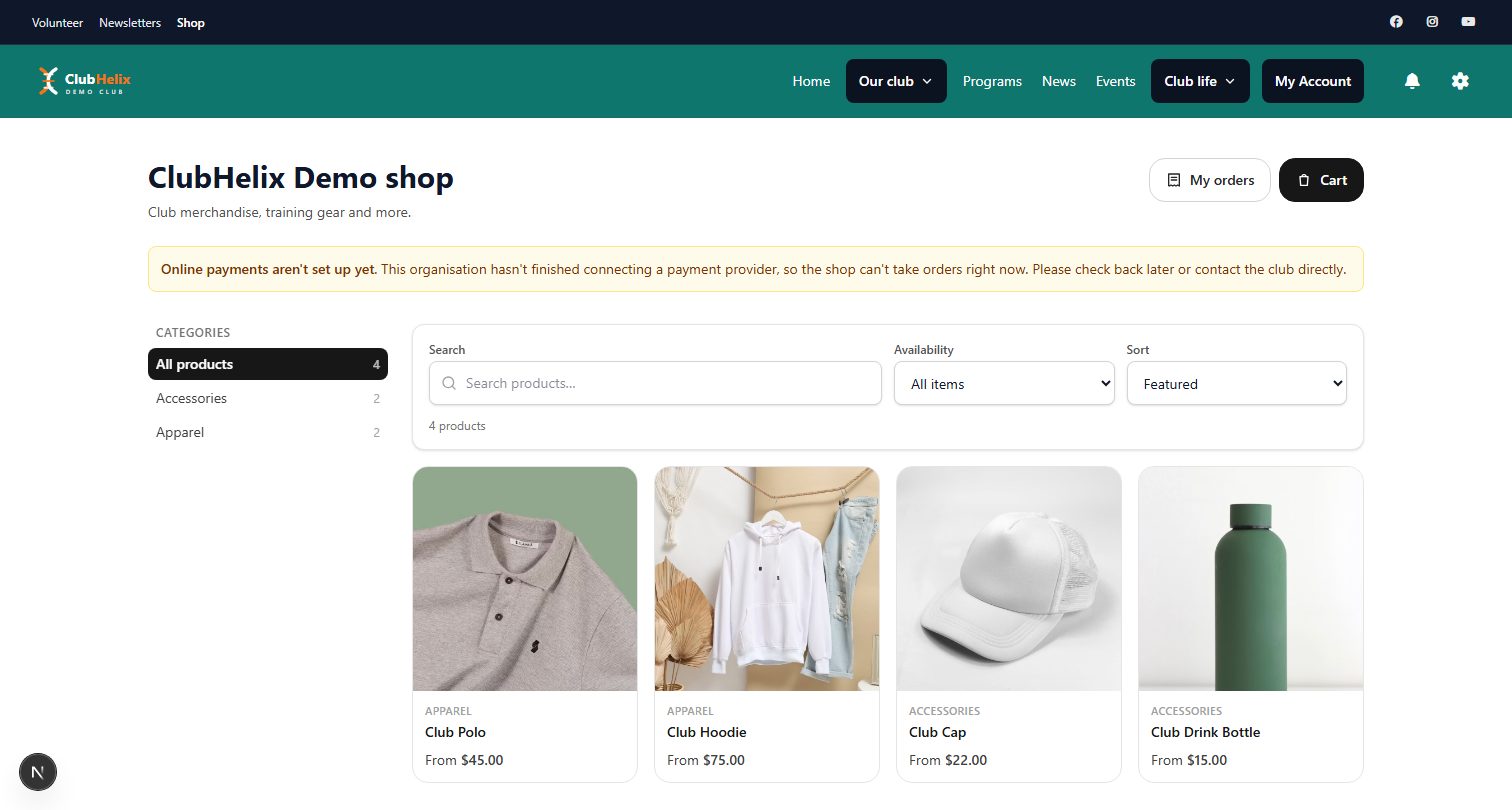
Moving uniform sales online is the biggest operational upgrade available to a uniform coordinator. Orders arrive with sizes, payment and the member's name attached; there's no cash tin, no IOU list, and the order history answers every "I definitely ordered a size 10" conversation. With an online club shop, the flow becomes: publish items with sizes and the size chart, take paid orders in ordering windows aligned to supplier runs, submit the consolidated order to the supplier, and mark orders as delivered when families collect at training.
Three practices that keep the shop tidy:
- Pre-order windows, not held stock, for anything beyond core compulsory items. Two windows a season (pre-season and mid-season) matched to supplier runs means the club never buys stock hoping it sells.
- Small buffer stock only of compulsory items in common sizes, for the new member who joins in round six.
- Publish the collection method on every item ("collected at Tuesday training from the uniform coordinator") so expectations are set at purchase.
If you're weighing what to charge, the same principles as membership fees apply — cost transparency and a small stated margin — covered in how much should club membership cost.
Subsidies, second-hand and keeping kit from being a barrier
Uniform cost is a real participation barrier, and the clubs that handle it best do three things:
-
A discreet subsidy path (policy clause 9): one named person, private requests, budget allocated annually. Many clubs fund it from shop margin — merch profits paying for kids' kit is an easy story to tell at the AGM.
-
A second-hand kit rail: outgrown kit donated back, available for a token amount. Normalise it — "the swap rail" at every sizing day — so there's no stigma.
-
Point families at local support. Some local authorities, charitable trusts and governing-body foundations help families with the cost of sport — link whatever applies in your area from the shop page and mention it in the welcome pack (see our club welcome pack template).

Rolling it out
Adopt the policy at a committee meeting with a version date; publish it on the website next to the shop; link it from registration; brief team managers pre-season (they field most uniform questions); and hand the uniform coordinator the supplier contacts, artwork files, stock list and this policy as a single handover pack. Review annually alongside fees — range creep (four new optional hoodie colourways) is how uniform programs drift from service to burden.
Frequently asked questions
What should a club uniform policy include?
Ten things: the compulsory playing uniform and standards; what's optional; clash/alternate strip arrangements; sponsor logo rules; the single purchasing channel and order windows; exchange and return terms; junior growth and second-hand arrangements; a confidential subsidy path; rules for club-owned kit; and who holds authority (a named uniform coordinator). The template above covers all ten — adapt the bracketed choices to your club and have the committee adopt it formally.
Should the club hold uniform stock or take pre-orders?
Mostly pre-orders. Run two ordering windows a season aligned to your supplier's production runs, and hold only a small buffer of compulsory items in common sizes for mid-season joiners. Held stock of optional merchandise is how clubs end up with a volunteer's garage full of unsold hoodies — if you want on-demand merch, negotiate that with the supplier even at a higher unit price.
How do we handle families who can't afford uniforms?
Three layers: a discreet subsidy clause in the policy (one named contact, private requests, an annual budget line — often funded from shop margin), a normalised second-hand exchange rack at sizing days, and signposting whatever outside help exists locally.
Depending on where you are, that might be municipal or local-authority fee subsidies, charitable participation funds, or a governing body's hardship scheme.
The policy's job is making sure no child misses selection over kit, quietly.
Can players wear their own shorts or socks if they're the right colour?
That's your call to make in the policy, bounded by your competition's rules — many associations require matching strip in matches, and match officials can enforce it. A common position: club-purchased items required for matches (so colours and sponsor placements match), anything goes at training. Whatever you decide, write it down; "close enough navy" debates on finals day are exactly what the policy exists to prevent.
What margin should a club put on uniform items?
A small, stated one — commonly around 10–20%, or a modest flat amount per item — published as "cost plus" so members see the club isn't gouging. Many clubs run compulsory items at cost and take margin only on optional merchandise, then earmark shop profit for the uniform subsidy fund. What kills trust is hidden or inconsistent pricing, not the margin itself.
Run uniforms without the garage full of stock: the ClubHelix club shop takes sized, paid orders against member records, with order windows, statuses and pickup notes built in. See the full picture at /features or start on pricing.


