
What this guide answers
- How many membership types should a club have?
Aim for four to seven on the public registration form. Fewer than four usually means real differences (juniors, non-players) are being ignored; more than seven usually means discounts and history are masquerading as…
- Should we offer a cheap "supporter" tier to boost numbers?
Yes, with clear eyes about what it is for. A $20–$50 social tier rarely matters as revenue, but it formalises the club's wider community — the parents, past players and locals who want to belong without playing — and…
- What about a trial or "come and try" membership type?
Handle trials as a policy, not a category: most insurers and governing bodies allow a defined number of come-and-try sessions before registration is required — check yours.
- Do membership types affect our insurance or affiliation fees?
Frequently, yes — many governing bodies charge per-capita affiliation or insurance levies at different rates for players versus non-players, seniors versus juniors, which makes your category boundaries financially…
UK edition. This guide is written for volunteer-run clubs in the UK. Where rules differ — grants, tax, incorporation, safeguarding — follow the UK-specific pointers below or check with your national body.
No committee ever sits down and designs its membership categories. They are inherited — from the founding committee, from whatever the old paper form listed, from a 2011 AGM motion nobody remembers the reason for. Then they accrete: a "student" rate added for one particular student, a "country member" type created for a family that moved away, a "veteran social playing (Tuesday)" category that exactly one person has ever held. Twenty years on, the registration form offers eleven options, three volunteers can explain the difference between four of them, and every new treasurer spends their first month asking what "Associate B" means.
The categories matter more than they look. They are the club's pricing structure, its welcome mat for people who are not ready to play, its recognition system for people who built the place — and, less romantically, the field that determines who can vote at your AGM. This guide is about structuring them deliberately: the small set of types that covers almost every community club, the decisions inside each one, and how to prune the list you already have. (What each type should cost is its own question — we cover pricing logic separately in how much should club membership cost.)
The six types that cover almost everyone
Strip away the historical accretion and nearly every community club needs some subset of six:
1. Playing (senior). The default adult member: plays, trains, votes, pays the full freight. If your club had only one category, this would be it — and everything else is defined by how it differs from this one.
2. Junior. Under-18 players, priced lower, and different in kind, not just price: the member is the child but the account is a parent's. Everything about junior membership — consent, communication, emergency contacts — runs through a guardian, which is why platforms with proper family and guardian accounts make junior-heavy clubs run so much more smoothly than shared spreadsheets ever did. Junior members generally do not vote; their parents often can, if you have a family or parent category that carries a vote.
3. Family. A bundle — typically two adults and their children — at a discount on the sum of its parts. Families are most clubs' economic backbone and the category with the most design decisions, so it gets its own section below.
4. Social / supporter. The non-playing member: the parent who runs the canteen, the retired player who still comes to home games, the local who just likes the club. Priced low, and worth taking seriously rather than treating as a rounding error — social members are your volunteer pipeline, your event audience and your future committee. The design decision that matters: do social members vote? Many constitutions say yes, which means a determined faction can theoretically stack an AGM with $20 memberships — decide the rules while it is hypothetical, not the week before a contested election.
5. Concession. Students, pensioners, healthcare-card holders — one discounted rate, defined by evidence you are willing to check ("current student card") rather than case-by-case committee sympathy. One concession type replaces the three or four narrow ones most clubs accumulate.
6. Life member. The honour category: awarded, not purchased, usually fee-exempt and voting for life. Life membership is governance as much as gratitude — the criteria and process deserve their own care, and we have written a full guide to life membership criteria.
Add sport-specific variants only where your club genuinely runs distinct programs with distinct costs — a midweek-only category for a tennis club, a boat-owning versus crewing distinction at a sailing club. The test for any additional type: will it hold ten or more people, and can a new member tell from its name whether it applies to them? A category failing either test is a discount pretending to be a type — better handled as a code on an existing type than a new row on the form.
The family membership decisions
Every club that offers family membership eventually meets the same five edge cases, and it is far cheaper to decide them in a policy line than to relitigate each one at committee:
- What is a "family"? The workable modern definition is people in one household — it handles blended families, grandparent carers and share-house siblings without anyone having to adjudicate relationships. Cap the number of playing members if you must (say, two adults + up to four juniors), not the household shape.
- Does family beat the sum of its parts by enough? The discount needs to be visible — families do the maths at the kitchen table. Ten to twenty per cent off the individual sum is the common range.
- Who votes? Typically the adults only — two votes per family membership, not one per person. Say so explicitly in the category description.
- What happens when a junior turns 18 mid-membership? Grandfather them to season's end, transition at renewal. Never mid-season surprise-bill a family.
- Can a family be part-paid? If you allow instalments (registration forms on ClubHelix can split a fee into instalments), the family's payment state should be visible on the member records like anyone else's — the who-has-paid picture must handle families as cleanly as individuals or your unpaid list fills with false alarms.
What each type includes — write it down once
A membership type is a small contract: this money, for these things. Most club disputes about categories are really disputes about undocumented inclusions — does social membership include a vote? does junior include the presentation-day ticket? does playing include the gym key? For each type, one line each on:
- Access — what they can do (play, train, book facilities, attend events at member prices).
- Voice — whether it votes at general meetings, and per your constitution.
- Cost — the fee, and any what's-included notes (insurance levy, affiliation fee passed through, kit).
- Evidence — anything the club checks (age for juniors and concessions, household for family).
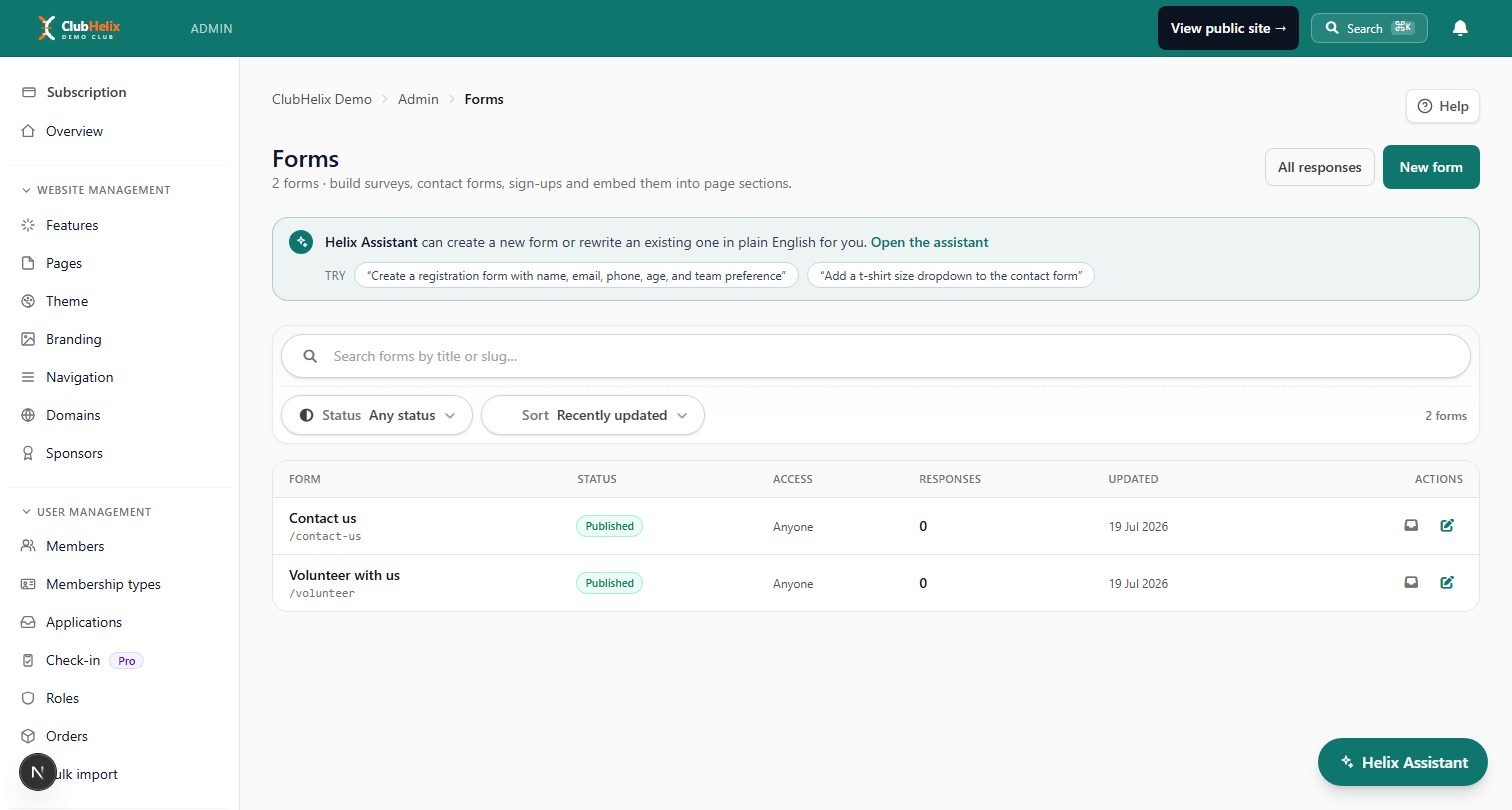
Put those lines on the registration form itself, next to each option. This single change kills most "I didn't know that wasn't included" conversations before they start — the member chose a documented option, and the registration form is the record that they saw it.
Pruning the list you inherited
If your club already has eleven categories, here is the renewal-season clean-up, in an evening:
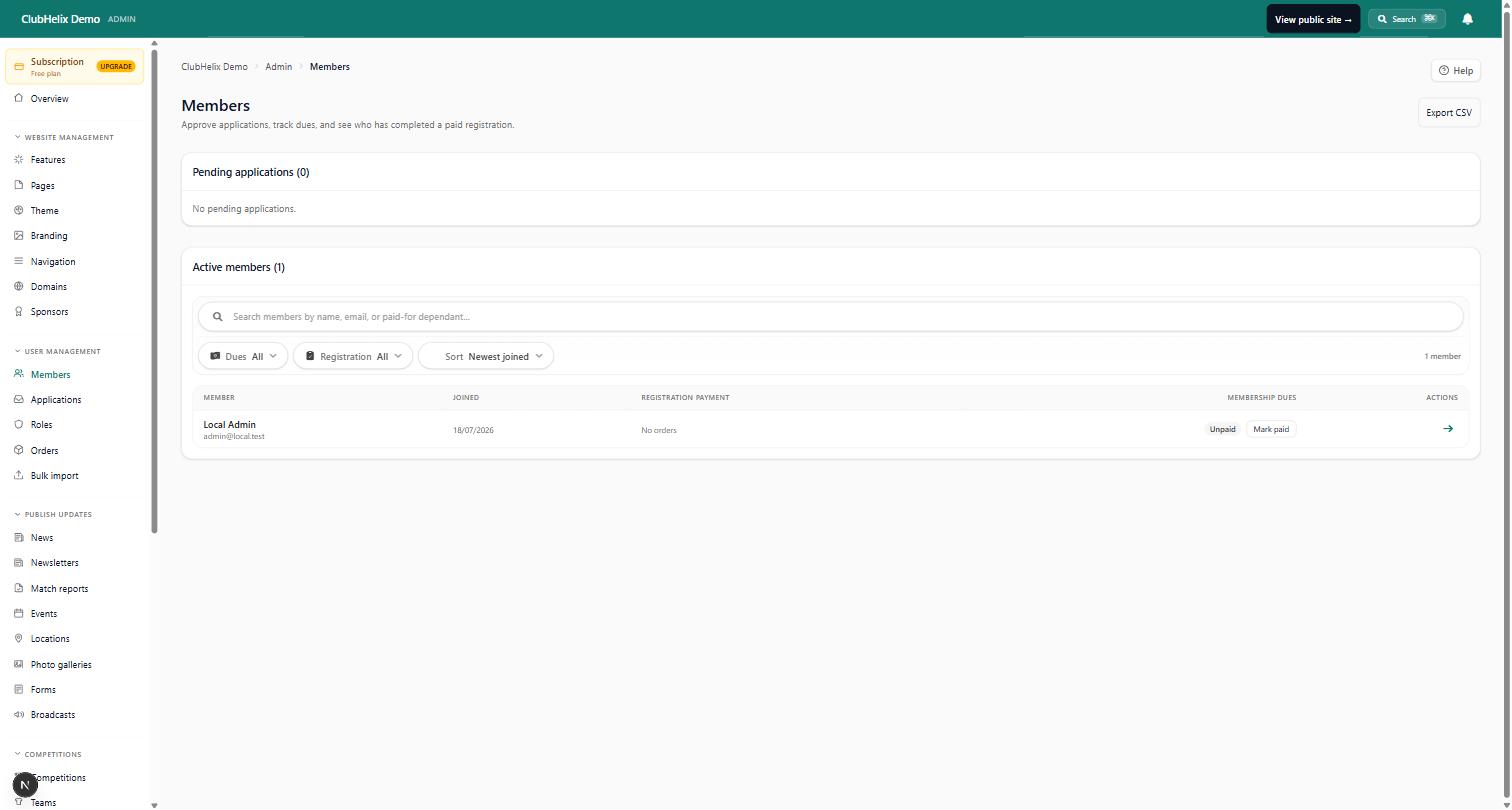
- Count heads per type. Your member system's reports will show the distribution in seconds. Every type with fewer than ten members is a candidate.
- Map the mercy killings. For each near-empty type, find the nearest surviving type. "Student" and "Pensioner" merge into Concession; "Country member" usually becomes Social; "Associate B" becomes whatever Associate B always secretly was.
- Grandfather, don't evict. Nobody's fee should jump because of an administrative tidy-up — hold affected individuals at their old price for a transition season while the category disappears. You are pruning the form, not the people.
- Check the constitution before deleting anything that votes. If a category is named in your constitution with voting rights, retiring it may need a general-meeting resolution, not a committee minute. Five minutes of checking beats an AGM procedural challenge.
- Relaunch at renewal. New season, clean form: six options, one line of inclusions each. Watch how much shorter the "which membership am I?" email queue gets.
Frequently asked questions
How many membership types should a club have?
Aim for four to seven on the public registration form. Fewer than four usually means real differences (juniors, non-players) are being ignored; more than seven usually means discounts and history are masquerading as categories. The strongest test is the form itself: a new member should be able to pick their correct type in under ten seconds without asking anyone. Every type past that threshold adds a support conversation per week and a reporting wrinkle per season.
Should we offer a cheap "supporter" tier to boost numbers?
Yes, with clear eyes about what it is for. A $20–$50 social tier rarely matters as revenue, but it formalises the club's wider community — the parents, past players and locals who want to belong without playing — and it gives you a legitimate mailing list of exactly the people who buy raffle tickets and turn up to working bees. Decide the voting question deliberately (see above), and resist inflating the tier's inclusions until it cannibalises playing membership.
What about a trial or "come and try" membership type?
Handle trials as a policy, not a category: most insurers and governing bodies allow a defined number of come-and-try sessions before registration is required — check yours. A person mid-trial does not need to be a member type; they need a sign-in sheet (for insurance) and a warm follow-up. Creating a $0 "trial member" category clutters the register with people who came twice in 2024. If your sport runs structured intro programs, that is different — those participants are genuinely enrolled, and our guide to running a come and try day covers the conversion path.
Do membership types affect our insurance or affiliation fees?
Frequently, yes — many governing bodies charge per-capita affiliation or insurance levies at different rates for players versus non-players, seniors versus juniors, which makes your category boundaries financially load-bearing. A "social" member who actually plays in the Wednesday comp may be uninsured, or may make the club liable for an unpaid levy. Align your types with your governing body's registration definitions, pass levies through visibly in each type's cost line, and audit once a season for players hiding in non-playing categories.


