
What this guide answers
- What date should we use for the census?
The date the requester specifies. If they do not specify one, use the same date every year — a month after sign-on closes is usually the most representative — and state it on the return.
- Do we count members who have not paid?
Report them separately. A single figure that blends paid and unpaid registrations will be challenged, and rightly.
- How do we count family memberships?
Count people, and note the number of family memberships separately.
- What if two systems give different numbers?
That is not a counting problem, it is a records problem, and it will recur every year until it is fixed.
- Can our association see our member data directly?
Only if you give them access. Where a governing body reports across affiliated clubs, that should be built on aggregate roll-ups — totals computed centrally — rather than member records leaving the club.
UK edition. This guide is written for volunteer-run clubs in the UK. Where rules differ — grants, tax, incorporation, safeguarding — follow the UK-specific pointers below or check with your national body.
Once a year, and sometimes three times a year, somebody asks your club how many members it has. The association wants it for affiliation. The council wants it for the lease. The funding body wants it for the acquittal. And each of them wants it sliced slightly differently, on a slightly different date, in a slightly different form.
Most clubs answer by counting. Someone exports a list, deletes the duplicates, argues about the social members, guesses at the juniors who never paid, and sends a number nobody could reproduce. Then next year they do it again from scratch.
There is a better way, and it starts with deciding what you are counting before anyone asks.
What a census actually is
A census is a count of a defined population at a defined moment. Both halves matter, and most club counts fail on one of them.
- Defined population — which memberships are in scope. Paid up? On the roster? Anyone who played a game? Including or excluding life members, social members, committee members who do not play?
- Defined moment — the date the count is true. Membership is not a stable quantity; a club can differ by 15 per cent between March and August.
A count without both is not defensible, and defensibility is the whole point. When an affiliation fee or a grant depends on the figure, you may be asked how you arrived at it.
The definitions to settle before the form arrives
Write these down once, in a document the committee has accepted, and reuse them every time.
Registered member. Someone with a current membership on the census date. State whether "current" means fully paid, or paid within an agreed grace period.
Participant. Someone who actually took part — played, trained, competed, attended a session. Usually smaller than registered, and increasingly the number funders care about. Requires that you record attendance somewhere.
Junior. Age bands vary by sport and funder. Record actual ages, or at least date-of-birth bands, and derive the categories per form — do not store the categories, because the next form will want different ones.
New this season. First membership at your club, ever. Distinguish from a returning member after a gap, or you will overstate growth badly.
Active volunteer. Someone who held a role or filled a duty in the period. Not "everyone on the committee list".
That is five definitions. It is an hour of committee time and it makes every future count a query instead of a debate.
What funders and associations usually ask for
The exact fields vary, but the underlying set is remarkably consistent:
- Total registered members on a stated date
- Split by age band — juniors, seniors, and often a masters or veterans band
- Split by gender, where your club collects it
- Participants versus registrations — the same person registered in two teams is one participant and two registrations
- New versus returning
- Geographic spread — postcodes or suburbs, for catchment questions
- Volunteer numbers, and increasingly volunteer hours
- Sessions or fixtures delivered in the period
Notice how many of those are things you either recorded during the year or cannot reconstruct afterwards. That is the central lesson of census work: the census is not an annual task, it is an annual read of a year-round habit.
The demographic question
Two of those fields — age and gender — are personal information, and a club should be deliberate about them.
If you collect them, collect them at registration with a plain statement of why, keep them accurate, and restrict who can see them. If you do not collect them, say so on the return rather than estimating. A funder would far rather receive "we do not collect gender data" than a guess presented as a count, and an estimate that later proves wrong is a much bigger problem than a gap.
Do not add demographic fields to your registration form the week before a funding round. Add them at the start of a season, with a sentence explaining the purpose, and update your privacy notice at the same time.
Producing the count without losing a fortnight
The fortnight goes on reconciliation: the roster spreadsheet, the payment records, the team lists and the association's portal all disagree, and someone has to arbitrate.
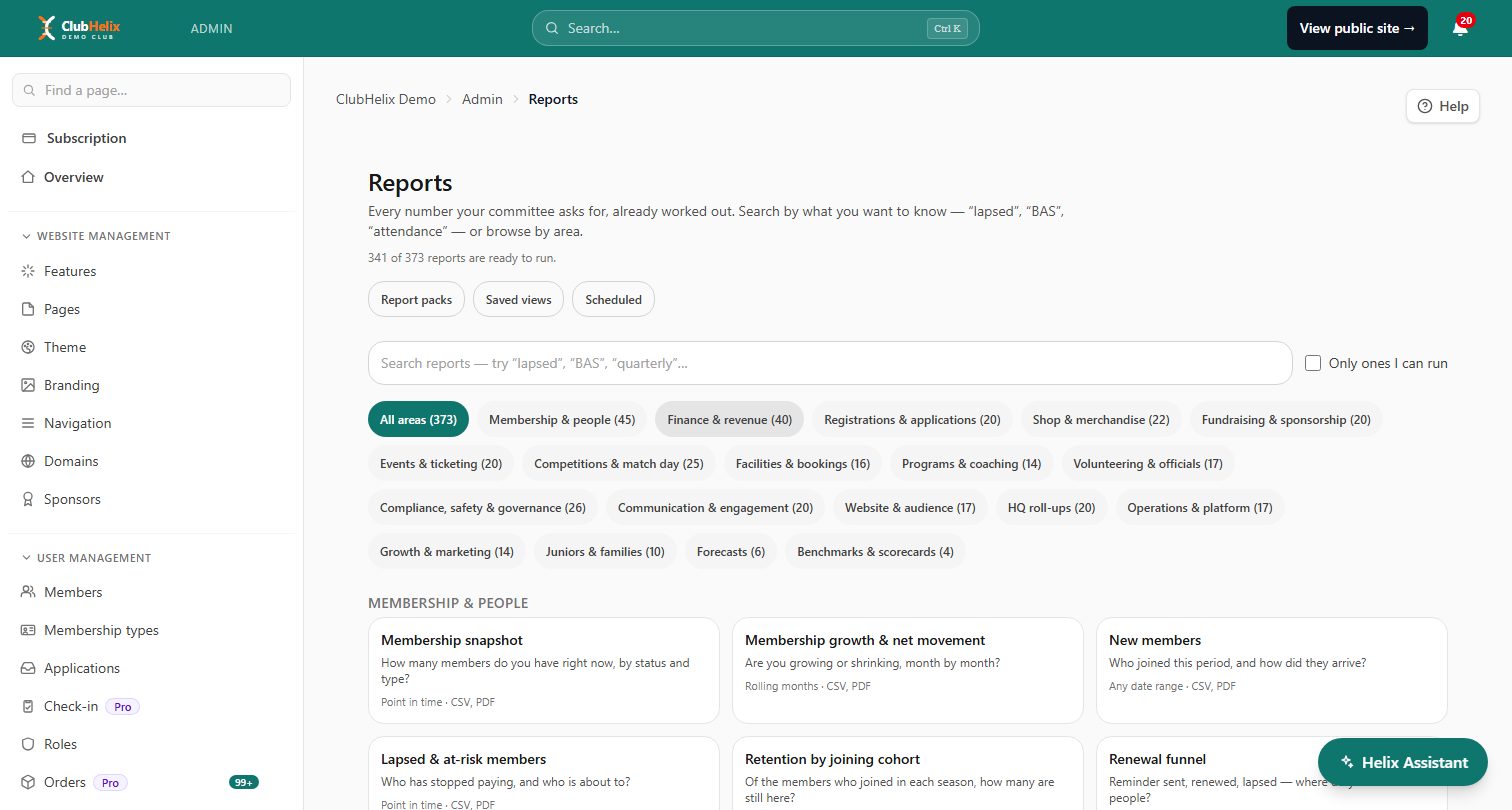
The structural fix is to make the roster the single record of who is a member — with a joining date, a paid-until date and a membership type against each person — and to take payment through the same system, so "paid" is a fact rather than an inference. When that is true, a census is a snapshot report at a chosen date, broken down by type and team, exported as CSV.
Three practical points:
- Take the snapshot on the date asked for, not today. A good membership report can produce the roster as it stood on 30 April even if you are running it in July. Reconstructing that from a live list is nearly impossible.
- Export the underlying rows, not just the totals. If the association queries the number, you want the list that produced it.
- Keep the export. File it with the return. When the same funder asks a follow-up question two years later, you will have the exact population you counted.

Registrations versus participants
This distinction is worth a paragraph of its own because it is where most clubs accidentally overstate.
A club with 300 people playing across 22 teams may have 380 registrations, because some people play in two grades. If the association counts registrations and the grant body counts participants, both numbers are correct and they are not the same number. Report whichever was asked for, label it explicitly, and if you are unsure, provide both with a one-line note.
The clubs that get into trouble are the ones that quietly use the bigger figure everywhere.
A census calendar
Rather than reacting to each request, run the count on a schedule:
- Start of season, plus four weeks — the affiliation count, once sign-on has settled.
- Mid-season — a participation check against attendance, which is the number that tells you whether the registered figure is real.
- End of season — the full census for annual reporting, grants and the annual general meeting.
- Same date each year — so your own comparison is honest.
Put the dates in the committee calendar. A census produced on a schedule takes an hour; the same census produced under deadline takes a fortnight and is less accurate.
Using the census for more than compliance
Once the count is a report rather than an ordeal, it stops being purely defensive.
The same data answers questions the club actually cares about: which age bands are growing, whether the new junior program is bringing in families who stay, whether your catchment has shifted, whether the club that opened one suburb over is taking your members. Combine the census with cohort retention and you can see not only how many members you have, but whether the ones you gained last year are still here.
That is the difference between counting because you were asked and counting because you want to know.
Frequently asked questions
What date should we use for the census?
The date the requester specifies. If they do not specify one, use the same date every year — a month after sign-on closes is usually the most representative — and state it on the return.
Do we count members who have not paid?
Report them separately. A single figure that blends paid and unpaid registrations will be challenged, and rightly. "412 registered, of whom 388 paid as at 30 April" is a stronger answer than either number alone.
How do we count family memberships?
Count people, and note the number of family memberships separately. A family membership covering four children is four participants, and every funder means participants when they ask about participation.
What if two systems give different numbers?
That is not a counting problem, it is a records problem, and it will recur every year until it is fixed. Pick one system as the record of truth for membership and make the others follow it.
Can our association see our member data directly?
Only if you give them access. Where a governing body reports across affiliated clubs, that should be built on aggregate roll-ups — totals computed centrally — rather than member records leaving the club. If a body is asking for full member exports, it is fair to ask what they need each field for.


