
What this guide answers
- Is all-in-one club software better than separate tools?
For most volunteer-run clubs, yes — but not because the individual modules are better.
- What is wrong with best-of-breed for a club?
Nothing, if you have someone whose job is to maintain the connections between the tools.
- How many tools should a club actually run?
A useful rule of thumb is one core system that holds people and money, no more than two genuine integrations, and accounting.
- What should I ask about an integration before relying on it?
Which direction the data flows and how often, which system wins when the two disagree, exactly which fields are synced, what happens when it fails, who maintains it, and what the manual fallback is during your busiest…
- Can we consolidate without a big migration?
Yes, if you go one tool at a time. Move the core first — membership and payments — then decommission each satellite only once its replacement has survived a whole season without anyone reaching for the old one.
Canada edition. This guide is written for volunteer-run clubs in Canada. Where rules differ — grants, tax, incorporation, safeguarding — follow the Canada-specific pointers below or check with your national body.
A twelve-year-old joins your club on a Sunday afternoon. Her mother fills in a form on her phone, pays, and thinks the job is done. Over the next six weeks that child's name, birth date, mobile number and medical note will be typed by hand into somewhere between five and nine different places by four different volunteers, none of whom will know exactly what the others have typed. In week six her mother changes her phone number in one of them.
That is the whole argument about all-in-one platforms versus separate tools, and it is not really an argument about features. Every tool in that chain might be excellent at its job. The problem lives in the gaps between them, which is precisely where nobody owns anything and where a club's data quietly stops agreeing with itself.
This guide takes the question seriously in both directions. We trace what re-keying actually costs, we make the genuine case for specialist tools — including in places where our own product is not the right answer — and we land on the middle path most clubs should take: one core system that holds people and money, a small number of deliberate integrations, and a firm rule about everything else. We build an all-in-one platform, so the conclusion is predictable; the reasoning is where the value is, and we have tried to make it honest enough to argue with. Our own account of what a single club management system actually holds sets out the scope we are arguing for.
Follow one new member through your club
Before comparing architectures, do this exercise at a committee meeting. Take one recent new member and list, out loud, every place their details ended up. It takes ten minutes and it usually goes quiet halfway through.
| The moment | Where the details land | Who types them in |
|---|---|---|
| The sign-up form is submitted | The form tool's response sheet | Nobody — it is automatic |
| The payment clears | Bank statement, then a fees sheet | The treasurer |
| She is added to the club roster | The member spreadsheet | The registrar |
| She is registered for competition | The affiliation portal | The registrar, again |
| She is allocated to a team | A team list in a group chat | The team manager |
| She should get the newsletter | The mailing tool's contact list | The comms volunteer |
| She orders a uniform | The uniform order sheet | The uniform coordinator |
| Her parent signs a consent | An email in somebody's inbox | Nobody, really |
| Week six — the mobile number changes | How many of the above get fixed? | Whoever was told |
That last row is the one that matters. Re-keying is annoying; divergence is expensive. After six weeks, no two of those lists agree, and there is no authority to appeal to because none of them is the official one. When the club needs to contact every under-13 parent on a wet Saturday morning, it will use whichever list somebody can find, and it will miss people.
The three costs, in order of how much they hurt
Time is the smallest cost. Say each destination takes two minutes of typing and checking, and eight destinations means sixteen minutes per member. A club processing 140 sign-ups and renewals in a season spends around 37 hours on pure transcription. Real, irritating, and still the least of it.
Accuracy is worse. Hand-typed data carries errors at a rate nobody measures because nobody checks. A transposed birth date puts a child in the wrong age group. A mistyped email means a family never hears about a cancellation and concludes the club is disorganised. Neither error announces itself; both surface at the worst possible moment.
Trust is worst of all. Once a committee learns that no list can be relied on, it stops relying on any of them, and the club reverts to asking people. "Can you just confirm you've paid?" is a sentence that costs a club members, because it tells them nobody is in charge.

Where specialist tools genuinely win
Now the case against consolidating everything, made properly. There are jobs where a dedicated tool beats a bundled module, and pretending otherwise would be marketing rather than advice.
- Anything with a professional or legal counterpart. Your bookkeeping belongs in accounting software your treasurer's successor and your auditor both recognise. A club platform should hand it clean data, not try to replace it.
- Anything your governing body mandates. If your sport runs registrations, clearances and competition through a national platform, that is the system of record for those things whether you like it or not. Feeding it is the job; duplicating it is waste.
- Deeply specialised operational tools. Timing systems, scoring hardware, video analysis, access control on doors and lights, ticketing at stadium scale. These are separate products because they are separate disciplines, and a general club platform that claimed to do them well would be lying. ClubHelix does not do video streaming or analysis, does not integrate with access-control hardware, and does not ship native app-store apps — if any of those is central to your club, budget for a specialist and plan the join.
- Genuine design work. If your club's identity depends on a heavily art-directed site — a gallery-led arts organisation, a photography club — a dedicated design tool will give you more control than any club platform's editor.
- Things only one person touches, that never change. A single spreadsheet owned by one person, holding data nobody else needs, is not a problem worth solving. Consolidation is for shared data.
The pattern underneath those five: specialist tools win where the data does not need to be joined to your member list. As soon as a job needs to know who somebody is, whether they have paid, and what they consented to, splitting it out creates a join that a volunteer has to maintain by hand.
Where one system genuinely wins
The symmetric case, and it is narrower than vendors pretend but stronger where it applies.
| What you get with one core | Why it matters in a volunteer club |
|---|---|
| One member record | There is an answer to "which list is right", and everyone knows what it is |
| One permission model | A team manager sees their team; a treasurer sees money; nobody shares a login |
| One audit trail | You can find out who changed what, months later, without an investigation |
| One place to look when it breaks | No week spent working out which of six suppliers caused the problem |
| One renewal, one privacy position | One bill, one supplier relationship, one set of terms to understand |
| One export | Leaving is a decision, not a project |
The last three are the ones committees undervalue. Six tools means six renewal dates, six accounts that may sit on personal email addresses, six privacy positions your members are implicitly agreeing to, and six exports to assemble if you ever want to move. None of that appears in a feature comparison, and all of it appears in a bad October.
The middle path — one core, a few integrations
Almost no club should be purist in either direction. Here is the rule we would give a committee, and it is deliberately short.
One system holds people and money. Everything that needs to know who somebody is, lives there. Membership, registrations, payments, teams, events, consents, communications. That is your core, and it is the thing you buy carefully.
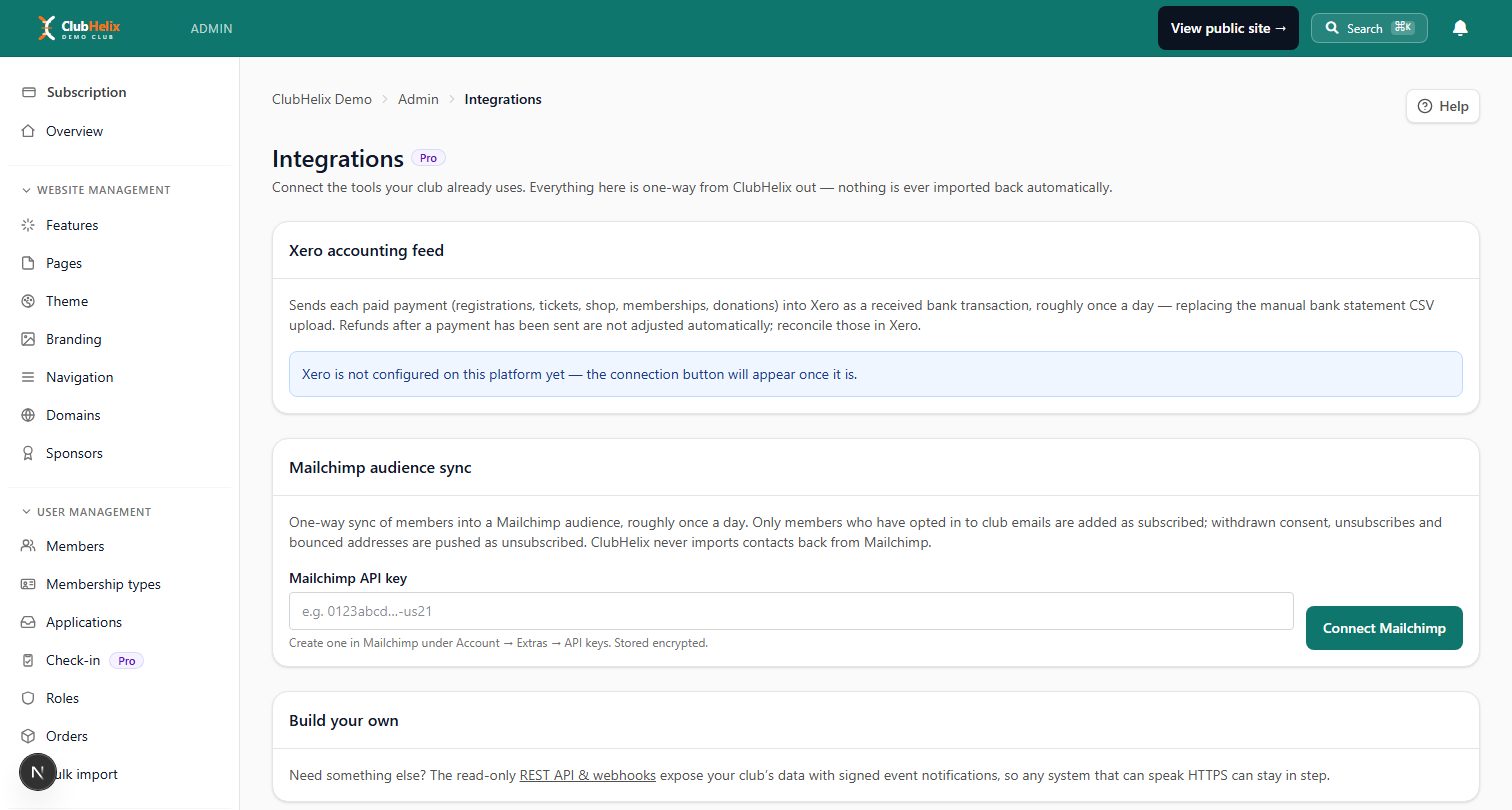
Integrate only where a professional counterpart exists. Accounting is the clearest case: the club platform records what was earned, the accounting package records what the books say, and the two reconcile. Email marketing is a second, if your club runs genuine campaigns rather than notices.
Everything else either lives in the core or lives nowhere. If a job cannot be done in the core and cannot be integrated, ask honestly whether it needs doing. A surprising amount of club software exists because one enthusiastic volunteer adopted it in 2019 and nobody has felt able to retire it since.
Cap the count. A workable rule of thumb for a volunteer club is a core plus no more than two integrations plus accounting. Beyond that, the joins outnumber the people maintaining them.
For clubs in Canada, provincial association requirements usually determine registration and eligibility, and often screening requirements for coaches and volunteers as well. Treat those as authoritative, and keep your own core for membership, dues, events, the shop and communications. Where a provincial body supplies a registration system to affiliated clubs, feed it from your core rather than maintaining two lists in parallel.
An integration is a promise, not a pipe
The word "integration" covers everything from a genuine two-way sync to a button that downloads a file. Before you rely on one, get answers to these six.
- Which direction does data flow, and how often? One-way nightly and two-way instant are different products wearing the same word.
- Which system wins a conflict? If a member's email is changed in both, what happens? An integration with no answer to this creates divergence rather than removing it.
- What exactly is synced? Usually a subset. Ask for the field list, not the marketing sentence.
- What happens when it fails? Does someone get told, or does it fail silently until the treasurer notices in March?
- Who owns it? An integration built by one supplier can be deprecated by the other. Ask how long it has existed and who maintains it.
- What is the manual fallback? If it breaks in your busiest fortnight, what does the volunteer do that afternoon?
If a supplier cannot answer four of those six clearly, treat the integration as a nice-to-have rather than a load-bearing part of your plan.
On the money side in Canada, most clubs want income and fee data to reconcile with accounting software the treasurer already uses, and a not-for-profit corporation has annual filing and record-keeping expectations attached. This is general information rather than advice — the treatment of dues, donations and fundraising income depends on your structure and province, so confirm it with your accountant first.
Take an inventory before you take a decision
You cannot consolidate a stack you have not written down. Build a one-page inventory — a shared document, not a slide — with a row per tool and these columns.
- Tool — what it is called, and what it is actually used for now (often not the same as when it was adopted).
- Owner — the one committee member who would notice if it broke.
- Who pays — the club, or somebody's personal card.
- What it holds — which member data lives in it, and whether that data exists anywhere else.
- What breaks without it — the honest answer, in one sentence.
- Renewal date — and where the invoice goes.
Two things fall out of this reliably. First, at least one tool has no owner, and it is usually the one holding member contact details. Second, at least one tool is paid for by a person rather than the club, which is a problem that solves itself right up until the moment it does not. Our committee handover checklist covers what to do about that at changeover.
Then rank the rows by a single question: does this tool need to know who our members are? Every row where the answer is yes is a candidate for the core. Every row where the answer is no can stay exactly where it is, and you should leave it alone.
Because that inventory names where member data actually sits, it doubles as the start of your privacy work. Clubs in Canada handling member information have obligations under federal and provincial privacy law, and the Office of the Privacy Commissioner publishes guidance for small organisations. General information only — but practically, a stack of six tools means six places to search when somebody asks what you hold about them.
Fewer moving parts, on purpose
If the inventory came back with seven tools and four of them need to know who your members are, you already have your answer, and it is not "buy a better spreadsheet". ClubHelix is a single core: self-registration creates the member and takes the payment in one step, so there is nothing to reconcile afterwards; reports answer the joined-up questions the stack could never answer at all; and the audit log means "who changed this, and when" has a real answer six months later. Where a professional counterpart genuinely exists, integrations hand your accounting and email-marketing tools clean data rather than trying to replace them.
We would rather you shrank your stack than replaced it over a single weekend. Take the core first, put one season's sign-ups through it, and decommission satellites only as each replacement earns its place — the free tier lets you build the whole thing before committing anything, pricing is published by club size, and a full export is always yours to take. Create your club's system in an evening and see how many rows of your inventory it quietly makes redundant.
Frequently asked questions
Is all-in-one club software better than separate tools?
For most volunteer-run clubs, yes — but not because the individual modules are better. It is because every join between two tools is maintained by a volunteer, and volunteers change. Separate tools win where a job genuinely does not need to know who your members are, or where a professional or regulatory counterpart exists, such as accounting or a governing body's mandated registration system.
What is wrong with best-of-breed for a club?
Nothing, if you have someone whose job is to maintain the connections between the tools. Clubs do not. Best-of-breed assumes an owner for the seams; in a committee, the seams are owned by nobody, so data diverges quietly until it can no longer be trusted. That failure is architectural, not a reflection on any of the tools involved.
How many tools should a club actually run?
A useful rule of thumb is one core system that holds people and money, no more than two genuine integrations, and accounting. Beyond that, the number of connections grows faster than the number of people maintaining them, and something is always half-broken.
What should I ask about an integration before relying on it?
Which direction the data flows and how often, which system wins when the two disagree, exactly which fields are synced, what happens when it fails, who maintains it, and what the manual fallback is during your busiest fortnight. If you cannot get clear answers to most of those, plan around the integration rather than on top of it.
Can we consolidate without a big migration?
Yes, if you go one tool at a time. Move the core first — membership and payments — then decommission each satellite only once its replacement has survived a whole season without anyone reaching for the old one. Do it between seasons, keep a monthly export of everything throughout, and never switch two things off in the same month.
Keep reading — free vs paid club management software works through the money side of the same decision, and a club communication plan covers the tool most likely to be duplicated three times over.


