
What this guide answers
- Will members be able to tell it's AI-written?
If you follow the facts-in workflow and edit for voice, no — because the substance is yours and the review is human.
- Should the AI ever send the newsletter itself?
No, and we'd hold that line even if you asked us to build it.
- What about photos?
Use real ones — your members photographing your actual club beat anything generated.
- Does this work for small clubs without a comms person?
It works best there. The method needs one person with facts and fifteen minutes, not a comms committee — and the drafts land in the same news and broadcast queues your club already uses, so there's no new tool to learn.
South Africa edition. This guide is written for volunteer-run clubs in South Africa. Where rules differ — grants, tax, incorporation, safeguarding — follow the South Africa-specific pointers below or check with your national body.
The club newsletter has a strange economics problem. It's one of the highest-value things a committee produces — it drives renewals, fills volunteer rosters, and keeps sponsors feeling seen — and it's also the job most likely to slip three weeks because nobody had ninety spare minutes on a Sunday night. Match reports are the same story in miniature: everyone wants them, the same one person always writes them, and by August that person has retired from writing them.
AI drafting fixes the economics without touching the part that matters. The committee still decides what's said, checks what's true, and presses send — but the blank page is gone. Here's a method that works in real clubs, plus the guardrails that stop "AI-drafted" from sliding into "nobody read it before it went out".
The golden rule: facts in, draft out
An AI assistant is a superb writer and an unreliable witness. It knows how a match report sounds; it does not know what happened on Saturday. So the workflow is never "write our newsletter" — it's you supply the facts, it supplies the prose.
A facts-in prompt for a match report looks like this:
Draft a 200-word match report for our club news page. Facts: seniors won 3–2 at home; goals to Priya (2) and Marcus; keeper Sam saved a penalty in the last ten minutes; juniors lost 1–4 but debutant Alexis scored; canteen raised $340 for the junior tour. Tone: warm, a bit cheeky, no clichés about "hard-fought battles". Don't invent anything not in these facts.
That last sentence is the most important line in this guide. Say it every time. A model told to stay inside the supplied facts almost always does; a model left to fill gaps will confidently invent a best-and-fairest winner who doesn't exist.
The same pattern runs a whole newsletter: paste your bullet list — results, upcoming dates, volunteer asks, sponsor mention, registration reminder — and ask for a draft in your club's voice with a short intro and clear section headings. Five minutes of bullets replaces an hour of composition.
Teaching it your club's voice
Generic AI prose reads like a press release from nowhere. Two fixes:
- Show it three past examples. "Here are three newsletters we're proud of — match this voice" outperforms any list of adjectives. Keep a "voice pack" of your best past comms in a shared doc for whoever's drafting.
- Name the banned phrases. Every club has clichés it hates. Tell the assistant: no "hard-fought battle", no "at the end of the day", no exclamation marks in sponsor thank-yous. It will comply with a discipline no human volunteer ever quite manages.
If your assistant is connected to your club's data, it can go a step further — pulling the weekend's actual results or the real count of unfilled volunteer shifts into the draft, so the facts arrive pre-verified from the same system your admins use.
The review pass: what to actually check
The human review is not a vibe check; it has a checklist. Before anything AI-drafted goes out:
- Names and spellings. The model will happily normalise "Jaxx" to "Jack". Player names, sponsor names, venue names — check every one.
- Numbers, dates, times. Scores, fees, kickoff times, RSVP deadlines. If a number appears in the draft and not in your facts list, it's invented — delete it.
- Promises. Watch for accidental commitments ("free sausage sizzle for all members!") the model added for warmth. If the club didn't promise it, the newsletter can't.
- Tone around sensitive topics. Injuries, disciplinary matters, a member's passing — draft these yourself, or edit the AI version heavily. Efficiency is for the routine 90%, not the human 10%.
This pass takes five minutes. It is the entire difference between "our comms got faster" and "the club apologised on social media".
Where the draft should live: inside your platform, not a chat window
The failure mode of casual AI use is copy-paste sprawl: drafts in one tool, member list in another, sending in a third, and no record anywhere of who approved what. The fix is to make drafts land inside the club platform, already in the review queue.
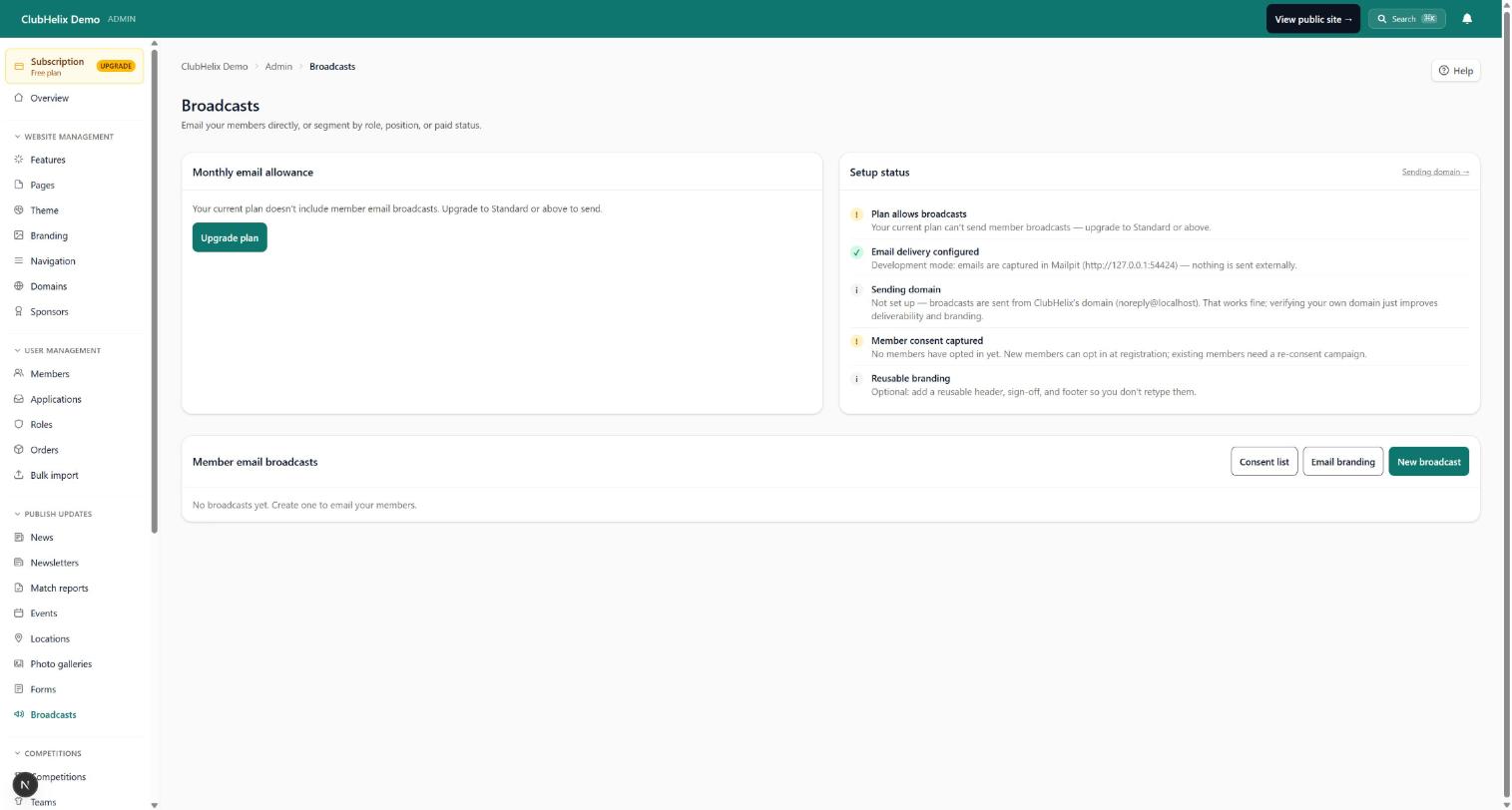
That's how ClubHelix wires it. Ask a connected assistant to draft a news post and it appears in your News admin as an ordinary unpublished draft — same place, same publish button, same audit trail as anything a human wrote. Ask for a newsletter and it lands in the broadcasts composer unsent, with no audience selected — choosing who receives it and pressing send remain deliberate human acts, with consent and unsubscribe handling applied automatically by the platform, not left to the model's judgement.
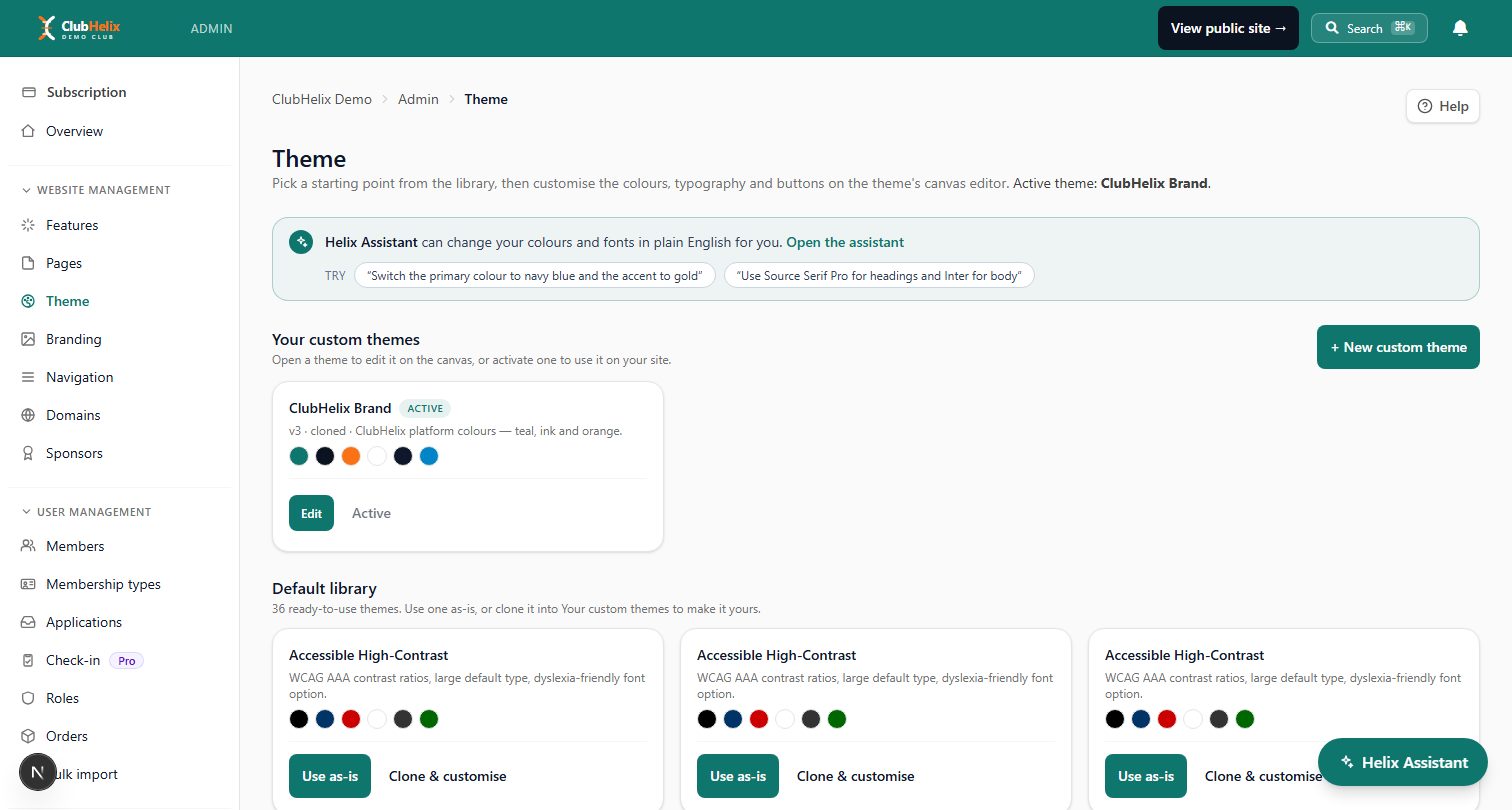
The site's built-in Helix Assistant follows the same contract for pages: propose, preview, apply-on-approval.
The same contract now covers the words themselves. On the news, match report and broadcast screens, a Draft with Helix button turns your notes into a draft inside the form, and AI Studio in the admin has the rest of the writing tools, including email subject lines and translation. Nothing is saved or sent until you do it. See AI writing tools for club volunteers for the full list and how to brief them.
A weekly rhythm that actually sticks
- Saturday, 15 minutes (whoever was at the game): message the facts to the drafting person — or straight into the assistant. Scores, standouts, canteen total, next week's ask.
- Sunday, 20 minutes (drafter): generate the match report and newsletter draft, run the review checklist, fix names and numbers, queue both as drafts.
- Monday, 10 minutes (approver — a second person): read fresh, approve, publish the news post, pick the newsletter audience, send.
Two-person separation matters: the drafter is too close to the text to catch its errors. Total cost: 45 volunteer minutes across three people, for comms that used to consume an evening — and consistency is the real prize, because a newsletter that reliably arrives every week beats a brilliant one that arrives monthly. (For the bigger picture on channels and cadence, see our club communication plan.)
Frequently asked questions
Will members be able to tell it's AI-written?
If you follow the facts-in workflow and edit for voice, no — because the substance is yours and the review is human. If you skip the review, yes, eventually, and usually via an error rather than the prose. Transparency is also a fine policy: plenty of clubs happily note that AI helps draft and volunteers approve everything.
Should the AI ever send the newsletter itself?
No, and we'd hold that line even if you asked us to build it. Sending to a member list involves consent, audience choice and accountability — human decisions. In ClubHelix a connected assistant cannot send or publish; it can only leave drafts in your review queue. The worst possible AI outcome becomes a bad draft nobody approved, which costs nothing.
What about photos?
Use real ones — your members photographing your actual club beat anything generated. AI's role in imagery is captioning and alt text (which it drafts well, improving accessibility). Publishing a generated image of a "match" that never happened is the fastest way to make all your comms feel fake.
Does this work for small clubs without a comms person?
It works best there. The method needs one person with facts and fifteen minutes, not a comms committee — and the drafts land in the same news and broadcast queues your club already uses, so there's no new tool to learn.


