
What this guide answers
- Can a new platform import our members' saved card details?
No, and be wary of anyone who says yes without qualification.
- Will we actually lose members just by switching?
You will lose payments if you do not run the re-authorisation properly, and you may lose a small number of people who were already leaving.
- What if a member will not put their card in online?
Give them a path that does not need one — bank transfer or paying in person — and record it against their membership so the roster shows them as paid.
- When is the best time to run the campaign?
Attach it to something people already expect: renewal time, registration day, or the start of a season.
- How do we know who has and has not re-authorised?
Take a count of active payers from your current system before you start — that number is the size of the job.
South Africa edition. This guide is written for volunteer-run clubs in South Africa. Where rules differ — grants, tax, incorporation, safeguarding — follow the South Africa-specific pointers below or check with your national body.
Ask a club committee what worries them about changing software and you will rarely hear a word about features.
What they are actually afraid of is the members. That half the club will never log in again. That the payments will quietly stop and nobody will notice until the treasurer reconciles in three months. That the person who has renewed every year since the nineties will be asked to do something on a phone and will simply not bother.
Those fears are reasonable, and one of them is entirely justified. This guide is the honest version: what genuinely cannot survive a switch, why that is true on every platform rather than just the one you are looking at, and how to run the part that falls on your members so it costs you a fortnight of admin instead of a chunk of your roster.
What "losing members" actually means
It is worth separating three different losses, because committees argue about them as if they were one thing.
The payment loss. People who stay in the club, still turn up, still think they are paid up — but whose recurring payment never restarted on the new system. This is the big one, it is silent, and it is the only loss that is genuinely caused by the switch.
The roster loss. People who never made it onto the new system at all: dropped in a messy import, sitting in a spreadsheet column nobody mapped, or never sent an invitation because their record had no email address.
The decision loss. People who were already half out the door and used the change as a natural moment to stop. Painful, but not really about software — and a well-run switch surfaces these people rather than creating them.
Only the first is unavoidable. The other two are planning failures, and both are cheap to prevent.
The one thing that never transfers
Here is the part good vendors say out loud and poor ones leave until week three: stored card details and recurring payment authorities do not move between systems. Every paying member has to authorise again.
There are two things behind that.
Card details are not held by your club or by your club's software. They sit in the vault of the payment provider your current platform uses, attached to that platform's merchant arrangement. When you change platforms you almost always change providers, merchant arrangement, or both, and the stored card does not follow. Provider-to-provider card migrations do exist, but they are arranged directly between two providers for the same merchant under conditions that rarely describe a community club changing platforms. It is not something a volunteer committee should build a plan around.
A recurring authority is narrower still. It is a permission your member gave to a named party to take money on a stated schedule. Change the party and the permission no longer describes the arrangement. That is a feature of the payments system, not an inconvenience someone forgot to fix — the whole point is that a member's bank account cannot be handed from one organisation to another without them agreeing.
So the honest planning rule is simple: assume every active payer re-authorises, and budget the effort for it.
Anyone who tells you their platform can lift your saved cards across is either describing a much narrower case than you have, or has not checked. Ask them the direct question and write down the answer.
There is a small consolation. A re-authorisation campaign is an audit. Clubs regularly find they have been carrying dormant authorities for people who left years ago, duplicate authorities for the same family, and members paying an amount that stopped matching the fee schedule three seasons back. You will clean all of that up in one pass.
Run the re-authorisation as a campaign, not an email
The clubs that lose payers are not the ones with the wrong software. They are the ones that treated this as a single announcement and then wondered why a third of people ignored it.
Tell people early, before anything visibly changes
Announce the change before the new system appears, not on the day it does. A member who has already heard "in a few weeks we will ask you to set your payment up again on the new system" reads the eventual link as expected admin. A member who has heard nothing reads exactly the same link as a scam — and in fairness to them, an unexpected message asking for card details is what a scam looks like.
Say it at training, in the newsletter, at the meeting, and on the club's social accounts. Repetition is what makes it feel official.
Explain why in one sentence
Do not write a paragraph about payment infrastructure. One sentence, in plain language, is enough:
For everyone's security, saved card details can never be transferred between systems — so we need you to set your membership payment up once on the new site. It takes about a minute and the amount and date are exactly the same.
Two things in there are doing all the work: "for everyone's security" (which is true, and reframes the ask as protection rather than inconvenience) and "the amount and date are exactly the same" (which pre-empts the fear that this is a price rise in disguise).
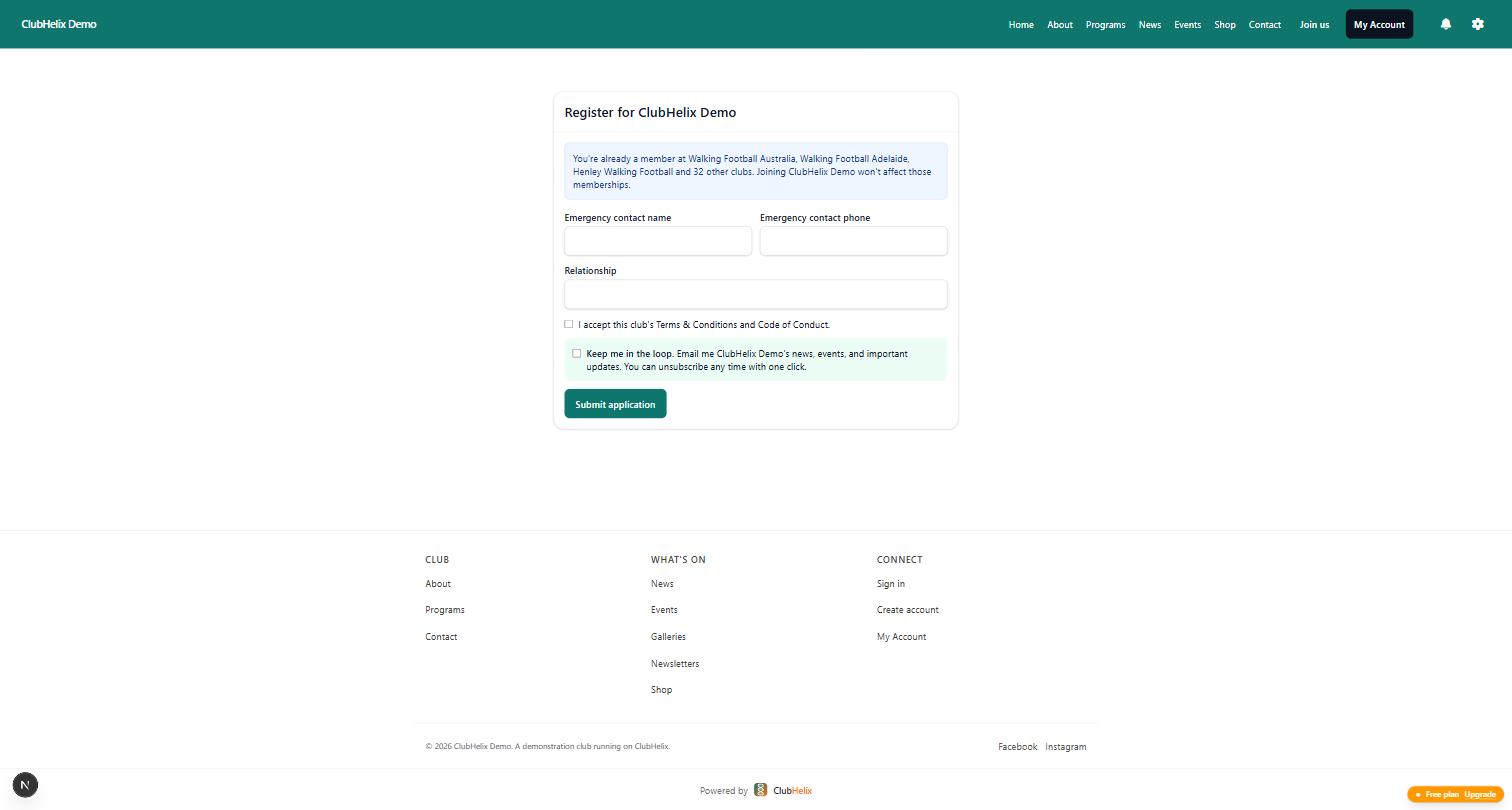
Make it one tap
Every extra step costs you people who intended to complete it.
- Link straight to the payment step. Not to a home page, not to a login screen, not to "create an account first, then find the payments tab".
- Assume a phone. Most of these will be done standing in a kitchen at 8pm.
- Do not change the fee, the schedule or the membership structure in the same season as the switch. If a price rise is due, it is a separate conversation with its own message.
- Give a non-card path for the people who will not enter a card online — a bank transfer, or paying at the club — and record those centrally so they do not show up as unpaid.
Chase in waves, and only chase the people who have not done it
Nothing burns goodwill faster than a fourth reminder sent to someone who paid on day one. Filter every wave to the people still outstanding.
- The announcement, to everybody, with the link and the one-sentence reason.
- A reminder a week or so later, to non-completers only, in the same channel.
- A different channel for the next round — a text message rather than another email, because a person who ignores email is not ignoring you, they are ignoring email.
- A human, for whoever is left. The registrar or a team manager having a thirty-second conversation at training will convert people that no amount of messaging will.
Keep a list, not a feeling
Track re-authorisation as a number the committee sees every week: how many active payers you started with, how many have completed, who is outstanding. Without that list the campaign quietly stops when everyone is tired of it, which is usually about two-thirds of the way through.
The other quiet ways a switch loses people
- Nobody's password moves. Logins never transfer either, and members will need to set a new one. Say so in advance or your inbox fills with "the new site won't let me in".
- The join link changes. Every printed flyer, clubroom QR code and council directory entry points at an address you are retiring. Redirects are what stop those becoming dead ends — see what happens to your old club website and our guide to keeping your search rankings.
- Your email may land in junk. A new sending setup has no reputation attached to it. Start with a message people are expecting, and get your sending domain verified properly before the campaign rather than during it.
- The gap in the middle. The fortnight where the old system stopped taking payments and the new one was not quite ready is where members conclude nothing is happening. Do not open that gap: run both until the new one is genuinely working.
- The special cases. Life members, complimentary members, concession rates, and the family paying one amount for three children. These are exactly the records an import handles worst and exactly the members you least want to annoy. Check them by hand.
Who to protect first
Not everyone needs the same care, and volunteer time is finite.
- Active payers, because that is the money.
- Committee and volunteers, who need working access on day one or every other job stalls.
- Life members and long-standing members, who deserve a phone call from someone they know rather than a bulk message. This costs an evening and buys an enormous amount of patience.
- Junior families, where one payer covers several registrations and a failed re-authorisation quietly disenrols three children.
Doing it on ClubHelix
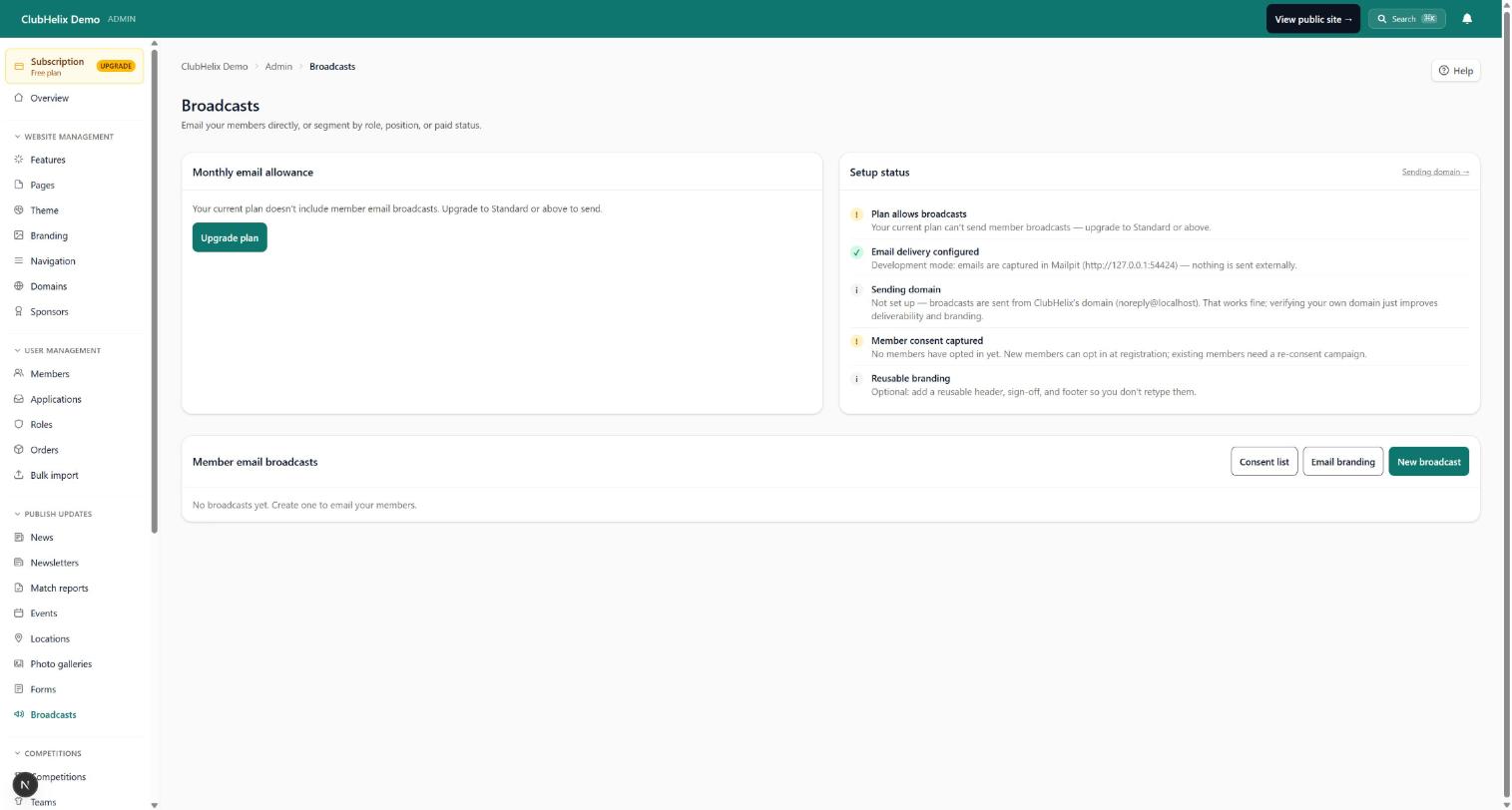
If ClubHelix is where you are heading, the parts that reduce this work are the roster import and the campaign tooling. An existing roster comes in by spreadsheet import with duplicate detection and a dry-run preview, so you see what will be created, updated and skipped before anything is written. Members then join or renew themselves on your branded site with your questions and your terms (self-serve registration), card payments and auto-renewal run through your club's own payment account, and renewal reminders go out automatically so the campaign does not depend on somebody remembering. Broadcasts handle the waves with audience filtering, and reports give you the outstanding list rather than a feeling.
What we will not pretend: we cannot import your members' stored cards or payment authorities either. Nobody can. That part of the work is the same wherever you go, and any platform that implies otherwise is worth a harder question.
If your committee would rather not run the campaign themselves, our done-for-you service covers the migration. Otherwise you can start free, build alongside your current system, and only switch the payments over when the new one is genuinely ready.
Frequently asked questions
Can a new platform import our members' saved card details?
No, and be wary of anyone who says yes without qualification. Card details sit with the payment provider under your current platform's merchant arrangement, and a recurring authority names the party permitted to take the money. Change either and the permission no longer applies. Plan for every active payer to authorise again.
Will we actually lose members just by switching?
You will lose payments if you do not run the re-authorisation properly, and you may lose a small number of people who were already leaving. Clubs that announce early, make the payment step one tap and chase the stragglers by name generally come out with a cleaner roster than they went in with.
What if a member will not put their card in online?
Give them a path that does not need one — bank transfer or paying in person — and record it against their membership so the roster shows them as paid. A member who pays by transfer is still a paid member; only your admin needs to know the difference.
When is the best time to run the campaign?
Attach it to something people already expect: renewal time, registration day, or the start of a season. Avoid finals, avoid the weeks either side of a major club event, and never run it in the same message as a fee increase.
How do we know who has and has not re-authorised?
Take a count of active payers from your current system before you start — that number is the size of the job. Then work from an outstanding list in the new system every week. Without a before-number you cannot tell the difference between finished and forgotten.
Should we change our fees while we are switching?
No. Change one thing at a time. A fee change during a re-authorisation campaign turns every reminder into an argument about price, and you will not be able to tell which of the two caused people to drop off.


