
What this guide answers
- What is a pennant tie, exactly?
A tie is the whole contest between two clubs in one round, and it is made up of several individual contests — four tennis rubbers, three bowls rinks, five badminton matches, a card of darts legs.
- How should we record a pennant result so the ladder is right?
Record each rubber, rink or set individually, with its score and its position in the order, and let the tie result follow from them.
- When should we name the side for a pennant fixture?
Mid-week, in writing, published to the whole club at once, with an ordered list of reserves who each know their place in it.
- Who fills in the match card and who signs it?
Each captain submits their own lineup in playing order before the start, one nominated scorer records each contest as it finishes, and both captains confirm the completed card at the end.
- What happens if a pennant tie is washed out or forfeited?
Whatever your by-laws say — which is why they need to say it before round one.
Canada edition. This guide is written for volunteer-run clubs in Canada. Where rules differ — grants, tax, incorporation, safeguarding — follow the Canada-specific pointers below or check with your national body.
Nobody hands you a manual on how to run pennant. Being the pennant secretary is one of those club jobs that looks like an hour a week from the outside; from the inside it is a weekly cycle of availability messages, a selection meeting, seven phone calls, a set of keys, a match card, and a result that has to reach the association before somebody's dinner goes cold. Depending on where you play, the same competition might be called interclub, league play, division play or a club championship — the mechanics below are identical whatever the sign on the noticeboard says.
And underneath all of it sits one structural problem that no amount of good will fixes. A pennant tie is not one score. It is a sequence of rubbers, sets, rinks or bouts, and the tie result is a consequence of them. Every spreadsheet ever handed down from the last pennant secretary gets this wrong: it has two columns, "us" and "them", so the four individual results that are the only thing the players actually care about get boiled down to a number somebody worked out in the car park and then lost.
Start with the shape of a tie
Before you organise anything else, write down what one tie in your competition actually consists of, and how the individual contests add up to a team result. Get this wrong and every ladder argument for the rest of the season traces back to it.
| Sport | A tie is usually | The tie result comes from | Kept underneath it |
|---|---|---|---|
| Tennis | Four singles rubbers, or two singles and two doubles | Rubbers won, then sets, then games | Set scores per rubber |
| Squash | Four or five singles rubbers in order of strength | Rubbers won, then games won | Best-of-five game scores |
| Badminton | Five or nine matches: singles, doubles and mixed | Matches won, then games | Two- or three-game scores |
| Table tennis | Four singles and one doubles, best of five sets | Matches won, then sets, then points | Set scores per match |
| Lawn bowls | Three or four rinks of four players | Rinks won, plus total shots for and against | Shots per rink |
| Darts | A set order of singles and doubles legs | Legs won across the card | Leg-by-leg detail |
| Pickleball | Four to six doubles and mixed combinations | Matches won, then games | Game scores per combination |
Two things follow from that table. First, the order matters: in most pennant formats rubber one is the number-one player, rink one is the skip's rink, and swapping the order to dodge an opponent is the oldest form of cheating in club sport. Write the ordering rule into your by-laws. Second, the aggregation rule has two families — wins (three rubbers to one, two rinks to one) and points (total shots, total legs) — and plenty of competitions use both, with rinks won as the primary measure and shot difference as the separator. Decide which one is the tie result and which one is the tiebreaker before round one, not in round eighteen.
Before the season: grading and nominating
Grading is the association's job, but the information it grades on is yours. Nominate teams honestly and you get a season of close ties; nominate a stacked side into a low grade and you get a regrade letter in round four and a clubroom full of people who did not enjoy winning 4–0 every week.
- Count your genuine players, not your members. A side of four needs six or seven realistically available people across a season of injuries, shift work and holidays. Two sides of four sharing nine players is one washout away from a forfeit.
- Nominate by strength, then by social group. Grading submissions usually want last season's grade, finishing position and returning players. Say if you have lost your top two — the association cannot grade information it does not have.
- Check the calendar before you accept the fixture. School holidays, long weekends, the club's own open day and the venue's other hirers all collide with pennant, and a clash spotted in January is an email while a clash spotted in April is a forfeit. Our guide to making a fixture draw covers how the draw itself is built, including how byes are distributed and why they should never be hand-assigned.
- Publish the pennant fixtures the day you get them. One authoritative copy on the club website, not a PDF that spawns four out-of-date versions in four inboxes.

Selecting and notifying the side each week
Pennant team selection is where seasons are actually won and lost, and the failure is almost never about ability. It is about the reserve who found out by group chat at 8pm on Friday that she was playing at 9am on Saturday, forty minutes away.
Run the week to a fixed rhythm so nobody has to guess:
- Ask for availability early and in one place. A standing weekly request beats a thread. Anyone who does not answer is unavailable — say so in the policy so it is a rule rather than a grudge.
- Select against a written policy. Strength, availability, form, and whatever balance of rotation your club has agreed. A selection policy turns an argument about favouritism into a conversation about criteria.
- Name the side by a deadline, in writing. Mid-week, published to the whole club, not just to the players in it — the people who were not picked need to see the same list at the same time.
- Notify every selected player individually, with the ground, the start time, the meeting time and who is driving. A team list on a noticeboard is not a notification.
- Name the reserves properly. A reserve who knows on Wednesday that she is first emergency for Saturday can plan her weekend. Give reserves a real order and tell them their place in it.
- Have one named person who handles a Friday withdrawal. Not the committee. One phone number.
Home venue, courts, rinks and keys
A home tie is a booking problem wearing a sporting costume. The courts, greens or tables the tie is played on are the same resource your members book socially, so the fixtures have to be loaded into the booking system as blocks before public bookings can land on top of them. Do it for the whole season in one sitting, the week the draw arrives.
Then settle the human logistics, in writing, once:
- Who unlocks. Name a person and a backup for every home round, with the key or the code, and the time they need to be there — which is before the visiting side arrives, not at the start time.
- Rink, court and table allocation. Decide how the home side allocates, and publish it. Rotating the good rink is fairer than the home skip taking it every week, and visiting teams notice.
- What the home club owes the visitors. Teas, a clean changing room, working lights, a scoreboard, somewhere to sit out of the weather. It is minor, it is cheap, and it is the entire reputation of your club in the association.
- Who is on the door if there is an entry cost. Keep the money handling boring and make sure the person on the door is not also playing rubber one.
The match card
The match card is the legal record of the tie, and it is the one artefact pennant clubs consistently treat too casually. Three phases, three different people:
Before play — the side is submitted. Each captain writes their lineup in playing order, and it locks at the scheduled start time. A side named after seeing the opposition's order is not a side, it is a tactic, and every competition's by-laws prohibit it.
During play — somebody scores. One person per tie records each rubber, set or rink as it finishes, with the detail underneath: "6–4 3–6 7–5" or the shots on each rink. Recording as you go, rather than reconstructing afterwards from memory and a beer mat, is the difference between a result and a dispute.
After play — both captains confirm. Both sides sign, because a card signed by one captain is that captain's opinion. When the two sides disagree, the card should be marked disputed and escalated to the association with both versions intact — not quietly amended by whoever got to the paperwork first.
Then: results are due to the association by its deadline, which is usually the same evening or the following morning. Know the deadline, know the method, and know who does it when that person is away. Late results are the single most common way a well-run club collects a fine.
Forfeits, washouts and byes
Every one of these is a rules question with a right answer written down somewhere. Look it up once, put it in your own by-laws in plain language, and stop arguing.
| Situation | What actually happened | How to record it |
|---|---|---|
| Forfeit — side does not arrive | No play at all | Standard forfeit score from the by-laws, full points to the side present |
| Forfeit — short side | Some rubbers played, the unfilled ones conceded | Played contests stand as played; unfilled ones recorded as forfeits |
| Washout before the start | Nothing began | Shared points or a replay date, per the by-laws — decided once, not per tie |
| Washout part-way through | Some contests complete, some abandoned | Completed contests stand; the by-law decides whether the tie counts |
| Bye | No opponent this round | Bye points as the competition specifies, recorded so the ladder is honest |
| Withdrawal mid-season | A club has pulled a side out | Expunge their results or let them stand — pick one rule and apply it to every round |
The principle behind all six: record what happened, not what it averaged out to. A forfeited rubber recorded as a forfeited rubber is auditable a month later. A 4–0 typed in by hand is not.
The ladder, and what actually separates two teams
Pennant ladders are usually decided on tie points first — the points for winning the tie — and then on the contests underneath it. That is exactly why the shape of a tie matters: if your ladder separates level teams on rubbers won, sets won or shot percentage, those numbers have to exist as data, not as a memory. Two teams on equal tie points is the normal end to a close grade, not a freak event, and the criterion that separates them needs to be published before round one. Our guide to ladder tiebreakers explains what each measure actually captures, which order suits which sport, and why head-to-head is both the most popular and the most awkward criterion in the list.
Finals eligibility
The finals dispute you will have is about eligibility, and it will arrive in the week you have the least time. Settle it in pre-season:
- Games played. A minimum number of home-and-away ties in that grade is the standard rule. Know the number, and track it from round one — a player discovered to be one game short on finals eve is a loss nobody recovers from.
- The player who played up. Somebody filling in for a higher side is the most common eligibility trap in pennant. Most by-laws limit how many times a player can play up before they are locked into the higher grade. Count it weekly.
- Financial status. Fees paid by a stated date is a common condition. Check it a month out, not on the Friday.
- The finals format itself. How many sides qualify, who gets a double chance, and what happens to a drawn final. Fixture and finals formats covers the options; the job here is simply to publish the one you are using.
The season wrap
Two weeks after the last tie, while it is still fresh: confirm your club competition results against the association's published ladder, settle any outstanding fees with the association, work out who has actually played enough to earn an award, write the grading note for next season while you remember which grade was too strong, and thank the people who unlocked the clubhouse. Then hand the next pennant secretary a document rather than a shoebox.
The weekly runsheet
| When | Who | What |
|---|---|---|
| Sunday or Monday | Pennant secretary | Confirm last week's result, check the published ladder matches your card |
| Monday | Pennant secretary | Send the availability request for the coming week |
| Tuesday evening | Selectors | Selection meeting against the written policy |
| Wednesday | Pennant secretary | Publish the side and the reserve order; notify every player individually |
| Thursday | Team manager | Confirm the venue, keys, teas, transport; brief the scorer |
| Friday | The named contact | Handle withdrawals; promote the first reserve |
| Match day, early | Home captain | Unlock, set up, allocate rinks or courts, exchange lineups |
| Match day, during | Scorer | Record each rubber, rink or set as it finishes, with the detail |
| Match day, after | Both captains | Confirm and sign the card; resolve or formally dispute |
| Match day, night | Pennant secretary | Submit the result to the association before the deadline |
How this looks in ClubHelix
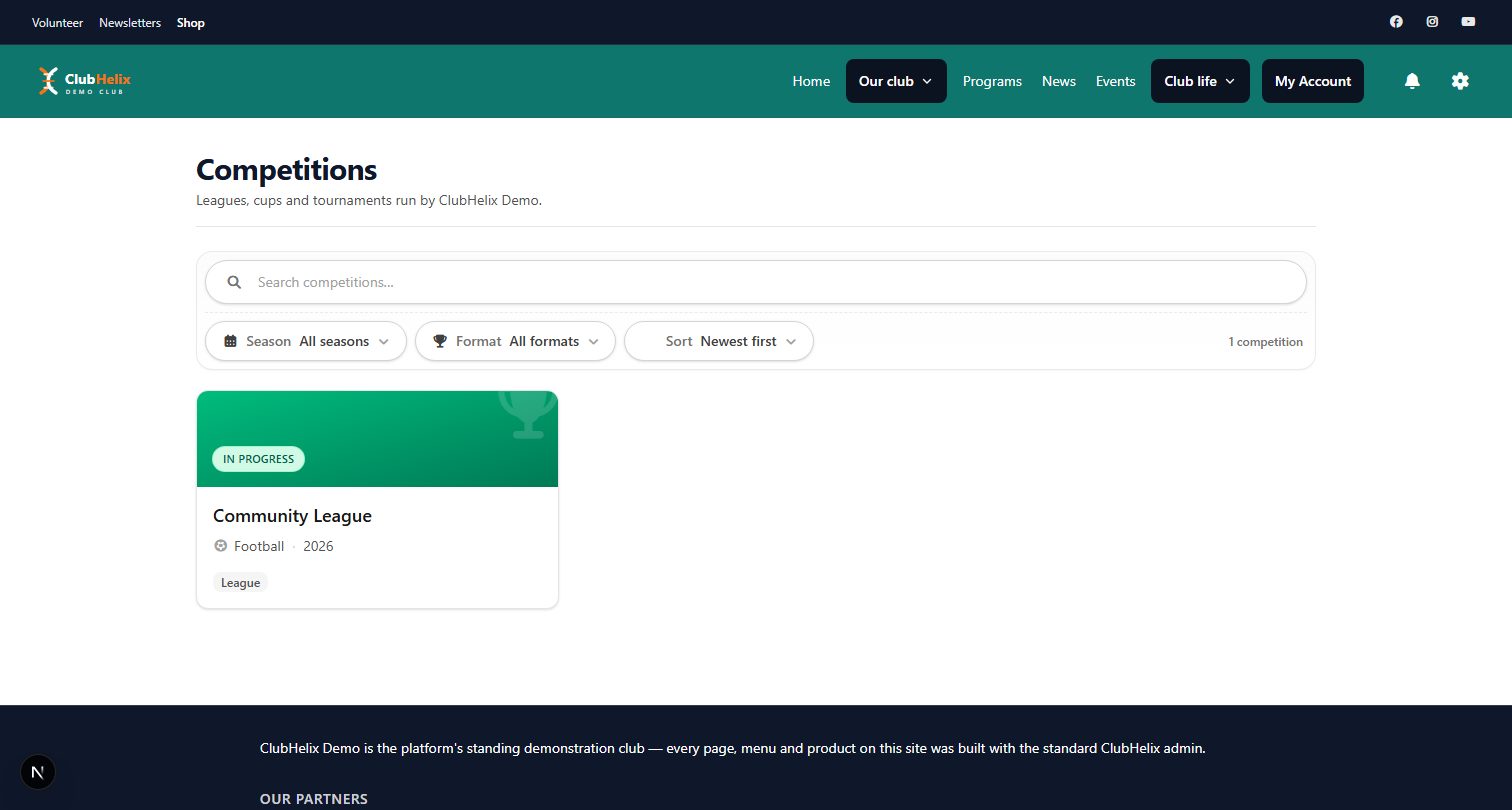
The reason the spreadsheet fails is structural, and it is the specific thing competitions in ClubHelix is built to fix: a tie is stored as an ordered sequence of sub-fixtures — rubbers, sets, rinks or bouts — each with its position, its label, the two participants, a score each and an outcome. The set scores inside a rubber live with it as detail ("6–4 3–6 7–5"), so nothing the players care about is thrown away.
Aggregation is a per-competition choice, so it matches your by-laws rather than fighting them. Set it to wins and the tie score becomes the number of contests each side won — three rubbers to one, two rinks to one. Set it to points and the tie score is the sum of the contest scores — total shots across three rinks, legs in a darts card. Either way the tie result is a consequence of the contests underneath it, and it flows straight into the ladder, with configurable tiebreakers so the criterion you published before round one is the one that runs.
Around that:
- Fixtures and the draw are generated and published to your public site, so a washed-out round is an edit rather than a re-issued PDF.
- Team lists carry coaches and contacts, so the person doing the Friday phone calls has the numbers in the same place as the fixture.
- Match cards run the pre-match lineup, the scoring and the post-match confirmation from both sides, with a disagreement recorded as a dispute instead of quietly overwritten.
- Facility booking holds the courts, greens or tables the tie is played on, so the season's home ties are blocked out before a member can book over the top of them.
- Finals series seeds the bracket straight off the final ladder, including a top-eight bracket, so the format you announced is the format that runs.
Three honest limits, because a guide that overclaims costs you a Saturday. ClubHelix does not submit your results to the association's own results portal — somebody at your club still types them in there. It does not import your association's grading, so grades and nominations are entered by hand. And it does not appoint officials automatically. What it does is make sure the record of the tie is complete, ordered and correct before any of that happens. Plans are on the pricing page, and you can start on the free tier — the lawn bowls club guide shows the same machinery from a bowls club's side of the green.
Frequently asked questions
What is a pennant tie, exactly?
A tie is the whole contest between two clubs in one round, and it is made up of several individual contests — four tennis rubbers, three bowls rinks, five badminton matches, a card of darts legs. The tie result is worked out from those contests, either by counting how many each side won or by adding up the scores, depending on what your competition's by-laws say.
How should we record a pennant result so the ladder is right?
Record each rubber, rink or set individually, with its score and its position in the order, and let the tie result follow from them. A tie typed in as a single aggregate cannot be audited later and cannot feed a tiebreaker that needs rubbers won, sets won or shot difference — which is exactly the number you will need in the week finals places are decided.
When should we name the side for a pennant fixture?
Mid-week, in writing, published to the whole club at once, with an ordered list of reserves who each know their place in it. Selecting on the Friday night by group chat is how a reserve discovers at 8pm that she is playing at 9am, and it is the most avoidable reason good players stop making themselves available.
Who fills in the match card and who signs it?
Each captain submits their own lineup in playing order before the start, one nominated scorer records each contest as it finishes, and both captains confirm the completed card at the end. If the two sides disagree, the card should be marked as disputed and sent to the association with both versions rather than amended by whoever reaches the paperwork first.
What happens if a pennant tie is washed out or forfeited?
Whatever your by-laws say — which is why they need to say it before round one. The important part is recording what actually happened: completed contests stand as played, unfilled rubbers are recorded as forfeits, and an abandoned tie is resolved by the same written rule every time, rather than by negotiation between the two clubs involved.
ClubHelix records a pennant tie the way it is actually played — an ordered sequence of rubbers, rinks or sets that aggregates into the tie result and feeds a ladder with the tiebreakers you published. Competitions, match cards, team lists and a finals series in one admin.
