
What this guide answers
- How do we attract junior players to our club?
Go where the juniors already are: build genuine partnerships with your three or four nearest primary schools (run clinics, don't drop flyers), time them to your registration window, and funnel families into a…
- Why do come-and-try days fail to convert?
Usually three misses: no contact capture (families attend anonymously and can never be followed up), a day built as a scratch match where beginners fail publicly instead of stations where they succeed, and no follow-up…
- At what ages do clubs lose the most juniors, and what helps?
The predictable cliffs are the jump to full-format versions of the sport, the early teens, and the transition to seniors.
- How much does the parent experience really matter?
It's usually the deciding factor. Kids leave clubs because parents burn out on chaotic communication, clunky admin, surprise costs and Saturday logistics — not because the child stopped enjoying the sport.
New Zealand edition. This guide is written for volunteer-run clubs in New Zealand. Where rules differ — grants, tax, incorporation, safeguarding — follow the New Zealand-specific pointers below or check with your national body.
Juniors are the future of every club — everyone says it at the AGM, and then most clubs go back to running junior recruitment the way they always have: a registration-day post before the season and hope. Meanwhile the clubs that are actually growing treat junior participation as a system with four moving parts: being found (school links and local visibility), being tried (come-and-try experiences that convert), being worth staying for (pathways), and being easy for parents (the experience that really decides retention).
Get all four working and they compound: more juniors means more families, more volunteers, more canteen revenue, more future seniors, and a stronger case in every grant application you ever write. Here's the playbook.
First, understand who you're recruiting
You're not recruiting eight-year-olds. You're recruiting their parents. Kids supply the enthusiasm, but parents supply the decision — and parents are weighing questions the club rarely thinks to answer publicly:
- What does the season actually cost, all-in (fees, uniform, equipment, carnival levies)?
- Which nights are training, and what time does it finish?
- Is my child going to be welcomed at their level, or benched behind kids who've played for years?
- Is this club safe, organised and friendly — and can I tell that from the outside?
- How much will I be roped into?
Every recruitment tactic below works better when your club's public answers to these questions are easy to find. That mostly means your website: fees published honestly, training times current, a warm photo-rich juniors page, your child-safety commitments stated, and a working online sign-up. Parents comparison-shop clubs at 9:30pm; the club that answers questions at 9:30pm wins. (If your site isn't up to that job yet, start with our club website guide.)
School links: the highest-leverage channel
Schools are where all your future juniors already are, five days a week. A real school partnership beats any amount of paid advertising, and it's built like this:
- Pick your three or four nearest primary schools and assign one club person as the named relationship owner for each. Relationships, not letter drops, are the mechanism.
- Offer to run sessions, not to distribute flyers. Schools drown in flyers but genuinely need help delivering sport: offer free club-run clinics at lunchtime or in PE time, a unit of coaching support for their teachers, or equipment for their sports day. You're solving a school's problem, and every session is a come-and-try in disguise.
- Connect through the national participation programs. Most sports run school-facing entry programs through their national or state bodies (school clinic programs, teacher resources, and funding support) — ask your state association what exists for your sport and get your club listed as the local delivery point.
- Time your presence to your registration window. Run school clinics in the four weeks before registrations open, send every participating kid home with a "your local club" note naming the come-and-try date — and put a QR code straight to your sign-up page on it.
- Say yes to the school fete. A club stall with a skills game, some club colours, and a friendly coach recruits better than any post because parents meet actual humans.
Give it two seasons and the pipeline becomes self-sustaining: kids recruit classmates, teachers recommend you by name, and the school newsletter runs your registration dates for free.
Come-and-try days that actually convert
Most come-and-try days are fun and convert almost nobody, because the club treats the event as the goal instead of the start of a follow-up sequence. Design the day backwards from the sign-up:
Before: promote through the school channels above with a real registration link (even for a free event) so you capture family contact details before the day. A free event with online registration is your contact list; a turn-up-whenever event is a mystery crowd you can never contact again.
On the day:
- Structure it as stations of small games, run by your most patient coaches and your best junior players as helpers — not a scratch match where newcomers stand lost on a wing.
- Group by age AND by experience, so first-timers succeed in front of their parents. A child who touched the ball thirty times is coming back; a child who chased better players for an hour is not.
- Look after the parents deliberately: a coffee van or club barbecue, a five-minute "here's how our juniors work" welcome from the junior coordinator, printed fee/training info, and current parents wearing club colours to answer the honest questions.
- End with a clear, single next step: "Registrations are open now — sign up today at this QR code and your rego includes the club training shirt." An on-the-day incentive (discount, free shirt, fee-free trial month) measurably lifts conversion.
After — where conversion actually happens: email every family within 48 hours: photos from the day, the sign-up link, fees and dates, and an invitation to the first two training sessions free with no commitment. One reminder a week later. This one follow-up sequence typically outperforms every poster the club has ever printed.
Then lower the commitment cliff. The gap between "fun taster" and "full season registration" is where families fall off. Bridge it with short intro programs — a six-week beginner block at a starter price, holiday clinics, a term of skills sessions — that feel like a natural next step rather than a marriage proposal.
Time these against the school terms, and check what your council or regional trust offers by way of participation subsidies — for many families a subsidy is the difference between trying your sport and not.
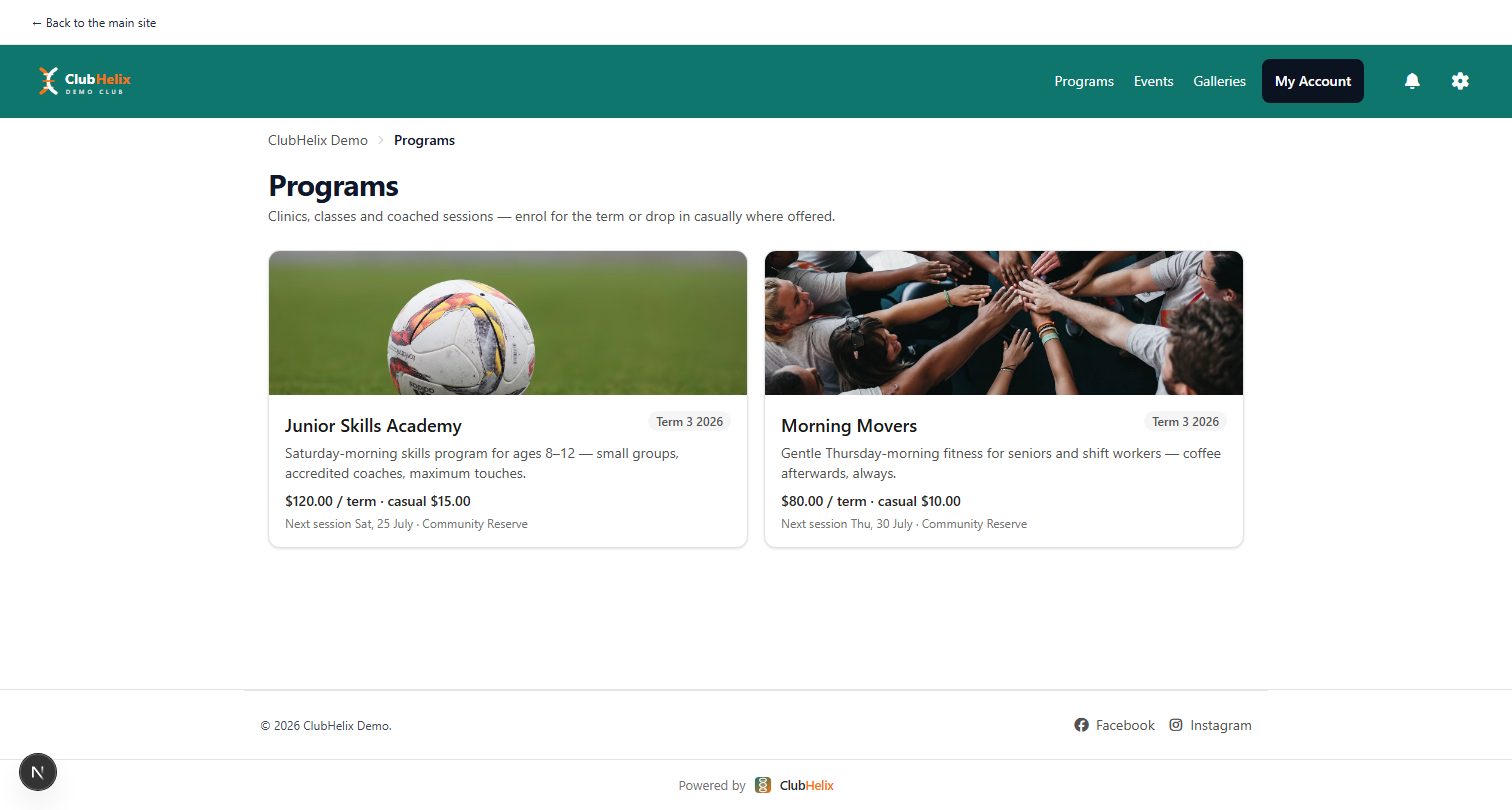
Purpose-built programs and enrolment tooling lets you publish these blocks with capped places and term-by-term sign-up, separate from full membership.
Pathways: give families a reason to stay
Recruitment fills the bottom of the funnel; pathways stop it leaking. Parents and kids both need to see what next season, and next stage, looks like:
- Publish the ladder. A simple visual on your juniors page: intro program → junior grades by age → youth/development squads → senior teams. Name real examples ("six of last year's under-17s played senior football this season") — nothing sells a pathway like faces that walked it. Where your sport's association runs rep or development squads, show how your club feeds them.
- Mind the cliffs. Junior sport haemorrhages participants at predictable ages — the moves to full-field formats, early teens (when sport competes with everything), and the jump to seniors. Counter deliberately: social/modified formats alongside competitive grades, never cutting kids at selection ages without a real alternative offer, and formal bridges to seniors (training with the seniors block, a youth player on the senior bench pathway, buddy pairings).
- Build non-playing pathways too. Teens who stop playing don't have to leave: junior coaching badges, scoring/officiating (often paid — a genuine teen job!), team manager assistant roles. Every one you keep is a future senior player, coach or committee member — and it feeds the volunteer engine every club runs on.
- Celebrate juniors publicly. Junior results and milestones on the club news page and socials, juniors as flag-bearers/ball-kids at senior games, a juniors segment at presentation night. Kids stay where they feel seen.
The parent experience: the retention system nobody budgets for
Here's the uncomfortable pattern behind most junior churn: the kid was happy, the parent was exhausted. The parent experience is a product, and these are its features:
- Frictionless admin. Online registration that works on a phone in five minutes, card payment with an instant receipt, and never filling in the same details twice. Every paper form and bank-transfer-with-reference is a family you're testing.
- Honest, all-in pricing — published fees including the hidden extras, family discounts for siblings, payment plans offered without embarrassment, and a quiet, dignified process for families who need help (many state governments run sports voucher schemes that rebate junior rego costs — accept them, promote them on your fees page, and you remove the price barrier for exactly the families most likely to walk).
- Predictable communication. One official channel, a weekly rhythm ("everything for Saturday, by Thursday night"), and no 9pm surprise messages about tomorrow's venue change. Chaos communication is the number-one parent complaint in junior sport.
- A proper welcome. The first-month experience — named contact, what-to-bring guide, "how Saturdays work" — is worth an entire guide of its own: see our club welcome pack template.
- Visible safety and warmth. Compliant-and-displayed child-safety practice, coaches who greet kids by name, and a culture where a new parent standing alone at training gets spoken to within ten minutes. Parents notice everything.
Measure it simply: registrations by age group each season, retention rate year-to-year, and one two-question survey to lapsed families ("what would have kept you?"). The answers will embarrass and then improve the club.

A season-cycle plan you can copy
- Pre-season (8–10 weeks before rego): confirm school partnerships and clinic dates; refresh the juniors page, fees and FAQs; open registrations online; announce come-and-try date through schools and socials.
- Registration window: run the come-and-try; execute the 48-hour follow-up; launch the intro program for the not-ready-yet families; sibling and voucher promos visible everywhere.
- Early season: welcome packs out; new-family check-in at week three; photograph everything.
- Mid-season: school-holiday clinic (recruits mid-season joiners for next year); juniors celebrated weekly on the news page.
- Late season: presentation day that makes every child feel like a champion; "re-register early" offer announced there; survey lapsed families.
- Off-season: debrief the numbers by age group; book next season's school clinics before the schools' calendars fill.
Frequently asked questions
How do we attract junior players to our club?
Go where the juniors already are: build genuine partnerships with your three or four nearest primary schools (run clinics, don't drop flyers), time them to your registration window, and funnel families into a come-and-try day with online registration so you can follow up. Then make the club easy to say yes to — published all-in fees, a five-minute phone-friendly sign-up, and a short intro program for families not ready to commit to a full season.
Why do come-and-try days fail to convert?
Usually three misses: no contact capture (families attend anonymously and can never be followed up), a day built as a scratch match where beginners fail publicly instead of stations where they succeed, and no follow-up sequence. Fix all three — register attendees online even for a free event, group by experience, and email within 48 hours with photos, the sign-up link and a low-commitment next step — and conversion transforms.
At what ages do clubs lose the most juniors, and what helps?
The predictable cliffs are the jump to full-format versions of the sport, the early teens, and the transition to seniors. What helps: modified and social formats running alongside competitive grades, never cutting a teenager without offering a real alternative (including non-playing roles like junior coaching or paid officiating), and formal bridges to senior sport so the step up is a pathway rather than a leap in the dark.
How much does the parent experience really matter?
It's usually the deciding factor. Kids leave clubs because parents burn out on chaotic communication, clunky admin, surprise costs and Saturday logistics — not because the child stopped enjoying the sport. Clubs that fix the parent side (online everything, honest pricing, one predictable communication channel, a real welcome in month one) routinely out-retain clubs with better teams, because the family's whole experience is the product.
ClubHelix handles the family-facing machinery: online registration that takes five minutes on a phone, and programs and enrolment for come-and-try follow-ons and holiday clinics. Then keep them with a proper welcome pack and a club website that answers parents' questions — see how to build one.


