
What this guide answers
- Can two riders book the same hour on our arena?
Only if you set the arena up as shared with a capacity, in which case each rider books their own place and the hour shows how many are left.
- What if someone brings a fourth horse they did not book?
That is a rules question first: your hire terms should say the number of horses stated at booking is the number allowed in.
- Do we need a card reader or a payment processor to hire out the arena?
No — a resource paid at the venue confirms bookings without any payment provider connected, so you can take arena bookings from day one and collect the money by QR code, bank transfer, cash or an EFTPOS terminal you…
- Can we stop non-members from booking?
Yes, per arena: eligibility can be everyone, financial members only, or specific membership types.
- What happens when the surface is waterlogged?
Close the arena for the day with a reason the public can see ("Surface waterlogged"), which takes it off the booking grid, and contact the riders who had booked.
USA edition. This guide is written for volunteer-run clubs in the United States. Where rules differ — grants, tax, incorporation, safeguarding — follow the USA-specific pointers below or check with your national body.
Stand at the arena fence on a weekday morning. The surface was harrowed at the weekend, the lights are wired, the fencing was the biggest single item in last year's accounts — and there is nobody in it. Meanwhile, a rider three roads away is hacking along a verge because the only arena she can get to is booked solid by the yard that owns it.
Arena hire is the equestrian club's most under-used asset, and the reasons it stays under-used are all administrative. Nobody wants to be the person who holds the diary, answers the phone at feed time, counts horses at the gate and chases the money afterwards. This guide sets out how to run arena hire so that it earns its keep: the two ways clubs hire, the rules worth writing down, how to price per horse and per hour, what to do about clinics and rallies, and how to take payment at the gate without losing track of who still owes. The last third shows how the whole thing runs in ClubHelix, but the decisions come first.
Why the arena earns nothing sitting empty
An arena is a fixed cost with a variable income. The surface needs the same watering, harrowing and topping-up whether one horse works on it or none, the floodlights cost the same to maintain, and the fencing depreciates on the calendar, not on use. Every hour it sits empty is an hour of that cost with nothing set against it.
The club that treats hire as a favour ("ring Sue, she'll see if it's free") gets a handful of bookings a month from the members who know Sue. The club that treats it as a small business — clear rates, published hours, a booking page, a visible list of what is owed — fills weekday mornings with liveries, coaches with clients, and riders whose own yard has no arena. That income is what pays for the surface renewal in five years' time. It also tends to bring new members, because a rider who hires the arena three times a month soon works out that a membership is cheaper.
Two ways to hire an arena, and how to choose
Almost every arena-hire arrangement is one of two shapes, and the mistake most clubs make is running both on one arena without deciding which.
Exclusive hire gives one booking the whole arena. A rider brings two horses and works them one after the other; a family brings three ponies and a helper; a coach hires it for a private lesson. Nobody else is in the arena for that hour, so the price is usually per horse, per hour, up to a cap.
Shared sessions treat the arena as a set of places. Four riders each book a place in the same hour and school alongside one another, the way they would on a yard. The arena is "full" when the places are gone, and the price is per horse because each rider pays for their own.
| Question | Exclusive hire | Shared session |
|---|---|---|
| Who is in the arena? | One booking — a rider, a family, a coach | Several bookings side by side, up to a capacity |
| What does the booker pay for? | The whole arena, usually per horse they bring | Their own place, per horse |
| Best for | Lessons, young horses, jumping courses, filming | Flatwork, fitness, hacking-in weather, busy weekend mornings |
| What can go wrong? | Empty arena, one horse, low income | Riders who don't mix — a stallion, a nervous novice |
| What the booking system has to prevent | Two bookings in the same hour | A fifth horse in a four-horse hour |
You do not have to choose one for the club. Choose per arena. A club with an indoor and an outdoor often runs the indoor exclusive (lessons, jumping, the surface that matters most) and the outdoor shared (four places, come and school). A club with one arena can run shared sessions in the mornings by convention and exclusive hire in the evenings, though that takes discipline or a system that treats them as two resources.
Whichever you pick, write it on the booking page in plain words. "Exclusive hire — nobody else will be in the arena" and "Shared session — up to four horses in the arena at once" prevent the argument at the gate.
Set the rules before you open the gate
Arena rules are short, but they need to exist before the first stranger's horsebox arrives.
The surface. Decide who judges it unfit and what happens when they do. A waterlogged or frozen surface is closed, not "use at your own risk", and the closure needs a reason the rider can see before they load a horse. Put the decision on one named person per day and give them a way to close the arena from their phone.
Safety kit. Helmets to a current standard, boots with a heel, and a body protector for jumping are the usual minimum. State whether a coach or a second adult must be present for children, and whether lunging is allowed while another rider is in.
Young, green and difficult horses. This is where a comments box earns its place. "Anything we should know?" at booking gives the rider somewhere to say "four-year-old, first time off the yard" or "mare in season, please no stallions in the same session", and gives the club the information before the hour, not during it. Nothing in the booking rules can replace that sentence.
Lights and evening hours. If the arena is floodlit, evening hours are your most valuable and your most expensive. Set the hours the lights may run, who switches them off, and whether evening slots cost more. Neighbours notice floodlights; a published curfew is cheaper than a complaint.
Capacity. How many horses may be in the arena at once, in either mode? Four is common for a standard arena; a large indoor may take six; a small outdoor may be two. Capacity is a safety rule first and a pricing rule second.
Arrival and departure. The booking is the riding time. Say plainly whether tacking up, warming up and hosing down happen inside it or outside it, where horseboxes park, and where muck goes.
Write all of this into a short set of hire terms — our facility hire terms and conditions template has the clauses — and put the same words on the booking page. Every rule that lives only in someone's head fails the first time that person is away.

Price it per horse, per hour
The equestrian convention is per horse per hour, and it works because it scales with the wear: two horses do twice the damage of one. A few principles, then some numbers.
Have a member rate and a casual rate. Members have already paid for the arena through their subscription; casual riders have not. A visible member discount does two jobs — it rewards the members and it turns regular casual hirers into members.
Charge per horse, not per rider. A rider with two horses uses the arena for two horses' worth of wear. Set a maximum per booking so nobody arrives with six.
Decide what "financial member" means. The member rate should follow paid-up status automatically, or your treasurer will spend the winter arguing about who lapsed in October.
The figures below are illustrative only — an example of the shape, not a recommendation. Price against the yards and centres your riders actually use.
| Rate | Illustrative figure (your currency, per horse, per hour) | Notes |
|---|---|---|
| Member, shared session | 8 | Your bread and butter |
| Casual, shared session | 12 | Roughly half as much again |
| Member, exclusive hire | 15 | Covers the empty places |
| Casual, exclusive hire | 20 | Coaches with clients usually land here |
| Maximum horses per booking | 4 | A safety cap as much as a pricing one |
In practice that reads as "$12 per horse per hour, casual" on the booking page, and a casual rider with three horses for an hour owes $36. Round to whole dollars; nobody wants to find coins at a gate.
Two honest limits. If you want evening slots under lights to cost more than morning slots, you need either two rates the system can tell apart or a second bookable resource ("Indoor arena — evening, floodlit") with its own hours and prices. And a discount for a regular — the coach who books every Tuesday — is a conversation and a membership type, not an automatic loyalty rate. Our guide to pricing facility hire walks through both.
Clinics, rallies and pony club days
The arena is not only for hire. Rallies, clinics, working hunter practice, the annual show, harrowing and the farrier's visit all take the arena out of hire, and each of them has to be visible on the booking page before someone books over the top of it.
Treat these as blocks, not bookings. A block holds the arena — every place on a shared arena, not just one — for the hours it needs, outside the public hours if necessary, and shows the public grid a reason ("Dressage clinic", "Surface maintenance") so nobody wastes a phone call. If the club runs a pony club branch, its rally programme is the first thing to block for the season; hire fills in around it.
Weather closures are the same tool with a different reason. A waterlogged outdoor arena is closed for the day with "Surface waterlogged" as the reason, and the riders who had booked are the club's first phone calls, not its last.
Take the money at the gate
Plenty of equestrian clubs would rather not take card payment when the booking is made, and their reasons are good ones. Riders cancel: a horse goes lame on the morning, a box won't start, the weather turns. Every card payment that has to be refunded is a job for the treasurer, a delay for the rider and a fee for someone. The yard down the road takes cash or a bank transfer at the gate and everyone is used to it.
The trouble with gate payment has never been the payment. It is the record. Who booked, how many horses, and did they pay? The QR code on the tack-room door collects the money; it does not tell you which of Tuesday's three bookings it was for. Payment at the venue only works when three things are true:
- The booking is confirmed straight away, without a card, so the rider knows the hour is theirs.
- The rider is told exactly what they owe and how to pay it — on the booking screen, in the confirmation email, and again when they check their bookings.
- The club has a list of what is owed, by booking, that someone can tick off against the QR-code or bank-transfer takings.
With those three, gate payment is calmer than card payment. Without them it is the reason the volunteer quit. Our guide to taking payment at the venue goes deeper on QR codes, EFTPOS terminals, cash and reconciliation.
Running it in ClubHelix
Here is how the decisions above land as a worked example, using the arena on the ClubHelix Demo club.
Set the arena up as a resource. Under Facilities, the arena is added to its venue from Locations with a kind of Arena, a 60-minute slot, a cap on how many slots one booking may take, and an advance-booking window so the diary never fills three months out. Weekly opening hours cover each day separately — floodlit evenings on Tuesday and Thursday, mornings only at the weekend — and the eligibility setting decides who may book: everyone, financial members only, or particular membership types. Because the member rate follows paid-up status automatically, a lapsed member simply sees the casual price.
Choose how it is booked. The resource form asks How is it booked? — "One booking at a time" for exclusive hire, or "Several people can share it" with a How many fit at once? of four for a shared arena. Then Count something per booking: the unit is "horse", the maximum per booking is four, and Charge per horse multiplies the hourly price by the number. A live preview under the form shows the arithmetic ("4 horses × 1 h = …") before you save, so you can see your own pricing the way a rider will.
Add the comments box. A label such as "Anything we should know?" puts an optional (or required) box on the booking screen for members and guests alike. What they write is private to the club — it appears under the booker's name on the Bookings page and in the CSV, never on the public grid.
Choose how it is paid. "Card at the time of booking" sends the rider to a hosted checkout. "At the venue" confirms the booking straight away and shows the rider "Pay [amount] at the venue" together with your own instructions — this is where you say what to do on arrival, "pay in the tack room before you ride" — on the booking screen, in their confirmation email and in their bookings list. No payment processor is needed for that, so a club can take bookings from the day it signs up.
Print the posters. Facilities prints a QR poster for the arena and one for the whole yard. Laminate the arena one for the tack-room door and the yard one for the gate. Scanning it opens a pay page that already knows which booking the rider is standing there to settle — their own bookings when they are signed in, the ones made on that device when they booked as a guest, or the link in their confirmation email. That is the answer to "which of Tuesday's three bookings was that transfer for": the page shows what is owed and a booking reference for the rider to quote.
Set up how the money reaches you, once. On the Paying at the venue card, put in the club's own payment details — your payment QR image, a payment link or your account details — and they appear on every poster and every pay page. A rider can then Pay by card on the pay page, which runs through the club's own payment provider like any other online payment and carries the club's usual card fees; or pay the club direct and press I've paid to tell you, which raises a Rider says paid flag on the booking. The club still confirms it with Mark paid — a claim is never money.
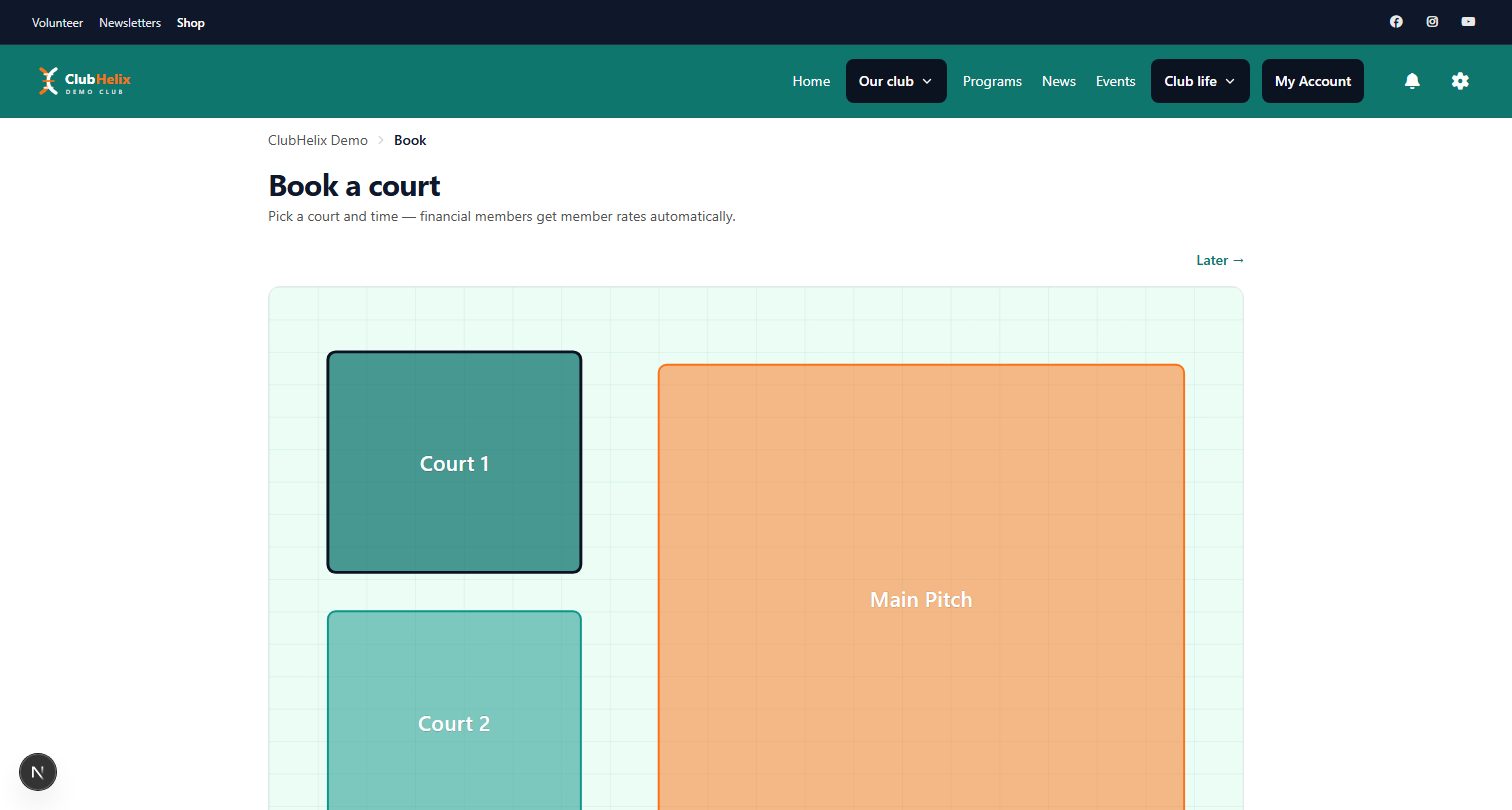
What a rider sees. On a shared arena every hour shows how many places are left ("2 of 4 left") and reads "Full" once they are gone. A rider booking three horses over two hours needs three places in both hours, and the stepper is capped by the places left across the whole selection. If two people race for the last place, the second is told "there are 0 left now" and the grid refreshes — the fifth horse is refused, not squeezed in. On an exclusive arena, clash-proofing is enforced at the database, so two bookings can never hold the same hour even if both press "book" in the same second. Guests book with a name and email; members sign in and can cancel their own upcoming bookings.
What the club sees. The Bookings page carries an "Owed at the venue" tile ("2 bookings still to settle"), a filter for everything still owed, a Horses column headed with your own noun, a "3 of 4" badge on each shared booking, and the rider's comment under their email. When the money arrives, Mark paid records cash, card at the venue, bank transfer or other, with an optional reference and an emailed receipt; the payment then appears in the club's ledger and finance reports dated the day it was collected, and the audit log records who marked it. Download CSV exports whatever the list is showing — units, comment, amount owed and payment method — for reconciling against the QR-code takings. Money the club records itself with Mark paid carries no platform commission.
For blocks, the same page holds the arena for a clinic or the harrow, taking every place unless you tell it otherwise, and a closure with a visible reason takes the arena off the grid for a waterlogged Saturday.
The full feature is described on the facility booking page, and the equestrian solutions page covers the rest of the club — memberships, rallies, the newsletter. Pricing is per club, not per booking; only money that actually goes through a payment provider carries the usual card fees.
Rollout checklist
- Committee decision: which arenas are for hire, exclusive or shared, and who administers it.
- Rules written: surface, safety kit, supervision of children, difficult horses, lights, arrival and departure, capacity.
- Prices set: member and casual, per horse per hour, a maximum per booking, and a plan for evening rates if you want them.
- Season blocked out: rallies, clinics, shows, maintenance — before hire opens.
- Payment decided: card at booking, or at the venue — the club's payment QR, link or account details entered once, the posters printed and laminated, and clear instructions written.
- Booking page live, with the rules and prices in plain words and the comments box switched on.
- One person per day owns the surface decision and the "owed at the venue" list.
- After a month: read the bookings report, count the empty hours, and go and find the coach who needs them.
Frequently asked questions
Can two riders book the same hour on our arena?
Only if you set the arena up as shared with a capacity, in which case each rider books their own place and the hour shows how many are left. An arena set to "one booking at a time" gives the whole hour to whoever books first, and the booking system refuses a second booking outright.
What if someone brings a fourth horse they did not book?
That is a rules question first: your hire terms should say the number of horses stated at booking is the number allowed in. Set a maximum per booking so the count is visible, charge per horse so the extra one costs something, and use the comments box so riders can tell you their plans in advance. On a shared arena a horse that was not booked has no place, and the club is within its rights to turn it away.
Do we need a card reader or a payment processor to hire out the arena?
No — a resource paid at the venue confirms bookings without any payment provider connected, so you can take arena bookings from day one and collect the money by QR code, bank transfer, cash or an EFTPOS terminal you already have. Record each payment with Mark paid so the list of what is owed stays honest. Card payment needs a processor either way — at the time of booking, or from the pay page a rider reaches by scanning the poster.
Can we stop non-members from booking?
Yes, per arena: eligibility can be everyone, financial members only, or specific membership types. Many clubs open shared sessions to everyone at a casual rate and keep exclusive evening hire for members, which is a good way to turn regular casual riders into members.
What happens when the surface is waterlogged?
Close the arena for the day with a reason the public can see ("Surface waterlogged"), which takes it off the booking grid, and contact the riders who had booked. A cancelled booking that was to be paid at the venue owes nothing; a card payment is refunded through your payment provider.


