
What this guide answers
- How much should we charge sponsors?
Price from your assets and your market, not from hope: count your real reach (members, families, email opens, event attendance), check what local advertising with similar reach costs, and package accordingly.
- What's the best way to approach a business for sponsorship?
Through a person, with a specific offer. Start with businesses connected to your members, address the owner by name, lead with the connection, attach a short proposal with clear packages, and follow up by phone within…
- What should a sponsorship proposal include?
Two to three pages: a personalised cover, the club's story in one paragraph, the audience numbers (members, families, digital reach, event attendance), the packages in a clear table with prices and exclusivity notes…
- How do we keep sponsors year after year?
Deliver visibly and report on it. Put every promised benefit on a checklist with a named owner, photograph the signage and features as they happen, send a short mid-season impact note, thank sponsors publicly at…
New Zealand edition. This guide is written for volunteer-run clubs in New Zealand. Where rules differ — grants, tax, incorporation, safeguarding — follow the New Zealand-specific pointers below or check with your national body.
Sponsorship is the most misunderstood money in club sport. Committees treat it as asking local businesses for charity — which is why the asking feels awkward, the letters go unanswered, and the same long-suffering local pub ends up on the back of the jerseys every year.
Reframe it and everything gets easier: sponsorship is selling something real. Your club owns attention — hundreds of members and families who see your ground, wear your kit, open your emails and attend your events, week after week, in exactly the neighbourhoods a local business wants to reach. A sponsorship proposal isn't a request for a donation; it's a marketing offer with a community-goodwill premium. Businesses buy it every day.
This guide turns that reframe into a system: audit what you're selling, package it, find the right businesses, make the approach (templates included), and — the part that determines whether they renew — deliver what you promised.
Step 1: audit your sponsorship assets
Before you price anything, list everything a sponsor could get from your club. Most committees are surprised how long the list is:
- Visual: jumper/uniform logo placement, ground signage, marquee and flag placement at events, scoreboard naming, training bib branding.
- Digital: logo and profile on the club website's sponsor page, inclusion in club email newsletters, social media posts and shout-outs, sponsor-of-the-match posts.
- Events: naming rights to events (presentation night, a race day, a tournament), a stall or banner at come-and-try days, tickets to club functions.
- Community: "proud supporter of X Club" rights for the sponsor's own marketing, member-only offers ("show your membership card for 10% off"), cheque presentations and photo opportunities.
- Numbers that make it real: member count, family reach, email list size and open rates, website visits, social following, event attendance. Gather these once a year — they're the difference between "support us" and "here's the audience".
Step 2: build three packages (and a jumper deal)
Businesses respond to clear options far better than "what would you like to give?". The classic structure works because it's easy to say yes to:
| Package | Typical price range (community club) | What's in it |
|---|---|---|
| Gold / Major partner (1–2 only) | $2,000–$10,000+ | Playing-kit or naming rights, premium signage, logo on everything, event naming, newsletter and social features, function tickets |
| Silver | $500–$2,000 | Ground sign, website + newsletter presence, social posts, member offer listing |
| Bronze / Club supporter | $100–$500 | Website sponsor page, seasonal social thank-yous, certificate for their wall |
Adjust the numbers to your market — a large metro club's Gold is a small country club's fantasy, and that's fine; the structure is the point. Three rules:
- Scarcity has value. One well-priced major partner beats five cheap ones, and exclusivity ("the only real estate agent we partner with") is often the single most persuasive line in a proposal.
- In-kind counts. The physio who treats players at a discount, the bakery that does presentation-day catering — value it honestly and give it the matching package benefits.
- Everything has a term. Twelve months or one season, with a renewal conversation booked before it lapses. Open-ended arrangements decay into logos nobody remembers paying for.
Step 3: build your target list (warm before cold)
The strongest predictor of a "yes" is an existing relationship. Build the list in this order:
- Businesses owned by or employing your members. Put one question in your registration form or a member survey: "Do you own or work for a business that might partner with the club?" This list alone usually fills half your packages.
- Businesses your members already spend with — the physio who sees your injuries, the sports store that fits your boots, the cafe near the ground, the places teams stop on the way home.
- Businesses that sell to your demographic: real estate agents, mortgage brokers, trades, accountants, gyms, car dealers. For junior clubs: orthodontists, tutors, swim schools.
- New businesses in the area — they need local awareness fast, and a club is one of the cheapest credible ways to buy it.
For each target, find the actual decision-maker's name (the owner or manager — not info@) and note any club connection. Ten well-researched approaches beat a hundred letterbox drops.
Step 4: the approach — letter first, conversation always
The letter or email opens the door; the deal happens in a conversation. Send the letter, then follow up by phone or a visit within a week. Here are both templates.
Sponsorship letter template
Dear [first name],
I'm [name], [role] at [Club Name] — we're the [sport] club at [ground/suburb], with [X] playing members and around [Y] families involved every week of the season.
[Personal connection line — the most important sentence in the letter. e.g. "Several of our senior players are long-time customers of yours" / "Your cafe is the unofficial post-training venue for half our junior parents".]
This season we're inviting a small number of local businesses to partner with the club. Our partners get in front of our community all season — on the ground, on our kit, on our website and in our member emails — and they get a club full of families who make a point of supporting the businesses that support them.
Our packages start at [Bronze price] a season, and our major partnership — which includes [headline benefit, e.g. playing-kit branding and presentation-night naming rights] — is [Gold price]. I've attached a one-page summary.
I'll give you a call early next week to see whether this could be a fit for [business name]. If you'd like to chat sooner, I'm on [mobile].
Thanks for considering it — and thanks for everything businesses like yours already do for [suburb].
[Name, role, club, phone, email]
Customise ruthlessly: the personal connection line and the specific benefit are what get replies. A letter that could have been sent to any business reads like it was.
Sponsorship proposal outline
Keep the attached/hand-over proposal to two or three pages:
- Cover: club logo + sponsor's name ("Partnership proposal for Smith & Co Real Estate") — personalisation signals effort.
- About the club (half page): history in one paragraph, then the numbers — members, families, teams, email reach, social following, season length, event attendance.
- The opportunity: why local partnership works, your audience's demographics/postcodes, this year's club goals so they know what they're enabling.
- Packages: the three tiers in a table, with the one you think fits them subtly featured. Include exclusivity notes.
- How we look after partners: the delivery commitments — where logos appear, how often they're featured, the mid-season report (see Step 6).
- Next step + contact: who to call, and a simple acceptance line or link.
Step 5: the conversation and the close
- Lead with their goals, not your needs. Ask what they're trying to grow — new customers, local profile, recruitment — then map your assets to it. The club that listens sells more than the club that pitches.
- Never apologise for the price. You're selling season-long local marketing; priced against a few weeks of local advertising, most club packages are cheap.
- Handle "no budget" with the ladder: offer Bronze, or in-kind, or "can I put you down for a conversation before next season?" Every warm relationship is a future sponsor.
- Put it in writing. A one-page agreement: benefits, amount, term, payment terms, logo usage. Then invoice it properly — sponsorship handled by handshake is sponsorship that evaporates. Tracking sponsor invoices and payments alongside club money is exactly what a billing and sponsorship tool is for.
One tax note: if your club is GST-registered, check how GST applies to sponsorship invoices with Inland Revenue before you send the first one — sponsorship is generally a business transaction, not a donation.
This is general information, not tax or legal advice — confirm the detail with your club's accountant.
Step 6: deliver like renewals depend on it (they do)
Most clubs lose sponsors not at the pitch but in the silence afterwards. The sponsor pays in March, hears nothing, and in February the renewal call feels like a fresh cold call. Delivery is a checklist:
- Within a fortnight: logo on the website sponsor page and welcome announcement in the newsletter and on social media.
- All season: the promised signage up (photograph it and send the photo), scheduled social features actually posted, member offers promoted.
- Mid-season: a one-page impact note — "your sign has been seen at 9 home games with ~300 attendees each; here are your two newsletter features; here's the team photo in the kit you sponsored."
- Season's end: a thank-you (signed team photo or framed playing shirt works wonders), an invitation to presentation night, and the renewal conversation booked before the season ends.
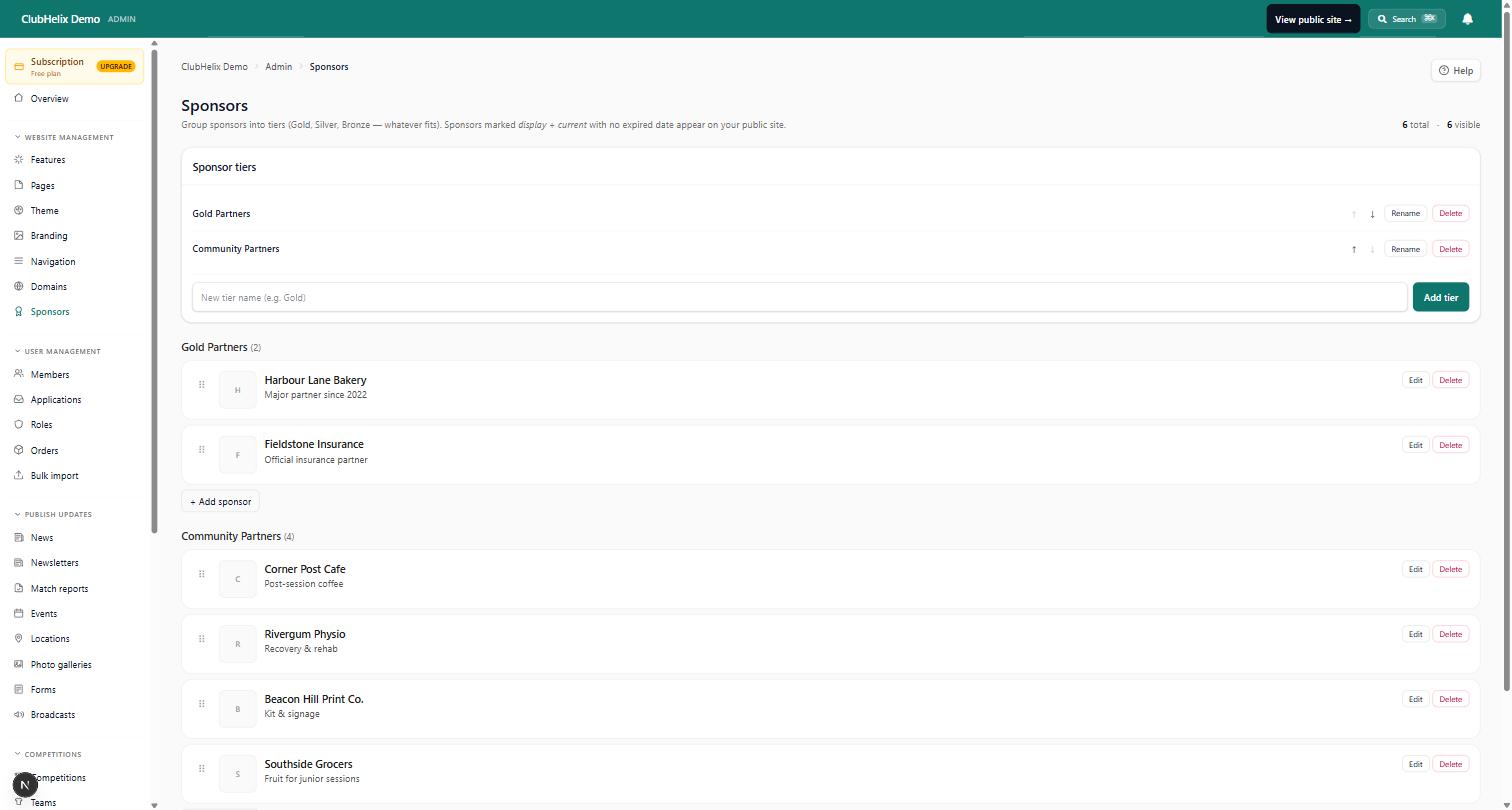
Do this and renewals become the default — and renewed sponsors are the cheapest sponsorship dollars a club ever raises. Publishing sponsor thank-yous is also good content for your club news feed, which keeps your website fresh at the same time.

Common mistakes
- One volunteer owns everything. Sponsorship should be a small subcommittee with the target list, packages and delivery checklist documented — so it survives handover.
- Selling the shirt twice. Keep a register of what's promised (exclusivity, placements) so packages never collide.
- Undervaluing digital. Clubs still price the fence sign high and the email newsletter low; for many businesses the reach is the other way around.
- Letting the season end silently. The renewal conversation happens at presentation night, not the following pre-season.
Frequently asked questions
How much should we charge sponsors?
Price from your assets and your market, not from hope: count your real reach (members, families, email opens, event attendance), check what local advertising with similar reach costs, and package accordingly.
Community club majors commonly land in the low thousands per season, mid tiers in the hundreds — but a large club in a business-dense area can charge multiples of that. Whatever you set, hold the price and negotiate the inclusions, not the number.
What's the best way to approach a business for sponsorship?
Through a person, with a specific offer. Start with businesses connected to your members, address the owner by name, lead with the connection, attach a short proposal with clear packages, and follow up by phone within a week. Cold letterbox drops and generic "Dear business owner" emails convert poorly; ten personalised approaches to well-chosen targets will outperform a hundred generic ones.
What should a sponsorship proposal include?
Two to three pages: a personalised cover, the club's story in one paragraph, the audience numbers (members, families, digital reach, event attendance), the packages in a clear table with prices and exclusivity notes, your delivery commitments, and a named contact with an easy next step. The goal is that a busy owner can understand the offer, the price and the value in under five minutes.
How do we keep sponsors year after year?
Deliver visibly and report on it. Put every promised benefit on a checklist with a named owner, photograph the signage and features as they happen, send a short mid-season impact note, thank sponsors publicly at season's end, and book the renewal conversation before the season closes. Sponsors leave clubs that go quiet; they stay with clubs that make them feel like partners — which is also why over-promising in the pitch is the most expensive mistake in this guide.
ClubHelix gives your club a sponsor page on your website, sponsor and billing management for packages and invoices, and news and events tools to deliver the features you promised. See pricing to get started.


